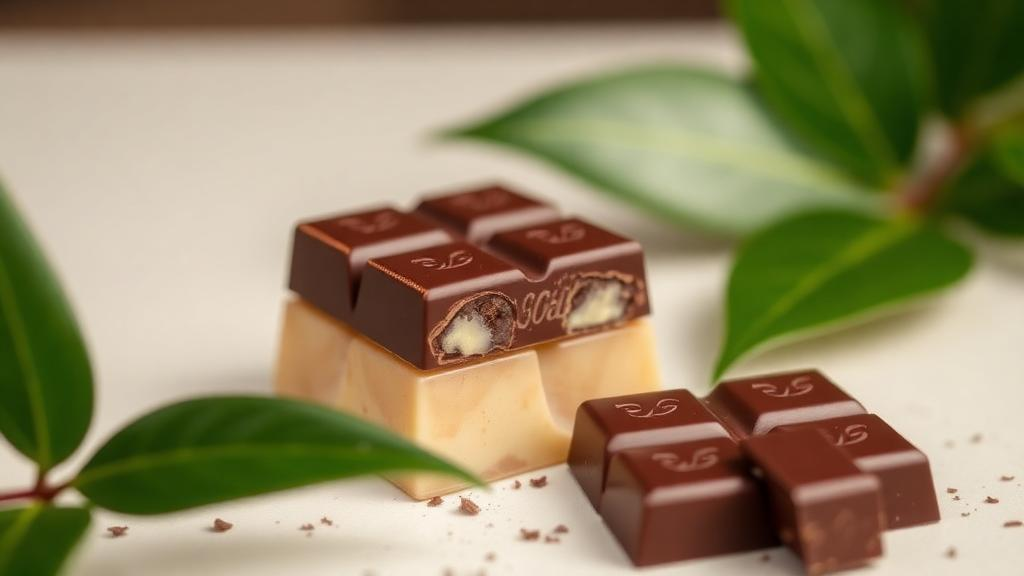
Chocolate may be on the verge of a quiet transformation, and the unexpected hero is a byproduct of the rubber tree. Researchers in China have shown that oil pressed from Hevea brasiliensis seeds can be coaxed into a solid, butter-like gel with a common food emulsifier, and that this gel can stand in for a substantial share of the expensive cocoa butter in chocolate without ruining the eating experience. The work, published in Food Chemistry: X, offers a technically detailed blueprint for turning an underused agricultural residue into a functional fat ingredient at a moment when the chocolate industry is desperate for both cheaper and healthier alternatives.
The appeal of rubber seed oil begins with its chemistry. Seeds from rubber trees contain 40 to 50 percent oil, and the cold-pressed oil is dominated by unsaturated fatty acids, making up about 81 percent of the total. Using gas chromatography coupled with quadrupole mass spectrometry, the team screened 37 fatty acid standards and quantified 16 of them in their oil. Linoleic acid led the profile at 40.39 percent, followed by oleic acid at 22.86 percent and alpha-linolenic acid at 21.72 percent. Saturated fatty acids accounted for only 14.65 percent of the total, and the ratio of omega-6 to omega-3 fatty acids came out at a nutritionally favorable 1.86. Long-chain C16 to C18 species made up 99.54 percent of the detected fatty acids, a composition the authors note broadly matches earlier reports on this oil.
The problem, of course, is that a liquid rich in polyunsaturates does not behave like cocoa butter, which owes its snap and melt to a dense saturated triacylglycerol structure. The researchers solved this with oleogelation, a technique that traps liquid oil inside a three-dimensional crystal network formed by a low-molecular-weight gelator. Their gelator of choice was glycerol monostearate, or monoglyceride, an inexpensive emulsifier already common in food processing. The method is elegantly simple: dissolve the monoglyceride in hot rubber seed oil at 72 degrees Celsius, then cool. Below 5 percent gelator, the mixtures flowed when inverted; at 5 percent and above, they set into opaque, self-supporting semi-solids.
Microscopy revealed how the network builds. Quantitative image analysis showed that network coverage rose monotonically from 10.2 percent at 1 percent monoglyceride to 44.5 percent at 12 percent, while the number of discrete crystals per square millimeter fell from 249 to 91 as individual aggregates merged into a fine, continuous mesh. Polarized light microscopy showed needle-like crystals distributed evenly through the oil at high gelator concentrations. Infrared spectroscopy found no new or vanished peaks, confirming that no covalent bonds formed or broke during gelation; instead, slight shifts in the methylene stretching bands and a strengthening hydroxyl envelope pointed to van der Waals contacts between alkyl chains and hydrogen bonding between monoglyceride hydroxyl groups, the glue of a physically assembled network.
X-ray diffraction added the polymorphic detail. The gels showed short spacings at 4.4 to 4.7 angstroms, characteristic of the triclinic beta form, and at 3.8 to 4.0 angstroms, signature of the orthorhombic beta-prime form. Increasing the gelator concentration intensified both reflections without shifting their positions, meaning more crystals formed but the crystal habits stayed the same. Because beta-prime crystals are smaller and pack into denser networks, this mixed population bodes well for oil retention. Differential scanning calorimetry tracked the consequences thermally: as monoglyceride rose from 1 to 12 percent, the main crystallization temperature climbed from 45.18 to 52.00 degrees Celsius and the main melting transition rose from 39.24 to 58.93 degrees Celsius, with melting enthalpy increasing more than fourfold.
The mechanical and functional metrics followed the same upward curve. Hardness increased dramatically from about 20 grams to nearly 1,128 grams across the gelator range, while oil binding capacity climbed from 24.92 percent to 99.87 percent under centrifugation. Rheology confirmed solid-like behavior, with the storage modulus exceeding the loss modulus across all frequencies, and temperature sweeps showed reversible thermogelation, melting between roughly 55 and 60 degrees Celsius and reforming on cooling. Perhaps most strikingly, the crystal network slowed oxidation. After 21 days of accelerated storage at 40 degrees Celsius, malondialdehyde levels in pure rubber seed oil rose 7.21-fold, but only 3.58-fold in the 12 percent gel, and the gels retained far more DPPH radical-scavenging capacity than the free oil, likely because immobilization restricts oxygen diffusion and radical propagation.
Then came the chocolate. Using the 7 percent monoglyceride gel, the team replaced cocoa butter at 0, 20, 40, 60, 80 and 100 percent in a model dark chocolate and put the bars through the full characterization gauntlet. Differential scanning calorimetry showed that the melting peak dropped from 21.93 degrees Celsius in the control to 17.84 degrees Celsius at full replacement, meaning the gel-based chocolate melts more readily in the mouth. On cooling, samples with more oleogel crystallized earlier, at up to 44.54 degrees Celsius, reflecting the monoglyceride crystals incorporated into the fat matrix. Rheological tests at 40 degrees Celsius showed that all samples were shear-thinning non-Newtonian fluids whose viscosity rose with oleogel content, as the additional crystals strengthened flow resistance during processing.
Sensory evaluation by thirty trained testers produced the study’s most commercially consequential finding. Chocolates with partial replacement actually beat the cocoa butter control in several respects: taste delicacy scores for the oleogel chocolates ranged from 9.52 to 11.67 against 8.67 for the control, reflecting an instant, smooth melt. Flavor balance peaked at 20 percent replacement with a score of 10.89, compared with 9.12 for pure cocoa butter chocolate, but fell to 5.32 at full replacement as the oil’s characteristic vegetable note overwhelmed the cocoa. Thermal tolerance testing set the hard limit: above 60 percent substitution the bars could not hold their shape at 30 degrees Celsius, and fully replaced chocolate collapsed at 25 degrees Celsius.
The practical verdict, therefore, is a sweet spot of 20 to 60 percent cocoa butter replacement, where nutrition, sensory quality and shelf stability all remain acceptable. The authors frame this as a way to sidestep both the high saturated fat and caloric load of cocoa butter and the trans fats associated with hydrogenated substitutes, aligning with World Health Organization goals of eliminating industrially produced trans fats. They also acknowledge the limitations honestly: oxidation was tracked only with TBARS and DPPH assays, clinical evidence for rubber seed oil’s cardiovascular benefits in humans remains lacking, and future work should explore composite gelator mixtures to push substitution higher. With an invention patent already filed on the gel’s preparation, and with cocoa butter prices straining the industry, a fat once discarded alongside rubber plantation waste may soon be crystallizing inside your favorite bar.
Subject of Research: Rubber seed oil oleogels structured with monoglycerides as partial cocoa butter replacements in chocolate
Article Title: Monoglyceride-structured rubber seed oil oleogels as a partial cocoa butter replacement in chocolate: physical properties, oxidative stability and applications
Article References: Huang, Z., Tang, Y., Yang, X., Liu, D., Liu, Y., Ren, Y., Wang, Y., Zhang, B., & Ma, J. (2026). Monoglyceride-structured rubber seed oil oleogels as a partial cocoa butter replacement in chocolate: physical properties, oxidative stability and applications. Food Chemistry: X, Article 104594. https://doi.org/10.1016/j.fochx.2026.104594
Image Credits: AI Generated
DOI: 10.1016/j.fochx.2026.104594
Keywords: rubber seed oil, oleogel, cocoa butter replacement, monoglyceride, chocolate, food chemistry, oxidative stability, fatty acid composition, oleogelation, rheology, trans-fat alternatives, sustainable food ingredients
News Source: Alan Morgan. (October 12, 2026). Rubber Seed Oil Oleogels Partially Replace Cocoa Butter in Healthier Chocolate. Scienmag.