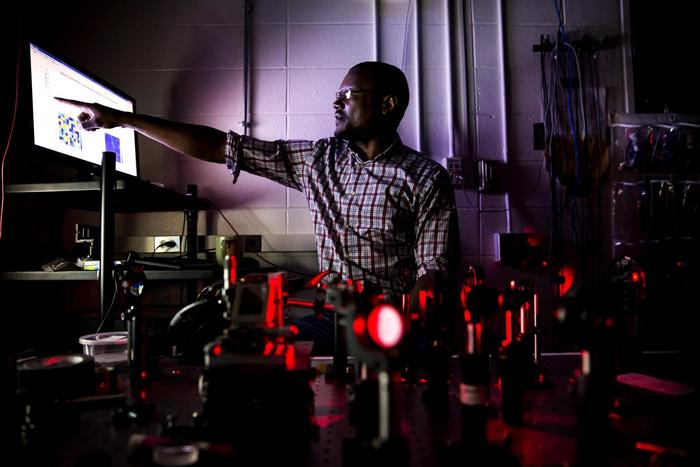
Our nation’s security depends on the effective detection of nuclear materials at our borders and beyond. To address this challenge, Rensselaer Polytechnic Institute (RPI) physicist Moussa N’Gom, Ph.D., is leading research aimed at developing a quantum sensing probe to detect and characterize special nuclear materials precisely and without contact. Special nuclear materials are only mildly radioactive but can be used in nuclear explosives.
Our nation’s security depends on the effective detection of nuclear materials at our borders and beyond. To address this challenge, Rensselaer Polytechnic Institute (RPI) physicist Moussa N’Gom, Ph.D., is leading research aimed at developing a quantum sensing probe to detect and characterize special nuclear materials precisely and without contact. Special nuclear materials are only mildly radioactive but can be used in nuclear explosives.
The research is being conducted through RPI’s participation in the Consortium for Enabling Technologies and Innovation, one of two consortia recently announced by the U.S. Department of Energy’s National Nuclear Security Administration (DOE/NNSA) Office of Defense Nuclear Nonproliferation as part of a $50 million initiative to strengthen its nuclear security and nonproliferation missions. RPI is one of 12 universities in this consortium led by Georgia Institute of Technology.
N’Gom is associate professor of physics and applied physics at RPI. He calls his work “Light with a Twist: An Adaptive Quantum Sensing Probe in Which a Bright Single Photon Source is Guided in Free Space To Remotely Interact, Detect, and Characterize Special Nuclear Materials.” He and his team are using light to develop an advanced quantum sensing probe to serve as a novel spectroscopy- and optics-based method for nuclear trial verification.
“In a single photon source, whenever a first photon has shown up, the exact same photon is guaranteed to follow, allowing for precise timing and control,” said N’Gom. “Any signal detected other than the source signal is a precise response or measurement from special nuclear materials with which the single photon interacts.”
The probe is expected to enable more precise control, measurement, detection, and characterization of special nuclear materials. Once the concept is developed, national laboratories will conduct tests to ensure the technology is ready for use in the private sector.
“Dr. N’Gom’s project is leveraging quantum sensing techniques, which allow for detection of the change in environment due to the presence of special nuclear materials and other phenomena in a very precise way,” said Curt Breneman, Ph.D., Dean of Rensselaer’s School of Science. “I am proud that his research will contribute to such an important cause. His work represents another way that RPI, the first university to have an IBM Quantum System One on its campus, is exploring the vast potential of the quantum realm to conduct impactful research.”
###
About Rensselaer Polytechnic Institute:
Founded in 1824 for the application of science to the common purposes of life, Rensselaer Polytechnic Institute is the first technological research university in the United States. Today, it is recognized as a premier university, noted for its robust and holistic learning community that connects creativity with science and technology. RPI is dedicated to inventing for the future, from shaping the scientists, engineers, technologists, architects, and entrepreneurs who will define what’s next for humanity, to research that bridges disciplines to solve the world’s toughest problems. Learn more at rpi.edu.
Contact:
Katie Malatino
[email protected]
838-240-5691
For general inquiries: [email protected]
Visit the Rensselaer research and discovery blog: https://everydaymatters.rpi.edu/
Follow us on Twitter: @RPINews