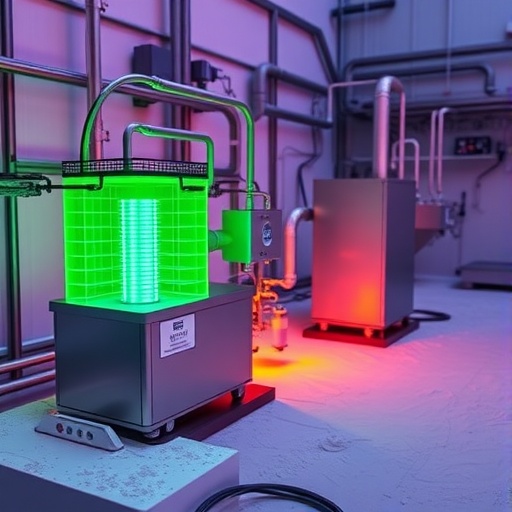

image: Direct electrochemical liquid ammonia splitting enables efficient onsite hydrogen generation at room temperature and low pressure (<1 MPa) using Ru nanoparticles on nitrogen-doped carbon. This breakthrough overcomes high-temperature barriers in traditional ammonia decomposition, offering a sustainable pathway for hydrogen production with superior activity and 100-hour stability, surpassing Pt/C catalysts.
view more
Credit: Chinese Journal of Catalysis
The pursuit of safe and efficient hydrogen storage and transportation is crucial for a sustainable hydrogen economy. Ammonia, with its high hydrogen density and ease of liquefaction, is a promising carrier, but its decomposition into hydrogen typically requires high temperatures (400–700 °C). Electrochemical liquid ammonia decomposition (ELADH) offers a promising route for room-temperature, on-site hydrogen release with a low theoretical voltage. However, its development has been hampered by sluggish kinetics, poor catalyst stability, and corrosive reaction environments.
Recently, a research team led by Prof. Jun-Min Yan from Jilin University and Prof. Hai-Xia Zhong from the Changchun Institute of Applied Chemistry, Chinese Academy of Sciences, demonstrated a highly efficient and stable ELADH system. Through density functional theory calculations, they identified Ru as a superior catalyst compared to Pt, Rh, and Ir, with the Ru (101) facet exhibiting a low energy barrier for N–H bond cleavage and optimal hydrogen adsorption. Guided by this, they synthesized nitrogen-doped carbon-supported Ru nanoparticle catalysts (Ru NPs-CN) via a two-step pyrolysis method.
The Ru NPs-CN catalyst, featuring predominantly exposed (101) facets and a porous structure, achieved outstanding performance in an optimized electrochemical system using a graphite plate anode and NH4PF6 electrolyte in liquid ammonia. It delivered a high current density of -910 mA cm-2 at –1.47 V and a low overpotential of –1.01 V at -10 mA cm-2, significantly outperforming Ru single-atom and commercial Pt/C catalysts. Crucially, the system maintained stable hydrogen evolution for over 100 hours in a two-electrode configuration, showcasing remarkable durability. This work provides a feasible strategy for mild-condition hydrogen production from ammonia and deepens the understanding of the electrochemical ammonia splitting process. The results were published in Chinese Journal of Catalysis (DOI: 10.1016/S1872-2067(25)64915-1).
About the journal
Chinese Journal of Catalysis is co-sponsored by Dalian Institute of Chemical Physics, Chinese Academy of Sciences and Chinese Chemical Society, and it is currently published by Elsevier group. This monthly journal publishes in English timely contributions of original and rigorously reviewed manuscripts covering all areas of catalysis. The journal publishes Reviews, Accounts, Communications, Articles, Highlights, Perspectives, and Viewpoints of highly scientific values that help understanding and defining of new concepts in both fundamental issues and practical applications of catalysis. Chinese Journal of Catalysis ranks among the top six journals in Applied Chemistry with a current SCI impact factor of 17.7.
At Elsevier
Manuscript submission
Journal
Chinese Journal of Catalysis
DOI
10.1016/S1872-2067(25)64915-1
Article Title
Direct electrochemical liquid ammonia splitting for onsite hydrogen generation under room temperature
Article Publication Date
3-Feb-2026
Media Contact
Yan Zhang
Dalian Institute of Chemical Physics, Chinese Academy Sciences
Journal
Chinese Journal of Catalysis
DOI
10.1016/S1872-2067(25)64915-1
Journal
Chinese Journal of Catalysis
DOI
10.1016/S1872-2067(25)64915-1
Article Title
Direct electrochemical liquid ammonia splitting for onsite hydrogen generation under room temperature
Article Publication Date
3-Feb-2026
Tags
/Applied sciences and engineering
bu içeriği en az 2000 kelime olacak şekilde ve alt başlıklar ve madde içermiyecek şekilde ünlü bir science magazine için İngilizce olarak yeniden yaz. Teknik açıklamalar içersin ve viral olacak şekilde İngilizce yaz. Haber dışında başka bir şey içermesin. Haber içerisinde en az 12 paragraf ve her bir paragrafta da en az 50 kelime olsun. Cevapta sadece haber olsun. Ayrıca haberi yazdıktan sonra içerikten yararlanarak aşağıdaki başlıkların bilgisi var ise haberin altında doldur. Eğer yoksa bilgisi ilgili kısmı yazma.:
Subject of Research:
Article Title:
News Publication Date:
Web References:
References:
Image Credits:
Keywords
Tags: ambient condition hydrogen generationammonia as hydrogen carrierammonia electrolysis for energyefficient hydrogen splitting techniqueselectrochemical ammonia splitting technologygreen hydrogen from ammonialiquid ammonia hydrogen productionlow pressure hydrogen productiononsite hydrogen generationrenewable hydrogen production methodsroom temperature electrochemical ammonia splittingsustainable hydrogen fuel production