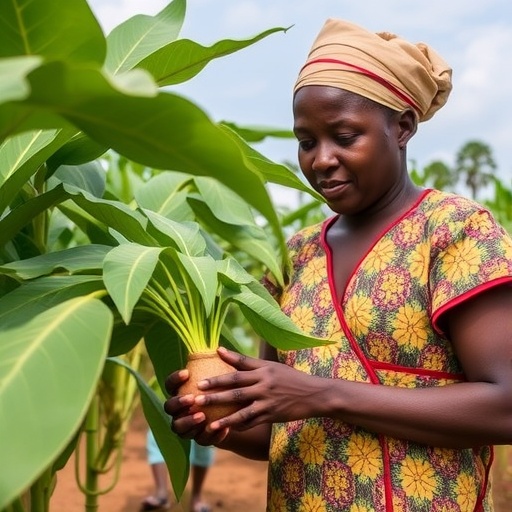
In a groundbreaking development poised to reshape the future of agriculture in Africa, researchers have unveiled an innovative framework titled the “One Plant Health” concept. This comprehensive strategy, meticulously detailed in a recent article published in CABI Agriculture and Bioscience, advocates for an integrative approach that fuses indigenous knowledge with cutting-edge technological advancements to combat plant diseases and secure sustainable food systems across the continent. The study addresses the escalating threats posed by climate change and emerging plant viruses, emphasizing the necessity of multidimensional strategies that transcend conventional boundaries.
At the heart of the One Plant Health strategy lies an acknowledgment of the immense value embedded within indigenous and local knowledge systems. For centuries, African communities have cultivated nuanced understandings of their ecosystems, identifying disease-resistant plant varieties through traditional agricultural practices such as selective seed saving, conventional breeding, and intercropping. These culturally-rooted methods have proven instrumental in fostering crop resilience under variable environmental stresses. The researchers argue that integrating these time-tested practices with modern scientific techniques could exponentially enhance plant health management.
Modern agriculture has witnessed rapid technological advancements, including molecular marker-assisted selection and the development of genetically enhanced crop varieties exhibiting greater resistance to viral pathogens and environmental stressors. The authors underscore that while these innovations hold tremendous promise, their efficacy can be significantly bolstered by incorporating local expertise. Remote sensing technologies, such as drone and satellite imagery, provide real-time, spatially explicit data on crop health and disease spread. When paired with indigenous observational insights, this data enables the design of precision interventions tailored to specific ecological contexts, thereby optimizing resource allocation and mitigating crop losses.
Dr. Gilbert Nchongboh Chofong, Senior Research Associate at the Julius Kühn-Institut and lead author, highlights the transformative potential of this synergistic approach. He states, “Combining indigenous knowledge with modern technologies creates a synergy that empowers stakeholders across all levels — from smallholder farmers to policymakers — to collaboratively improve disease management, enhance sustainable agricultural practices, and build resilient food systems that can withstand future adversities.” This participatory model fosters inclusive stakeholder engagement, ensuring that solutions are grounded in local realities while leveraging global innovations.
Beyond disease management, the One Plant Health framework presents a holistic strategy that also confronts broader environmental challenges imperiling agriculture in Africa. Issues such as deforestation, soil degradation, pollution, and water scarcity are intricately linked to plant health and food security. By advocating coordinated action among researchers, local communities, farmers, and legislators, the strategy promotes ecosystem-based approaches that safeguard biodiversity and environmental services essential for resilient agriculture.
Notably, the integration of plant health within the wider One Health concept marks a critical advancement in recognizing the interconnectedness of human, animal, and ecological health. Historically, plant health has been underrepresented in One Health initiatives, despite its foundational role in nutrition and disease prevention. The study elucidates how emerging plant pathogens not only threaten crop yields but also have cascading effects on human and animal well-being by impacting food availability and ecosystem integrity. Elevating plant health to equal standing enhances multidisciplinary efforts to address these complex health challenges.
Agroecological practices emerge as a pivotal component of the strategy, weaving ecological principles with traditional farming to foster sustainable, low-input systems. Techniques such as intercropping, agroforestry, and soil conservation bolster natural pest regulation and improve soil fertility, reducing dependency on chemical inputs. These systems, enriched by indigenous wisdom and amplified by technological monitoring, offer pathways to resilient agricultural landscapes capable of adapting to climate perturbations.
The deployment of remote sensing as part of this integrated approach enables early detection of plant stress and disease outbreaks at landscape scales. High-resolution imagery and spectral analysis facilitate monitoring of vegetation health indicators, allowing timely, site-specific interventions. This precision agriculture tool, combined with local ground-truthing knowledge, optimizes disease surveillance networks and resource use efficiency, which is crucial given resource constraints in many African regions.
Another cornerstone of the proposed framework is capacity building and knowledge co-creation among stakeholders. The authors emphasize participatory methods where scientists, extension agents, local leaders, and farmers collaborate in knowledge exchange and decision-making processes. This democratization of plant health management fosters community ownership and enhances uptake of innovative practices, ultimately driving sustainability and resilience.
The review also draws attention to the policy implications underpinning effective implementation of the One Plant Health concept. Integrated governance structures that facilitate cross-sectoral collaboration, adequate funding for research and extension services, and support for traditional knowledge systems are highlighted as essential. Strengthening institutional frameworks will be key to scaling up the approach and embedding it within national agricultural development agendas.
Moreover, the strategy’s potential extends beyond Africa, serving as a model for other regions facing similar challenges of plant disease emergence, ecosystem degradation, and food insecurity. Its emphasis on inclusivity, interdisciplinarity, and innovation offers a blueprint for global efforts aimed at safeguarding plant health within the broader sustainability discourse.
In sum, this pioneering work by Dr. Chofong, Dr. Julia Mulabisana, and Dr. Katja Richert-Poeggeler presents an urgent call to action. By weaving together the threads of indigenous knowledge, technological innovation, ecological stewardship, and policy coherence, the One Plant Health concept provides a robust pathway toward resilient, equitable, and sustainable food systems in Africa, standing as a beacon of hope in the face of unprecedented environmental and agricultural challenges.
Subject of Research:
Article Title: One Plant Health Concept: Addressing emerging plant viruses and food security in Africa
News Publication Date: 31-Mar-2026
Web References: 10.1079/ab.2026.0025
Keywords
One Plant Health, indigenous knowledge, plant disease management, food security, Africa, climate change, plant viruses, remote sensing, agroecology, sustainable agriculture, molecular breeding, One Health.
Tags: climate change impact on African cropscombating plant diseases in Africagenetically enhanced crop varietiesintegrating indigenous knowledge and technologyintercropping benefits for plant healthmolecular marker-assisted selection in agriculturemultidimensional plant disease management strategiesOne Plant Health concept in Africaselective seed saving traditional methodssustainable food systems African agriculturetraditional agricultural practices Africavirus-resistant crops Africa