


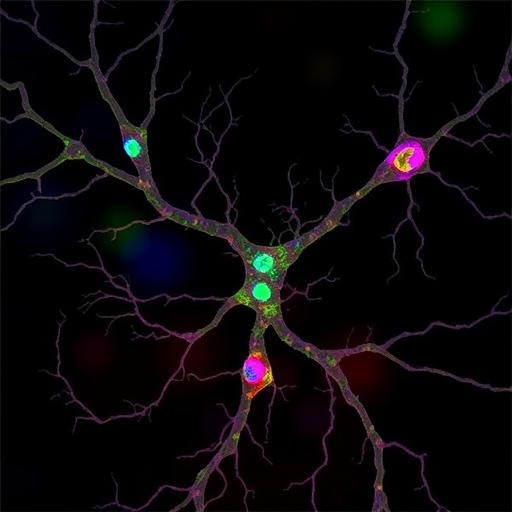
In a groundbreaking study published in npj Parkinson’s Disease, researchers have unveiled pivotal insights into the cellular mechanics underlying Parkinson’s disease, focusing on the autophagy dysfunction in neurons derived from induced pluripotent stem cells (iPSCs) and midbrain organoids carrying a triplication of the SNCA gene. This research marks a significant advance in our understanding of the molecular pathogenesis of Parkinson’s disease, particularly how genetic abnormalities in alpha-synuclein production disrupt cellular homeostasis in human neuronal models.
Parkinson’s disease is characterized by the accumulation of misfolded alpha-synuclein protein aggregates, which form Lewy bodies—a hallmark of neuronal degeneration. The SNCA gene encodes alpha-synuclein, and triplication of this gene results in the overproduction of the protein, exacerbating neurodegenerative processes. By using iPSCs-derived neurons and engineered midbrain organoids, the research team recreated a human-relevant model that faithfully reproduces the cellular environment of Parkinson’s-affected brain regions. This innovative approach bypasses the limitations of animal models and cell lines that lack disease-specific human neural architecture.
Central to their findings is the demonstration that autophagy, a vital intracellular degradation pathway responsible for recycling damaged organelles and misfolded proteins, is profoundly disrupted in SNCA triplication carriers. Autophagy ensures cellular survival by maintaining proteostasis, but its impairment leads to toxic accumulation of alpha-synuclein, creating a vicious cycle that propels neuronal death. The study meticulously dissects how this dysfunction manifests at molecular and organelle levels, providing unprecedented mechanistic clarity.
Through quantitative and qualitative assays, the research reveals significant deficits in autophagosome formation, impaired lysosomal function, and altered dynamics of autophagic flux in iPSC-derived dopaminergic neurons. These neurons mimic the vulnerable neuronal subtype predominantly lost in Parkinson’s disease, namely those located in the substantia nigra. The organoids, which recapitulate the three-dimensional architecture and cell diversity of the midbrain, displayed similar pathological autophagic abnormalities, underscoring the robustness of the model.
A key revelation of the study is the identification of specific molecular interactions disrupted by SNCA gene triplication. Overexpressed alpha-synuclein appears to interfere with key regulatory proteins involved in autophagy initiation and progression, including components of the ULK1 complex and the PI3K-III complex. These alterations culminate in defective nucleation of autophagic vesicles and compromised clearance of cytotoxic aggregates, amplifying cellular stress.
The researchers also employed advanced imaging techniques and live-cell tracking to monitor autophagic vesicles and lysosomal compartments in real-time within living neurons. These dynamic observations highlighted delayed vesicle trafficking and fusion inefficiencies between autophagosomes and lysosomes in SNCA triplication models. The result is an accumulation of autophagic intermediates, reflecting a bottleneck in the degradation pathway, which correlates with increased cytoplasmic inclusion burden and mitochondrial dysfunction.
Mitochondrial anomalies were another critical finding linked to autophagy failure. Parkinson’s neurons exhibited pronounced mitochondrial fragmentation, loss of membrane potential, and elevated reactive oxygen species production. Given that mitophagy – a selective form of autophagy targeting mitochondria – is essential for mitochondrial quality control, its impairment exacerbates oxidative damage and contributes to neuronal vulnerability. These insights consolidate the connection between proteostasis, organelle health, and neurodegeneration.
Importantly, the study explores potential therapeutic avenues aimed at restoring autophagic function. By pharmacologically activating autophagy pathways using mTOR inhibitors or AMPK activators, the researchers could partly ameliorate alpha-synuclein accumulation and enhance neuronal survival in vitro. These results not only validate autophagy as a critical target in Parkinson’s but also suggest that early intervention employing autophagy modulators could modify disease trajectory in patients harboring SNCA multiplications.
Beyond therapeutic implications, this work provides a powerful platform for drug screening and personalized medicine. The human iPSC-derived neuronal and organoid models enable the testing of candidate molecules in a patient-specific context, offering prospects for tailored treatments based on individual genetic backgrounds. Such precision modeling is particularly vital for familial Parkinson’s disease cases with known genetic drivers.
The significance of this study extends to understanding sporadic Parkinson’s disease, where alpha-synuclein accumulation also plays a central pathological role. Insights into autophagy disruption mechanisms can shed light on universal disease processes and potentially identify shared intervention points applicable across diverse patient populations. By integrating genetic, molecular, and cellular data, the authors contribute a comprehensive narrative of Parkinson’s pathophysiology.
Moreover, the research highlights the importance of the midbrain organoid system as a near-physiological model for neurodegenerative diseases. Unlike monolayer cultures, organoids better recapitulate neural connectivity, extracellular matrix components, and intercellular signaling, factors crucial for disease manifestation and progression. This methodological advance will likely pave the way for future studies on other neurodegenerative disorders influenced by proteostasis and autophagy.
Future investigations inspired by this study may focus on elucidating how autophagy dysfunction interplays with neuroinflammation, another key contributor to Parkinson’s pathology. The crosstalk between dying neurons and glial cells, mediated by dysfunctional degradation pathways, could represent additional therapeutic targets. Furthermore, the integration of multi-omics techniques might reveal novel biomarkers for early detection and monitoring of autophagic health in vivo.
In conclusion, the work spearheaded by Serra-Almeida, Jarazo, Gomez-Giro, and colleagues offers a detailed and mechanistic understanding of autophagy impairment driven by SNCA triplication in human neuronal tissues. This research not only elucidates fundamental pathological processes underlying familial Parkinson’s disease but also sets a framework for the development of autophagy-targeted therapies. With the promise of patient-specific modeling and pharmacological rescue, it represents a milestone toward more effective treatment paradigms for this debilitating condition that affects millions worldwide.
Subject of Research: Autophagy dysfunction in neurons and midbrain organoids carrying SNCA triplication linked to Parkinson’s disease.
Article Title: Autophagy dysfunction in iPSCs-derived neurons and midbrain organoids carrying a SNCA triplication.
Article References: Serra-Almeida, C., Jarazo, J., Gomez-Giro, G. et al. Autophagy dysfunction in iPSCs-derived neurons and midbrain organoids carrying a SNCA triplication. npj Parkinsons Dis. (2026). https://doi.org/10.1038/s41531-026-01330-x
Image Credits: AI Generated
Tags: alpha-synuclein overproductionautophagy dysfunction in neuronsautophagy impairment and neurodegenerationgenetic causes of Parkinson’s diseasehuman neuronal models for neurodegenerationinduced pluripotent stem cell-derived neuronsLewy body formation mechanismsmidbrain organoid Parkinson’s modelsmolecular pathogenesis of Parkinson’sneuronal proteostasis disruptionParkinson’s disease cellular modelsSNCA gene triplication


