• HOME
  • NEWS
  • EXPLORE
    • CAREER
      • Companies
      • Jobs
    • EVENTS
    • iGEM
      • News
      • Team
    • PHOTOS
    • VIDEO
    • WIKI
  • BLOG
  • COMMUNITY
    • FACEBOOK
    • INSTAGRAM
    • TWITTER
Monday, August 10, 2026
BIOENGINEER.ORG
No Result
View All Result
  • Login
  • HOME
  • NEWS
  • EXPLORE
    • CAREER
      • Companies
      • Jobs
        • Lecturer
        • PhD Studentship
        • Postdoc
        • Research Assistant
    • EVENTS
    • iGEM
      • News
      • Team
    • PHOTOS
    • VIDEO
    • WIKI
  • BLOG
  • COMMUNITY
    • FACEBOOK
    • INSTAGRAM
    • TWITTER
  • HOME
  • NEWS
  • EXPLORE
    • CAREER
      • Companies
      • Jobs
        • Lecturer
        • PhD Studentship
        • Postdoc
        • Research Assistant
    • EVENTS
    • iGEM
      • News
      • Team
    • PHOTOS
    • VIDEO
    • WIKI
  • BLOG
  • COMMUNITY
    • FACEBOOK
    • INSTAGRAM
    • TWITTER
No Result
View All Result
Bioengineer.org
No Result
View All Result
Home NEWS Science News Biology

Room for improvement in drug dosage timing in hospitals

Bioengineer by Bioengineer
October 1, 2019
in Biology
Reading Time: 2 mins read
0
IMAGE
Share on FacebookShare on TwitterShare on LinkedinShare on RedditShare on Telegram

IMAGE

Credit: Cincinnati Children’s

Too many hospitals provide medications according to the practicalities of their staffing schedules rather than the ideal dosing times for their patients, according to a new study led by experts at Cincinnati Children’s.

The study, published Oct. 1, 2019, in PNAS, was led by David Smith, MD, PhD, Divisions of Pediatric Otolaryngology and Pulmonary Medicine; Marc Ruben, PhD; and John Hogenesch, PhD, Co-Director, Center for Circadian Medicine at Cincinnati Children’s.

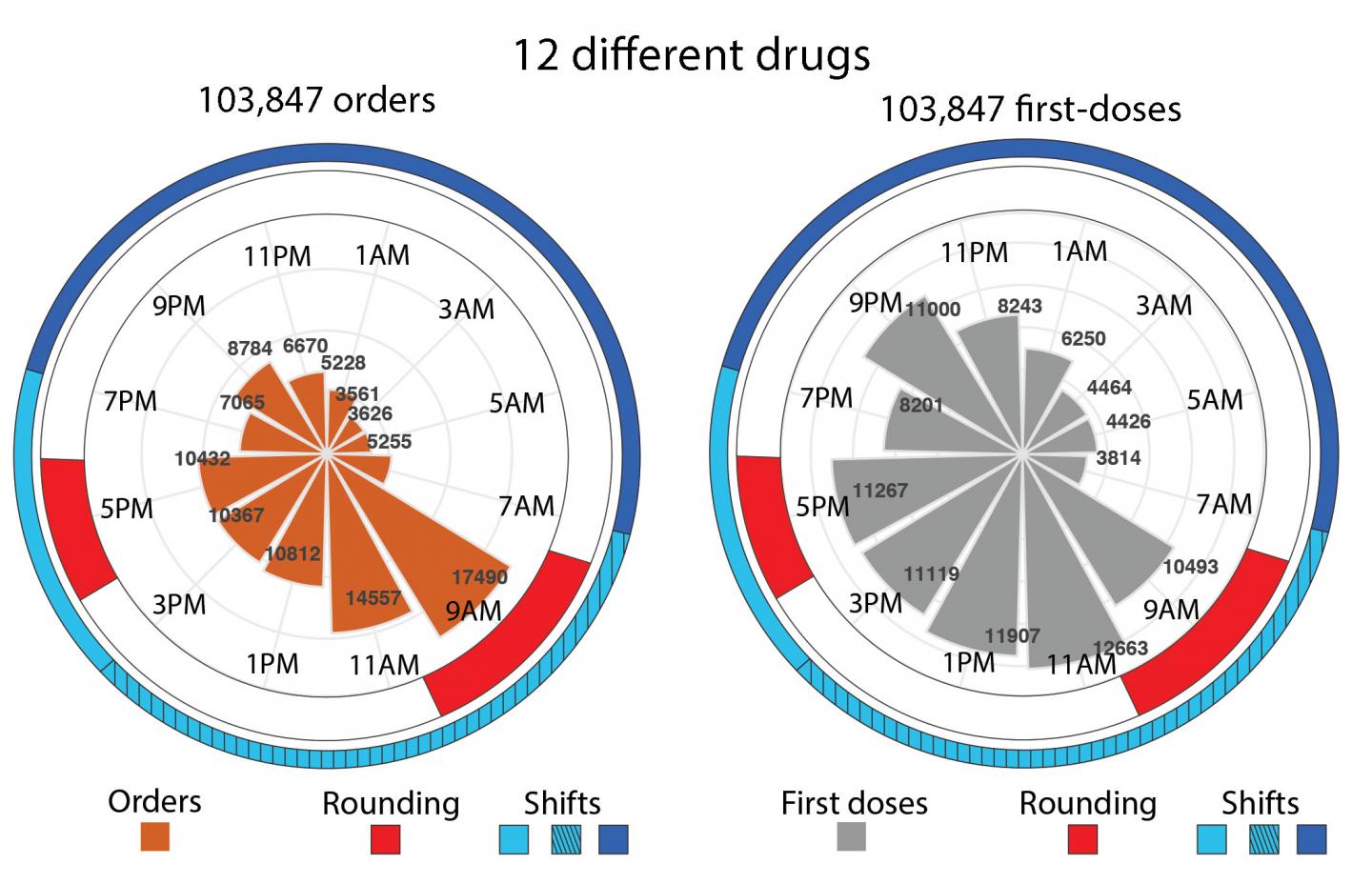
The study examined the daily distribution of approximately 500,000 doses of 12 drugs in 1,486 inpatients at a major U.S. children’s hospital.

“For every drug, order times were time-of-day?dependent, with morning-time surges and overnight lulls. These rhythms corresponded to shift changes and rounding times,” the co-authors state.

However, these time peaks do not always match when patients need medications the most, be it to relieve pain, control blood pressure, or battle infections.

For example, the study found a day shift-driven rhythmic order for morphine, acetaminophen and other pain medications, which raises questions about whether night-time pain goes undertreated. Meanwhile, some corticosteroids are administered in the evening, which can lead to insomnia and overnight hunger.

Smith and Hogenesch say their team is working with other doctors and nurses at Cincinnati Children’s to adjust drug administration protocols where warranted. They also are reminding caregivers to conduct night-time check-ins with patients at highest risk of experiencing pain.

“There is great potential here to align what we know about drug timing from the last 60 years of research and implement this knowledge in hospitals,” Smith says. “There are immediately actionable steps.”

The pilot work happening at Cincinnati Children’s represents some of the early steps in a growing recognition of how circadian rhythms (our set of internal body clocks) can influence the outcomes of medical care.

“The most exciting aspect of these findings is the opportunity to conduct larger-scale studies of dosing times and how drugs work,” Hogenesch says.

###

Read more about advances in circadian science:

Is Now the Time for Circadian Medicine?

Dosing Time Matters

This work is supported by Cincinnati Children’s Hospital Medical Center, the National Institute of Neurological Disorders and Stroke (2R01NS054794 and 1R21NS101983), the National Heart, Lung, and Blood Institute (R01HL138551) and the National Human Genome Research Institute (2R01HG005220).

Media Contact
Timothy J Bonfield
[email protected]

Related Journal Article

http://dx.doi.org/10.1073/pnas.1909557116

Tags: Circadian RhythmGenesHealth Care Systems/ServicesMedicine/HealthPediatrics
Share12Tweet8Share2ShareShareShare2

Related Posts

Alternative splicing could reveal proteins’ hidden functions

Alternative splicing could reveal proteins’ hidden functions

August 10, 2026
Endometriosis Linked to 46% Higher Type 2 Diabetes Risk in Women

Endometriosis Linked to 46% Higher Type 2 Diabetes Risk in Women

August 10, 2026

When Fever Fails, Infected Tadpoles Cool Down to Combat Viruses

August 10, 2026

Silent DNA switches near TBX1 linked to rare heart defect, study finds

August 10, 2026
Please login to join discussion

POPULAR NEWS

  • Computing Professor Wins $584K NSF CAREER Award for Smart-City Research

    29 shares
    Share 12 Tweet 7
  • AI Reveals NDRG1-Linked DNA Repair and Synthetic Lethality in Colorectal Cancer

    29 shares
    Share 12 Tweet 7
  • Boston College Chemist Alexis Grimaud Wins NSF CAREER Award

    29 shares
    Share 12 Tweet 7
  • Researchers uncover new insights into immune cell activity in sarcoidosis

    29 shares
    Share 12 Tweet 7

About

We bring you the latest biotechnology news from best research centers and universities around the world. Check our website.

Follow us

Recent News

Computing Professor Wins $584K NSF CAREER Award for Smart-City Research

AI Reveals NDRG1-Linked DNA Repair and Synthetic Lethality in Colorectal Cancer

Boston College Chemist Alexis Grimaud Wins NSF CAREER Award

Subscribe to Blog via Email

Enter your email address to subscribe to this blog and receive notifications of new posts by email.

Join 86 other subscribers
  • Contact Us

Bioengineer.org © Copyright 2023 All Rights Reserved.

Welcome Back!

Login to your account below

Forgotten Password?

Retrieve your password

Please enter your username or email address to reset your password.

Log In
No Result
View All Result
  • Homepages
    • Home Page 1
    • Home Page 2
  • News
  • National
  • Business
  • Health
  • Lifestyle
  • Science

Bioengineer.org © Copyright 2023 All Rights Reserved.