A wearable robotic exoskeleton may sharpen a stroke patient’s stride within the span of a single rehabilitation session. In a prospective pilot study conducted at Tokushima University Hospital in Japan, researchers report that gait training with the Hybrid Assistive Limb, or HAL, was followed by significant immediate increases in step length and walking velocity among patients in the acute phase of stroke, while conventional gait training produced no significant immediate changes. The work, published in Frontiers in Neurorobotics, offers some of the first objective session-level evidence that robot-assisted gait training can alter walking performance on the spot in patients just days after a stroke. Yet the authors are careful about the strength of their claim: after statistical adjustment for patient-specific differences, the corresponding pre-training values, and the number of days since training began, the differences between HAL and conventional training did not reach statistical significance. The study is small, involving only four patients, and the team frames the results as preliminary signals that justify larger, randomized investigations rather than proof of superiority.
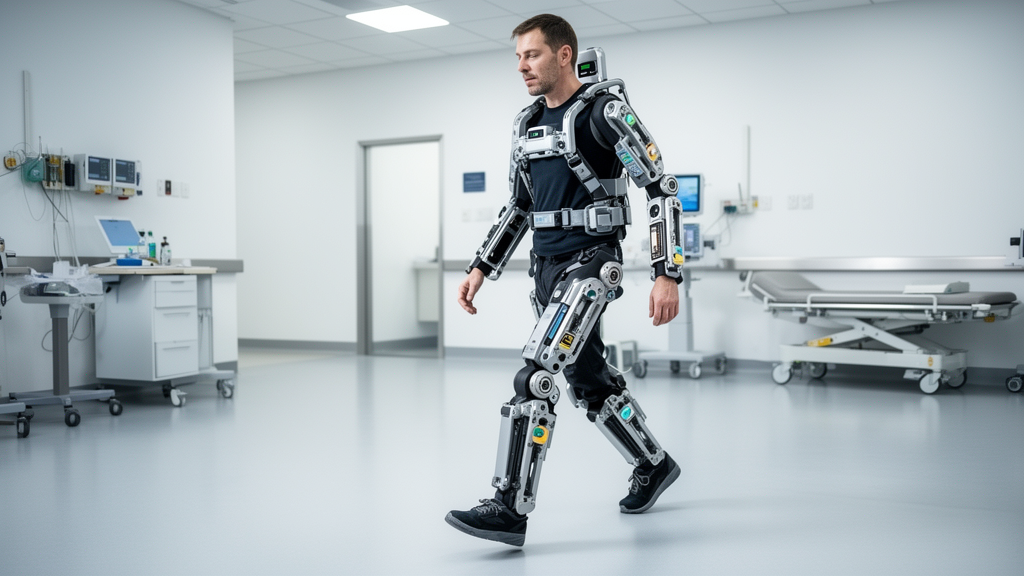
The HAL, developed by Cyberdyne Inc. in Ibaraki, Japan, is a wearable exoskeleton designed to support and reinforce a wearer’s own movements. It comes in lower-limb, single-joint, and lumbar versions, and it operates on a principle the developers call interactive biofeedback. The device detects weak bioelectrical signals emitted through the skin when the wearer intends to move, and it assists the resulting motion accordingly. That assistance generates movement information that is fed back to the brain as sensory signals, which in theory enhances output from the central nervous system. This loop may activate neuroplastic processes that support recovery from hemiparesis, the one-sided weakness that often follows stroke. The technology has been progressively adopted in rehabilitation for neurological disorders, spinal cord injuries, and stroke, and current clinical guidelines already recommend combining robot-assisted movement therapy with conventional rehabilitation to enhance motor performance and functional mobility in stroke recovery.
Most of the existing clinical evidence for HAL in stroke comes from patients in the subacute and chronic phases of rehabilitation, where several studies have suggested the device can facilitate motor recovery. The acute phase, the earliest window after onset, has remained far less clear. Some studies found no significant differences in functional outcomes between HAL-assisted and conventional gait training in acute patients, although one reported better outcomes in the HAL group among patients with right intracranial hemorrhage, and another found that apathy scores decreased with HAL training, hinting that the robot could promote early mobilization. Earlier initiation of HAL training has also been associated with better long-term outcomes in prior work. What had not been documented, according to the Tokushima team, was an immediate effect: the clinicians at their institution often observed improvements in walking ability right after HAL sessions, a phenomenon previously suggested only in case reports involving cerebral palsy, never in stroke patients.
To probe that question, the researchers enrolled four patients treated at Tokushima University Hospital between January and August 2021 for hemiparesis caused by cerebral hemorrhage or infarction. The inclusion criteria were strict: patients had to be under 80 years old, within seven days of stroke onset, unable to walk independently at the start of rehabilitation despite having walked normally before the stroke, and capable of producing bioelectrical signals detectable by the HAL. Patients with consciousness disorders, sensory aphasia, cognitive dysfunction, lower-limb spasticity, active orthopedic, respiratory, or cardiovascular disease, or skin conditions preventing electrode attachment were excluded. Conventional gait training began the day after stroke onset, and the HAL program started one week later. Physiotherapy consisted of 20-minute gait training units delivered twice daily, five days per week, for three weeks. Within that schedule, HAL sessions occupied three units per week, for a total of nine, with conventional training filling the remaining units. A physiotherapist and a neurosurgeon assisted during HAL sessions, using the device’s Cybernic Voluntary Control mode on both sides, and safety was monitored throughout for falls, electrode-related skin injuries, abnormal vital signs, and interruptions.
The outcome measure was the 10-meter walking test at maximum speed, performed immediately before and after each training session whenever patients could walk with a cane or assistance. The post-training test was completed within five minutes of the session’s end, with two-meter acceleration and deceleration zones bracketing the measured ten meters. Each test was run twice, and the faster trial was analyzed. To minimize fatigue and cumulative exertion, measurements were limited to morning sessions. From the recorded time and step count, the team calculated step length as total distance divided by steps, and cadence as steps per minute. Orthotic support and assistance levels were reduced as motor function improved, while consistency between pre- and post-training measurements within each unit was maintained. Crucially, an assessor blinded to the training condition took the measurements. Across the study, 60 units were tested, and nine were excluded because patients could not walk with a cane or assistance, leaving 51 units for analysis: 31 HAL sessions and 20 conventional sessions.
The headline statistical comparison came back equivocal. In linear models adjusted for patient identity, the pre-training value, and days from the first gait-training session, the adjusted difference between HAL and conventional training was 0.033 meters per second for walking velocity, with a 95 percent confidence interval spanning from minus 0.004 to 0.071 and a p-value of 0.0775. For step length, the adjusted difference was 1.60 centimeters, with a confidence interval of minus 0.05 to 3.25 and a p-value of 0.0564, and for cadence it was 2.02 steps per minute, with a confidence interval of minus 2.10 to 6.14 and a p-value of 0.3278. All three intervals included zero. However, the within-condition analyses told a sharper story. Immediately after HAL training, step length increased significantly, with a p-value below 0.0001, and walking velocity rose significantly as well, at p equals 0.0169, while cadence stayed unchanged. After conventional training, none of the three parameters changed significantly, with p-values of 0.1670 for step length, 0.4820 for velocity, and 0.4980 for cadence.
The researchers also looked for patterns in who responded. In the HAL group, a significant negative correlation emerged between pre-training cadence and its rate of change after training, with a Spearman coefficient of minus 0.4176 and a p-value of 0.0194, meaning that patients who started a session with a lower stepping frequency tended to show larger immediate changes afterward. No significant correlations appeared for step length or velocity in the HAL group, and no parameter correlated with its rate of change in the conventional group. The team then split sessions by pre-training walking velocity, using a threshold of 0.4 meters per second, the level below which previous work classified walking as limited to the household. In this exploratory subgroup analysis, the slower group showed significantly greater rates of improvement after HAL than after conventional training across all three parameters: step length at p equals 0.0103, velocity at p equals 0.0057, and cadence at p equals 0.0261. In the faster group, no parameter differed significantly between the two training methods.
The subgroup pattern carries an intriguing clinical implication. At the start of the training series, all four patients fell into the slower category, but as recovery progressed, three of the four transitioned into the faster group, raising the possibility that HAL training may be particularly beneficial early after stroke, when walking ability is most limited. Because applying the exoskeleton demands time and manpower, identifying which patients stand to gain the most could matter greatly for clinical practice, though the authors stress that the 0.4 meters per second cutoff should not be read as a definitive selection threshold, since the subgroup analysis did not account for repeated measurements within a small number of patients. On mechanisms, the team notes that the changes observed within a single session may reflect transient sensorimotor facilitation, motor learning, or both, rather than gains in muscle strength alone. Somatosensory input is thought to contribute to motor learning, and prior work has reported changes in interhemispheric communication after early HAL training, but this study did not directly measure neural activity, leaving the underlying process unresolved.
The authors also point to practical reasons why early HAL training might make sense. Robot-assisted gait training has been shown to increase walking distance during sessions, which could enable earlier mobilization, and spasticity is notably lower in the acute phase than in the chronic phase, when it often becomes a major barrier to rehabilitation and makes robotic gait training harder to perform. Early active training might even help prevent spasticity from progressing by reinforcing proper gait patterns. Still, the limitations are substantial: only four patients were studied, multiple measurements came from each patient, the subgroup analyses were exploratory, and the study was neither randomized nor blinded, with no chronic-phase comparison and no long-term follow-up. Whether repeated immediate effects accumulate into better long-term outcomes remains unknown. The team concludes that the preliminary findings support further investigation of early HAL gait training in acute stroke patients, particularly those with limited walking ability, and call for larger randomized prospective studies to confirm the immediate effects and identify the patients most likely to benefit.
Subject of Research: Immediate effects of Hybrid Assistive Limb exoskeleton gait training in acute-phase stroke patients
Article Title: Immediate effect of gait training using the hybrid assistive limb in patients in the acute phase of stroke: a prospective pilot study
Article References: Matsuda, T., Kondo, S., Kagusa, H., Korai, M., Miyamoto, T., Morigaki, R., Shimada, K., Sato, N., Umemura, K., Matsuura, T., Izumi, Y., Katoh, S., & Takagi, Y. (2026). Immediate effect of gait training using the hybrid assistive limb in patients in the acute phase of stroke: a prospective pilot study. Frontiers in Neurorobotics, 20, Article 1985500. https://doi.org/10.3389/fnbot.2026.1985500
Image Credits: AI Generated
DOI: 10.3389/fnbot.2026.1985500
Keywords: stroke rehabilitation, Hybrid Assistive Limb, exoskeleton, gait training, robot-assisted therapy, acute-phase stroke, 10-meter walking test, neuroplasticity, bioelectrical signals, pilot study, physiotherapy, hemiparesis
News Source: Denise Maddox. (October 23, 2026). Robotic Exoskeleton Yields Immediate Gait Gains After Acute Stroke. Scienmag.