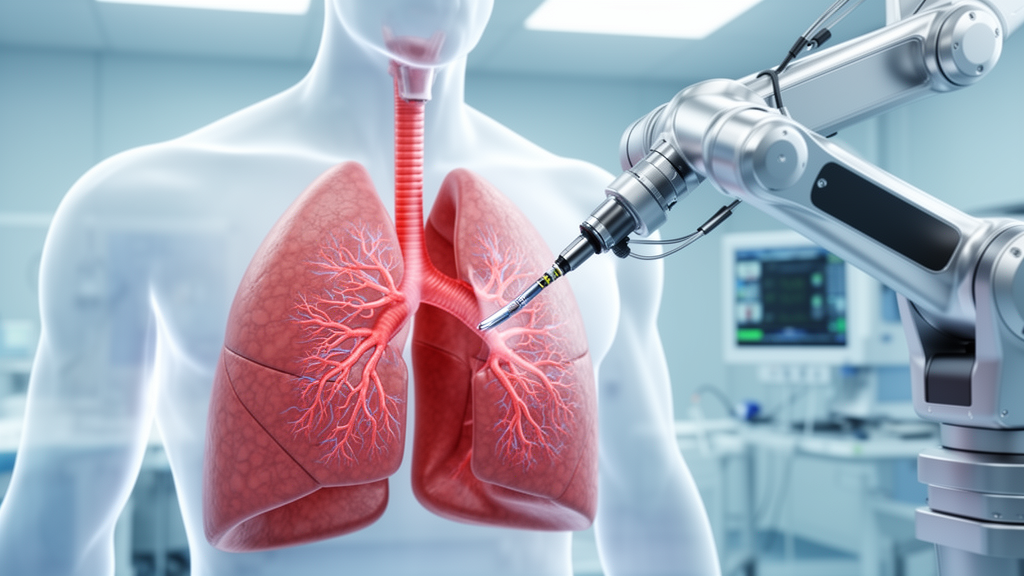
Robotic bronchoscopy is increasingly being used to sample peripheral pulmonary lesions, a shift driven in part by lung cancer screening programmes that are detecting more small, distal, subsolid and ground-glass nodules than ever before. A new state-of-the-art review argues that the way this technology has been judged so far — mainly through diagnostic yield and safety — captures only part of its clinical value, and proposes a broader, decision-centred way of measuring what bronchoscopy actually delivers to patients with suspected early lung cancer.
The review, published in Frontiers in Genetics, examines robotic bronchoscopy not as an isolated navigation device but as a potential diagnosis-to-treatment platform. Its central question is whether a bronchoscopic procedure can provide information sufficient for diagnosis, staging, molecular profiling and treatment-ready decision-making in a single coordinated episode of care.
To build that argument, the authors summarise evidence on the technical determinants of successful sampling: distal airway access, procedural stability, CT-to-body divergence, tool-in-lesion confirmation, cone-beam CT, mobile cone-beam CT and radial endobronchial ultrasound.
The review also frames tissue stewardship as a first-order concern rather than an afterthought. Rapid on-site evaluation, cell block preparation, next-generation sequencing and PD-L1 testing are discussed as determinants of molecular adequacy and clinical actionability. So too is the option of same-session endobronchial ultrasound-guided transbronchial needle aspiration (EBUS-TBNA) and, when appropriate, endoscopic ultrasound with bronchoscope-guided fine-needle aspiration (EUS-B-FNA), which can allow nodal staging to be addressed during the same anaesthetic as the diagnostic sampling.
The paper’s key proposal is a new reporting construct the authors call clinically actionable yield. Described as pragmatic, complementary and currently unvalidated, it links a chain of discrete outcomes: lesion access, confirmed targeting, pathological diagnosis, molecular adequacy, staging completeness and management decisions. The construct is intended to sit alongside conventional diagnostic yield rather than replace it, reflecting the observation that a technically successful biopsy that cannot support molecular testing or staging may still fall short of what early lung cancer care requires.
For prospective evaluation, the authors specify a concrete benchmark: Level 5, defined as a treatment decision informed or changed, should be assessed within 30 days after the index bronchoscopic procedure or before definitive therapy, whichever occurs first.
The review also looks forward to bronchoscopic ablation as a possible therapeutic extension of the platform. However, the authors are explicit that the current evidence remains early and does not establish equivalence with surgery, stereotactic body radiotherapy or percutaneous ablation.
Looking ahead, the authors call for future studies to evaluate decision-centred and patient-centred endpoints, including molecular-testing success, repeat biopsy avoidance, time to treatment, local control, pulmonary function, quality of life and cost-effectiveness.
As a review article, the paper synthesises and interprets existing evidence rather than reporting new clinical trial results, and its proposed construct has not yet been validated in prospective studies. Its significance lies in setting an agenda: if robotic bronchoscopy is to justify its place in early lung cancer care, the authors argue, the field should measure it by the decisions it enables, not only by the tissue it retrieves.
Subject of Research: Robotic bronchoscopy as a diagnosis-to-treatment platform in early lung cancer, with a proposed clinically actionable yield reporting framework
Article Title: Robotic bronchoscopy in early lung cancer: a biomarker-driven platform for genomic profiling and immunotherapy-oriented decision-making
Article References: Zhang, D., Han, Y., Zhang, H., Yu, C., Zhang, S., & Li, T. (2026). Robotic bronchoscopy in early lung cancer: a biomarker-driven platform for genomic profiling and immunotherapy-oriented decision-making. Frontiers in Genetics, 17, 1980607. https://doi.org/10.3389/fgene.2026.1980607
Image Credits: AI Generated
DOI: 10.3389/fgene.2026.1980607
Keywords: robotic bronchoscopy, early lung cancer, peripheral pulmonary lesions, genomic profiling, PD-L1 testing, EBUS-TBNA, cone-beam CT, clinically actionable yield, molecular adequacy, lung cancer screening, bronchoscopic ablation, diagnostic yield
News Source: Ophelia Keating. (October 27, 2026). Robotic Bronchoscopy Moves Toward Becoming a Diagnosis-to-Treatment Platform in Early Lung Cancer. Scienmag.