Architectural researchers have demonstrated a robotic additive manufacturing process that deposits continuous beech veneer along calculated principal stress lines to structurally reinforce lightweight timber slabs. Conventional timber construction relies heavily on solid mass-timber systems, such as cross-laminated timber, which simplify structural assembly but require substantial volumes of raw material. While additive manufacturing offers targeted material deposition capable of reducing consumption, integrating natural solid wood into digital printing workflows has historically faced severe technical constraints. Natural wood possesses significant direction-dependent mechanical anisotropy, natural material variability, and inherent physical resistance to being processed into continuous extrudable mixes. Consequently, previous additive approaches typically relied on grinding timber into fine particles mixed with polymer or mineral binders, which sacrifices the mechanical tensile benefits of natural uncut grain lines.
To overcome the performance limits of ground-wood composites, the research team developed a solid wood additive manufacturing methodology based on the automated lamination of continuous beech veneer filaments using reactive polyurethane hot-melt adhesives. Natural wood functions structurally as a biocomposite where stiff, load-bearing cellulose fibers are embedded within a compliant lignin matrix, providing exceptionally high tensile capacity parallel to the grain.
The structural geometry of the printed elements was defined through an automated digital workflow combining finite element modeling with principal stress trajectory optimization. In the computational model, the first two support points restrained translation across all three spatial axes while allowing free rotation, whereas the opposing supports constrained only vertical displacement along the z-axis. Finite element analysis calculated the primary and secondary principal stress trajectories across the planar domain. A spatial clustering algorithm then grouped proximate trajectories, filtering dense regions into normalized representative toolpaths aligned with the minimal continuous segment constraints of the mechanical deposition hardware.
Prior to conducting large-scale robotic manufacturing, the design methodology was calibrated using small-scale fused filament fabrication specimens measuring 120 millimeters by 60 millimeters by 6 millimeters. These prototype specimens were manufactured from black polyethylene terephthalate glycol using a Prusa MK3s printer equipped with an 0.8-millimeter nozzle, operating at an extrusion temperature of 250 degrees Celsius, a bed temperature of 80 degrees Celsius, a 30 millimeter per second print speed, and an 80 percent flow rate. Across specimen variants SP1.1 through SP12, distinct configurations of primary and secondary principal stress lines were deposited over three-layer solid baseplates. Destructive three-point bending tests performed at five millimeters per minute on a ZwickRoell universal testing machine showed that designs featuring fewer but thicker primary stress lines, widened to seven times the nozzle diameter, delivered superior mechanical stiffness and load-bearing capacity compared to high-resolution networks of thin lines, which suffered from localized stress concentrations at line intersections.
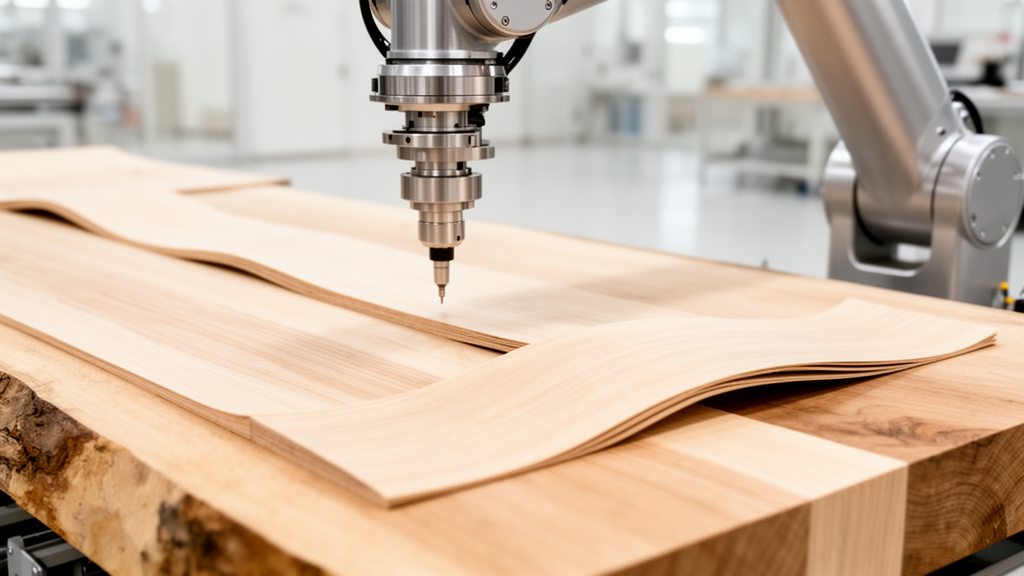
The physical deposition of continuous wood strips was executed using a specialized end-effector mounted to an ABB IRB4600 six-axis industrial robotic arm. The custom end-effector integrated an automated feed mechanism driven by a NEMA23 stepper motor that propelled the veneer strip through spring-tensioned urethane rollers. A Reka TR70 adhesive application gun delivered liquid reactive polyurethane hot-melt adhesive through an aluminum pipe into an electrically heated block maintained at elevated temperatures. A single adhesive bead with a nominal diameter of 5.8 millimeters was deposited continuously along the centerline on the underside of the veneer strip. Downstream from the extrusion nozzle, two firm silicone rollers spaced 80 millimeters apart compressed the strip against the underlying substrate, while a pneumatically actuated planar knife executed a rapid cutting pause of 0.2 seconds at the termination of each programmed path segment.
Material characterization trials revealed that the thermal and mechanical parameters of the adhesive application process govern interlayer bonding integrity. Under evaluation at a constant deposition velocity of 25 millimeters per second, the two silicone compaction rollers exerted continuous pressure over an interface duration of 3.2 seconds. While higher application temperatures lowered adhesive viscosity and improved chemical wetting, excessive fluidity at 120 degrees Celsius caused uncontrolled lateral slipping of the veneer strips during compression. Destructive three-point bending tests revealed that flexural capacity peaked when the adhesive was applied at 90 degrees Celsius, whereas interlaminar shear and delamination resistance peaked between 110 and 120 degrees Celsius. Balancing production speed, deposition precision, and bond strength led the team to select an operating temperature of 100 degrees Celsius, achieving an effective lateral adhesive coverage between 75 and 80 percent of the total strip width.
Robotic deposition substantially improved joint compaction and dimensional consistency relative to manual wood lamination. In manual fabrication trials, applying adhesive beads to 48-millimeter-wide veneer strips followed by hand rolling produced an average adhesive layer thickness of 0.576 millimeters across 17 stacked layers. In contrast, robotic placement of stacked 500-millimeter veneer lines with calibrated z-axis indexing reduced the mean adhesive joint gap to approximately 0.133 millimeters, demonstrating a 433 percent relative improvement in joint tightness. Kinematic calibration of the robot across four intersecting test lines established a spatial placement tolerance of plus or minus 2 millimeters. Experimental overhang trials showed that while isolated angles up to 75 degrees could be deposited, lateral material displacement occurred beyond 35 degrees under roller compression before chemical crosslinking, indicating that steep overhang geometries require temporary external support frameworks.
Material coupon evaluations confirmed high directional stiffness along the continuous wood fibers. Manually pressed beech veneer exhibited a primary Young’s modulus of 1153.55 kilonewtons per square centimeter and a primary tensile strength of 10.591 kilonewtons per square centimeter, compared to secondary transverse values of 144.96 kilonewtons per square centimeter and 0.891 kilonewtons per square centimeter, respectively. The in-plane shear modulus was 50.61 kilonewtons per square centimeter, while interlaminar shear strength was 0.622 kilonewtons per square centimeter. In parallel tests, the 6-millimeter poplar plywood printing substrate exhibited an longitudinal elastic modulus of 728.04 kilonewtons per square centimeter and a transverse modulus of 311.17 kilonewtons per square centimeter, with corresponding directional tensile strengths of 3.69 kilonewtons per square centimeter and 1.97 kilonewtons per square centimeter, and a shear modulus of 147.37 kilonewtons per square centimeter.
Structural verification of the additive manufacturing process culminated in the fabrication and load testing of six full-scale shell elements measuring 1600 millimeters by 800 millimeters with a total reinforced depth of 30 millimeters. Poplar plywood baseplates served both as continuous printing surfaces and permanent tensile skins. The printed beech reinforcement ribs were layered up to 30 millimeters, incorporating 120-millimeter overlapping finger-joint patches at line intersections to transfer stresses smoothly across intersecting toolpaths. Three specimens featured reinforcement ribs aligned exclusively with the primary principal stress direction, designated HS01 through HS03, while three specimens incorporated bidirectional reinforcement matching both primary and secondary stress trajectories, designated HVS01 through HVS03. For baseline comparison, two solid plywood panels assembled with D3 wood adhesive were prepared at thicknesses of 30 millimeters and 12 millimeters.
Destructive mechanical loading conducted on a custom four-point testing rig equipped with a central pulling winch, a crane scale, and laser deflection tracking highlighted clear performance distinctions between the structural configurations. In contrast, the unidirectional HS specimens exhibited greater ultimate strength, with specimen HS03 carrying 316.35 kilograms before failure, representing a 1.79-fold increase in ultimate load capacity over HVS01.
The authors emphasized several operational boundaries and physical constraints that currently govern robotic solid wood additive manufacturing. Destructive tests on printed specimens revealed occasional localized delamination and stepped load drops on force-deformation graphs, stemming from micro-level variances in adhesive distribution and timber surface contact. Because the reactive polyurethane adhesive requires up to 72 hours for complete polyaddition crosslinking with ambient and substrate moisture, high initial deposition speeds are constrained by the physical setting dynamics of the hot melt. Furthermore, direct numerical comparisons between small-scale polymer prototypes and architectural veneer components remain constrained by size-dependent scaling effects, necessitating dedicated large-scale empirical optimization for each structural application.
Subject of Research: Robotic stress-aligned 3D printing of continuous beech veneer for lightweight structural timber components
Article Title: Advancing additive manufacturing with renewable materials: a novel method for stress-aligned 3D printing using beech veneer
Article References: Ochs, J., Eversmann, P., Heise, J., & Böhm, S. (2025). Advancing additive manufacturing with renewable materials: a novel method for stress-aligned 3D printing using beech veneer. Architectural Intelligence, 4(1), Article 25. https://doi.org/10.1007/s44223-025-00104-4
Image Credits: AI Generated
DOI: 10.1007/s44223-025-00104-4
Keywords: Additive Manufacturing, Robotic Construction, Beech Veneer, Timber Construction, Structural Optimization, Principal Stress Lines, Polyurethane Adhesive, Finite Element Analysis, Advancing, additive, manufacturing, renewable
News Source: Denise Maddox. (November 9, 2026). Robotic Additive Manufacturing Uses Continuous Beech Veneer to Reinforce Timber Slabs. Scienmag.