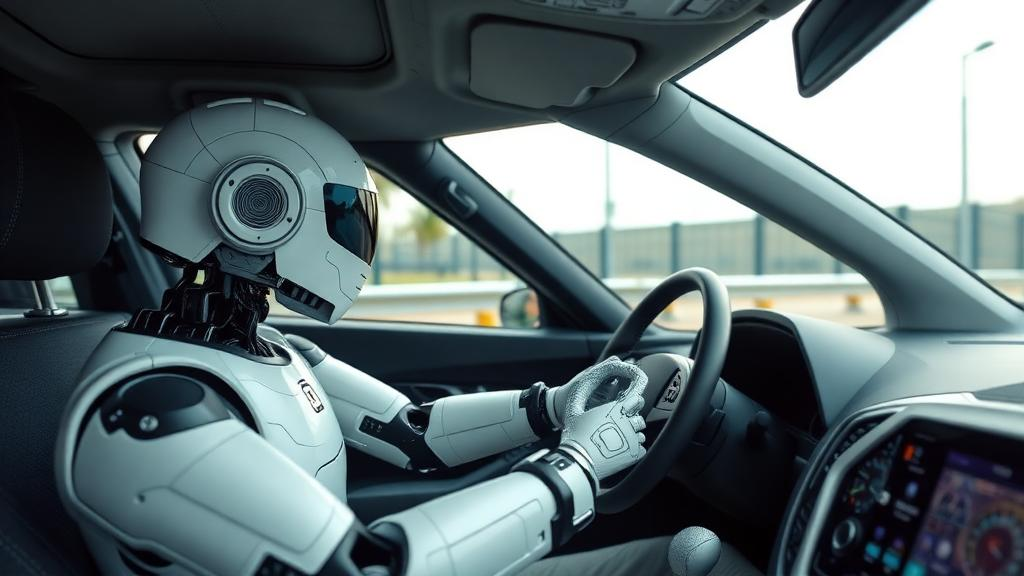
Automated vehicles are engineered to be paragons of road etiquette. They brake smoothly, keep generous following distances, obey speed limits, and never succumb to the impatience, distraction, or aggression that plague human drivers. The implicit promise of the industry has been simple: as robots take over the wheel, traffic becomes safer. But a new study published in Communications Engineering suggests that this promise is more complicated than it appears. When researchers examined how real driverless vehicles interact with the humans around them, they found a striking paradox. The automated vehicles themselves do indeed follow more safely than people do. Yet the human drivers trailing behind those same automated vehicles respond by driving more dangerously, tailgating with shorter headways and leaving themselves less time to react than they would behind another human.
The study, led by Yueying Chu and Peng Liu of Zhejiang University together with Ying Gao and Zhigang Xu of Chang’an University, tackled a problem that has dogged earlier research on automated vehicle safety: how to make fair comparisons between fundamentally different kinds of drivers. A car-following event is the most common interaction on any road, the moment-to-moment dance in which one vehicle trails another at close range. Whether a following driver is safe depends on how much time cushion they keep and how much collision risk they tolerate. But comparing a robot following a cautious driver with a human following an aggressive one tells you little, because the behavior of the lead vehicle shapes what the follower can and must do. The researchers’ solution was to align car-following events by the similarity of the lead vehicle’s speed profile, so that a robot’s behavior behind a given pattern of acceleration and braking could be compared directly with a human’s behavior behind a nearly identical pattern.
To build this comparison, the team drew on three real-world datasets, including trajectory data from driverless robotaxis operated by Lyft and Waymo, along with data from vehicles driven by adaptive cruise control, the semi-automated systems that many modern cars already carry. These are not driving simulators or hypothetical models; they are records of actual vehicles navigating actual traffic. That grounding matters, because laboratory studies of driver behavior around automation have often produced results that fail to materialize on real streets. By working with genuine trajectories, the researchers could observe how the presence of automated leaders changes human behavior in the wild, at scale, across thousands of natural car-following episodes.
The first half of the findings confirmed the industry’s assumptions. Lyft’s automated vehicles, when following manually driven cars whose speed profiles had been matched to those encountered by human followers, exhibited smoother and safer car-following behavior than human drivers in the same situations. They maintained longer time-headways, meaning they kept a bigger time gap between themselves and the vehicle ahead, and they achieved higher time-to-collision values, a standard safety metric that estimates how many seconds would remain before a crash if both vehicles continued at their current speeds and trajectories. In plain terms, the robots left themselves more room and more time, exactly the defensive posture that safety engineers design into automated driving systems.
The second half of the findings upended the expected consequences. When human drivers followed automated vehicles, compared with following manually driven vehicles with aligned speed profiles, they behaved more riskily. Their time-headways shrank and their time-to-collision values dropped, indicating that they were crowding the robots and accepting smaller safety margins than they extended to human drivers. The effect appeared not only in the Lyft data but also, with similar patterns, in the Waymo driverless dataset and in the adaptive cruise control dataset, suggesting that the phenomenon is not an artifact of one company’s driving style or one fleet’s calibration. Something about following an automated vehicle appears to systematically change how humans calibrate their own risk.
The researchers propose a partial explanation rooted in the stability of the automated leaders. Automated vehicles accelerate and brake more gently and predictably than humans do, producing steadier speed profiles. To a following driver, that stability may read as an invitation. If the car ahead never lurches, never slams its brakes, and never does anything surprising, the follower may unconsciously conclude that close following is cheap, that the buffer can be trimmed without consequence. Human drivers already exhibit this kind of risk compensation in other contexts: seatbelts, antilock brakes, and improved road design have all been associated with some degree of behavioral adaptation in which perceived safety gains are partially spent on more aggressive driving. An automated leader that behaves with machine-like consistency may amplify that dynamic, because its predictability makes the follower’s own margins feel less necessary.
The implications for traffic safety policy are uncomfortable but important. If automated vehicles are deployed on the assumption that their individual safety translates directly into network-wide safety, this study suggests the accounting is incomplete. A fleet of smooth, rule-abiding robots may be safer per vehicle-mile than the humans they replace, yet simultaneously degrade the behavior of the human drivers mixed in among them. Since human-driven vehicles will remain the overwhelming majority of traffic for decades, the net safety effect of automation could be smaller than expected, or in the worst case even negative in certain mixed-traffic configurations, if the induced riskiness of followers outweighs the intrinsic safety of the robots. Car-following is not a marginal scenario; it is the dominant mode of interaction in dense traffic, which makes the finding broadly consequential.
The methodological contribution may prove as influential as the empirical one. Previous studies comparing automated and human drivers often compared raw events without controlling for the lead vehicle’s behavior, leaving open the possibility that apparent differences in following safety reflected differences in the situations rather than the drivers. By matching events on lead-vehicle speed profile similarity and framing the comparison as a quasi-experiment, the researchers approximated the causal question that a randomized trial would answer: holding the situation constant, does the type of follower, or the type of leader, change safety outcomes? This design allowed them to separate two effects that are usually entangled, the safety of automated vehicles as followers and the influence of automated vehicles as leaders on the humans behind them. The framework can be applied to future datasets as driverless fleets expand, offering a reusable template for monitoring how automation reshapes the behavior of everyone on the road.
There are also design lessons embedded in the results. If the stability of automated leaders is part of what emboldens risky following, then manufacturers and regulators may need to think beyond making automated vehicles smooth and predictable. Subtle cues that communicate braking intent, or driving policies that occasionally assert a more human-like rhythm, could help followers maintain healthier margins. Some researchers have proposed that automated vehicles could actively manage the traffic around them, modulating their own behavior to encourage safe following rather than merely modeling it. The present study does not test such interventions, but it supplies the evidence base that motivates them: a clear, quantified demonstration that the behavior of a leader vehicle changes the risk calculus of the humans trailing it.
For now, the study stands as a caution against the simplest version of the automation story. Safety is not a property that a vehicle possesses in isolation; it emerges from the interactions among all the agents on the road, human and machine alike. The Zhejiang University and Chang’an University team has shown that even a perfectly behaved automated vehicle can have side effects that its own onboard systems cannot measure, because those effects live in the decisions of the drivers behind it. As robotaxis multiply in cities and adaptive cruise control becomes standard equipment, understanding and managing these behavioral feedbacks will be essential. The paradox the researchers documented, robots driving better while making humans drive worse, is a reminder that the hardest problems in automated transportation may lie not in the code of the vehicles themselves, but in the psychology of everyone sharing the road with them.
Subject of Research: Safety impacts of automated vehicles on human car-following behavior in mixed traffic
Article Title: Automated vehicles drive safer but induce riskier behavior in human drivers in car-following scenarios
Article References: Chu, Y., Gao, Y., Xu, Z., & Liu, P. (2026). Automated vehicles drive safer but induce riskier behavior in human drivers in car-following scenarios. Communications Engineering. https://doi.org/10.1038/s44172-026-00793-3
Image Credits: AI Generated
DOI: 10.1038/s44172-026-00793-3
Keywords: automated vehicles, car-following, driver behavior, traffic safety, Lyft, Waymo, adaptive cruise control, time-to-collision, time-headway, risk compensation, mixed traffic, quasi-experiment
News Source: Denise Maddox. (October 10, 2026). Robot Drivers Behave Safely, But They Make Humans Behind Them Drive Worse. Scienmag.