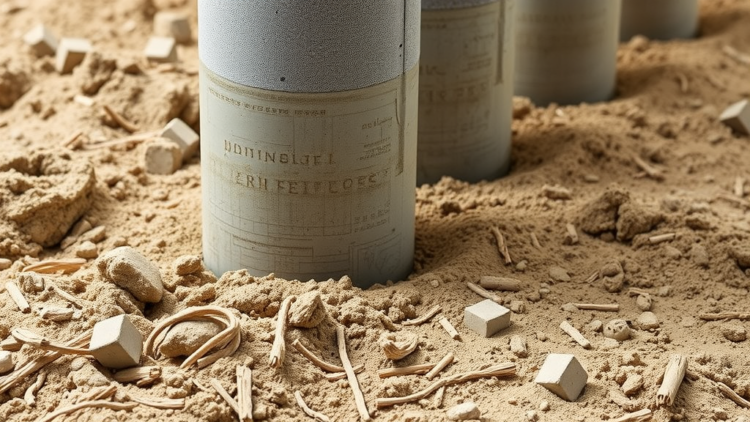
Deep foundations often succeed or fail not at the pile itself but at the thin, easily overlooked boundary where engineered materials meet the ground. A new study published in Scientific Reports examines one of the most consequential of these boundaries: the interface between a concrete core and the surrounding cement-treated soil in composite piles used to support buildings, bridges, and other heavy structures. Using a ring shear testing apparatus, the researchers have assembled a detailed picture of how shear stress develops, accumulates, and ultimately dissipates at this contact zone, offering engineers a more rigorous basis for designing foundations that must survive decades of loading, settlement, and environmental exposure.
Composite piles of the concrete–cement soil variety are built by treating soft or weak ground with cement, forming an improved soil mass, and then casting or driving a concrete element through or within that treated zone. The concept is attractive because it combines the stiffness and strength of concrete with the improved bearing and reduced compressibility of cement-stabilized soil. The load path, however, depends on how well the two materials transfer forces to one another. If the concrete–cemented soil interface slips under load, the composite action that makes the system economical is lost, and the pile may behave as two separate elements rather than one integrated foundation unit. Understanding the shear behavior of that interface is therefore not an academic detail but a central question in geotechnical design.
Previous studies of soil–structure interfaces have relied heavily on direct shear boxes and simple shear apparatus. These devices have well-known limitations: the shear plane is forced to a fixed location, stress distributions across the sample are non-uniform, and large relative displacements cannot be achieved without losing contact area. Ring shear testing addresses several of these shortcomings. In a ring shear apparatus, an annular specimen is confined in a circular chamber, and one portion of the sample is rotated relative to the other under a controlled normal stress. Because the geometry is continuous, shear displacement can proceed indefinitely without changing the nominal contact area, which makes the device particularly well suited for studying residual interface behavior—the strength that remains after very large relative movements.
In the reported experiments, the research team prepared interface specimens pairing concrete surfaces with cement-treated soil formulations, varying the cement content, curing conditions, and applied normal stresses to capture a representative range of field conditions. The ring shear tests tracked shear resistance as relative displacement accumulated, allowing the investigators to distinguish between peak strength, the transient maximum mobilized early in loading, and residual strength, the lower value that governs behavior after the interface has experienced substantial sliding. This distinction matters enormously in practice: a foundation that relies on peak interface strength may be safe for small, monotonic movements but could lose significant capacity if settlement, lateral spreading, or cyclic loading forces large relative displacements.
The results reveal a clear and consistent pattern in how these interfaces mobilize strength. At small displacements, adhesion and interlocking between the concrete surface and the cemented soil matrix resist relative movement. As displacement grows, the cemented bonds at the contact are progressively sheared, and the resistance transitions toward a steady residual value controlled largely by friction along a polished shear zone and by the granularity of the crushed cemented particles that accumulate there. The tests show that the ratio of residual to peak strength depends on the cement treatment level and on the roughness of the concrete surface, with rougher interfaces retaining more of their capacity after large deformation. This finding provides quantitative support for the long-standing intuition among foundation engineers that surface texture is a first-order design variable, not a secondary consideration.
Normal stress emerges as another controlling factor. Higher confining pressures increase both peak and residual shear resistance, but the shape of the shear-displacement curve changes with stress level, reflecting the competing roles of particle crushing, dilation, and reorientation within the interface zone. Under low normal stress, the interface reaches its residual condition relatively quickly, whereas under high normal stress the cemented soil continues to evolve, with crushing of bonded clusters generating fresh particle surfaces and altering the frictional response over extended displacement. These observations help explain why field-scale interface behavior can be difficult to predict from small laboratory tests alone: the operative mechanisms are stress- and displacement-dependent, and any design model must account for the full loading history rather than a single strength value.
What makes the study particularly valuable to practitioners is the way it translates laboratory observations into parameters usable in interface models. Modern numerical analyses of pile foundations often employ constitutive laws for soil–structure interfaces in which shear stiffness, peak strength, post-peak softening, and residual friction must all be specified. The ring shear data provide calibrated values for these parameters across a range of cement treatments and stress states, allowing analysts to represent the concrete–cemented soil contact with far greater fidelity than was previously possible. In pile load simulations, the difference between assuming full composite action and modeling realistic interface softening can be substantial, particularly for long piles and for designs in which load must be transferred deep into the ground.
The implications extend to construction quality control as well. Because interface strength is sensitive to concrete surface condition and to the degree and uniformity of cement treatment, the study’s findings reinforce the importance of specifying and verifying surface preparation and treatment quality in the field. A smooth or contaminated concrete surface, or a poorly mixed cement-stabilized soil zone, can reduce interface resistance to values near the residual floor identified in the tests. Conversely, deliberate roughening of the concrete and careful control of cement content can preserve a substantial fraction of peak strength even after significant relative displacement. In seismic regions and in ground subject to consolidation-induced downdrag, where large interface movements are plausible, these controls translate directly into reliability.
From a scientific standpoint, the work also contributes to a broader understanding of cemented geomaterial interfaces. Cement-treated soil occupies an intermediate position between uncemented granular materials and intact rock, and its behavior under shear is governed by the progressive destruction of bonds, a process that has been studied extensively in cemented sands and in rock joints but less thoroughly at concrete contacts. The ring shear results document this bond-breaking process at the pile interface in detail, showing how residual strength emerges from a self-organized shear zone of crushed and reoriented particles. The methodology—continuous large-displacement shearing under controlled stress—offers a template that other researchers can apply to related problems, including the interfaces of ground-improvement columns, soil-mixing walls, and caissons founded in stabilized ground.
As cities expand into softer ground and engineers push foundations deeper, composite systems that blend concrete with treated soil will play an increasing role in keeping construction both safe and economical. The ring shear testing program described in Scientific Reports gives the profession something it has long lacked: a quantitative, displacement-resolved description of the shear mechanisms at the heart of these systems. By quantifying how peak strength is developed, how it softens, and what residual capacity remains, the study turns a formerly assumed property into a measured one. For the engineers who must certify that a bridge pier or a high-rise will stand safely on treated ground for generations, that difference between assumption and measurement is precisely where modern foundation engineering is won.
Subject of Research: Interface shear mechanisms between concrete and cement-treated soil in composite foundation piles investigated using ring shear testing.
Article Title: Interface shear mechanisms in concrete–cement soil composite piles revealed by ring shear testing
Article References: Interface shear mechanisms in concrete–cement soil composite piles revealed by ring shear testing. (n.d.). https://doi.org/10.1038/s41598-026-70864-0
Image Credits: AI Generated
DOI: 10.1038/s41598-026-70864-0
Keywords: ring shear testing, concrete–cement soil composite piles, interface shear strength, cement-treated soil, residual strength, deep foundations, soil–structure interaction, ground improvement, pile design, geotechnical engineering, Interface, shear
Cite Scienmag News
APA MLA Chicago
Denise Maddox. (September 20, 2026). Ring Shear Tests Reveal How Concrete and Cement-Treated Soil Grip Together in Composite Piles. Scienmag. https://scienmag.com/ring-shear-tests-reveal-how-concrete-and-cement-treated-soil-grip-together-in-composite-piles/
Denise Maddox. “Ring Shear Tests Reveal How Concrete and Cement-Treated Soil Grip Together in Composite Piles.” Scienmag, 20 September 2026, https://scienmag.com/ring-shear-tests-reveal-how-concrete-and-cement-treated-soil-grip-together-in-composite-piles/. Accessed 20 September 2026.
Denise Maddox. “Ring Shear Tests Reveal How Concrete and Cement-Treated Soil Grip Together in Composite Piles.” Scienmag. September 20, 2026. https://scienmag.com/ring-shear-tests-reveal-how-concrete-and-cement-treated-soil-grip-together-in-composite-piles/
Copy citation Download RIS
Tags: cement-treated soilcement-treated soil and concrete bond mechanicsComposite pile foundation interface analysisconcrete and cement-treated soil shear behaviorconcrete–cement soil composite pilesdeep foundationsengineering design of composite pile interfacesfoundation interface slip and stabilitygeotechnical engineeringground improvementimpact of environmental factors on concrete-soil interfaceInterfaceinterface shear strengthlong-term performance of composite foundation materialspile designresidual strengthring shear testingring shear testing for foundation materialsshearshear behavior of composite pile materialsshear strength of composite pile interfacesshear stress at concrete-soil boundarysoil-structure interactionsoil-structure interaction in deep foundations