HOUSTON – (March 5, 2024) – Nai-Hui Chia, an assistant professor of computer science at Rice University, has won a National Science Foundation CAREER Award to develop a new theoretical framework to facilitate the development of efficient quantum algorithms for a range of problems in quantum physics and computer science as well as enhance the security of quantum cryptography.
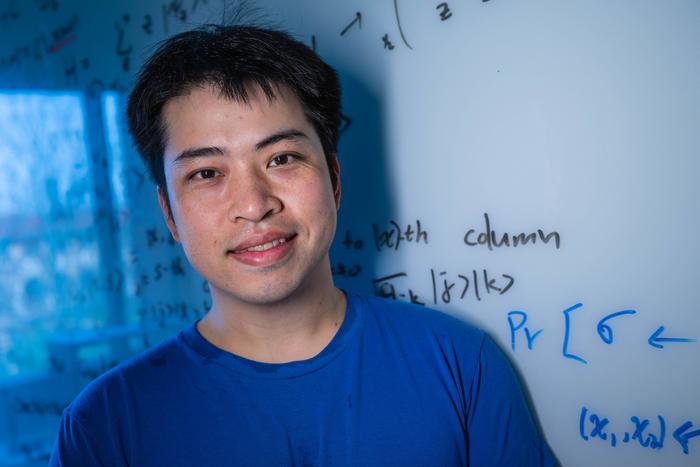
Credit: (Photo by Jeff Fitlow/Rice University)
HOUSTON – (March 5, 2024) – Nai-Hui Chia, an assistant professor of computer science at Rice University, has won a National Science Foundation CAREER Award to develop a new theoretical framework to facilitate the development of efficient quantum algorithms for a range of problems in quantum physics and computer science as well as enhance the security of quantum cryptography.
The highly competitive grants are awarded each year to a selective cohort of about 500 early career faculty across all disciplines engaged in pathbreaking research and committed to growing their field through outreach and education.
“Quantum computing holds immense potential for tackling complex problems across various fields like physics, chemistry and machine learning,” Chia said. “Quantum complexity theory plays a crucial role in guiding the advancement of quantum computing, but the standard complexity theory framework falls short in effectively guiding the investigation of numerous emerging challenges within quantum physics and quantum computing.
“We foresee that the proposed new theoretical framework will enhance our ability to identify the computational complexity of these new problems. Moreover, we believe this advancement will contribute to deepening our understanding of quantum computation, particularly regarding its capability to accelerate computations and develop secure protocols.”
One key focus of Chia’s five-year, $788,220 grant is to provide a profound and impactful reworking of standard complexity theory, which is typically equipped to deal with classical inputs and outputs. The proposed overhaul of this theoretical framework would enable it to handle the computational complexity of tasks that involve identifying the specific properties of quantum inputs such as state tomography, quantum cryptography and more.
Beyond technology, the award will broaden the participation of quantum computing at Rice and nearby institutions by developing specialized courses, hybrid research seminars and mentoring programs for underrepresented students.
Chia earned his Ph.D. in computer science and engineering from Pennsylvania State University in 2018. He next worked as a postdoctoral fellow at the University of Texas at Austin; a Hartree Postdoctoral Fellow in the Joint Center for Quantum Information and Computer Science at the University of Maryland; and an assistant professor in the Luddy School of Informatics, Computing and Engineering at Indiana University. He joined the Rice faculty in 2022.
-30-
This release was authored by Patrick Kurp and can be found online at news.rice.edu.
Follow Rice News and Media Relations via Twitter @RiceUNews.
CAREER Award information:
“Complexity Theory of Quantum States: A Novel Approach for Characterizing Quantum Computer Science”
https://www.nsf.gov/awardsearch/showAward?AWD_ID=2339116&HistoricalAwards=false
Image downloads:
https://news-network.rice.edu/news/files/2024/03/240227_Chia_Fitlow_2-7bea3db35c4aab9b.jpg
CAPTION: Nai-Hui Chia is an assistant professor of computer science at Rice University.
(Photo by Jeff Fitlow/Rice University)
Links:
Chia website: https://sites.google.com/view/naihuichia
Department of Computer Science: https://cs.rice.edu/
George R. Brown School of Engineering: https://engineering.rice.edu/
Quantum Initiative: https://quantum.rice.edu/
About Rice:
Located on a 300-acre forested campus in Houston, Rice University is consistently ranked among the nation’s top 20 universities by U.S. News & World Report. Rice has highly respected schools of architecture, business, continuing studies, engineering, humanities, music, natural sciences and social sciences and is home to the Baker Institute for Public Policy. With 4,574 undergraduates and 3,982 graduate students, Rice’s undergraduate student-to-faculty ratio is just under 6-to-1. Its residential college system builds close-knit communities and lifelong friendships, just one reason why Rice is ranked No. 1 for lots of race/class interaction, No. 2 for best-run colleges and No. 12 for quality of life by the Princeton Review. Rice is also rated as a best value among private universities by Kiplinger’s Personal Finance.