DOE Early Career award to physicist Ming Yi backs experiments on 2D materials
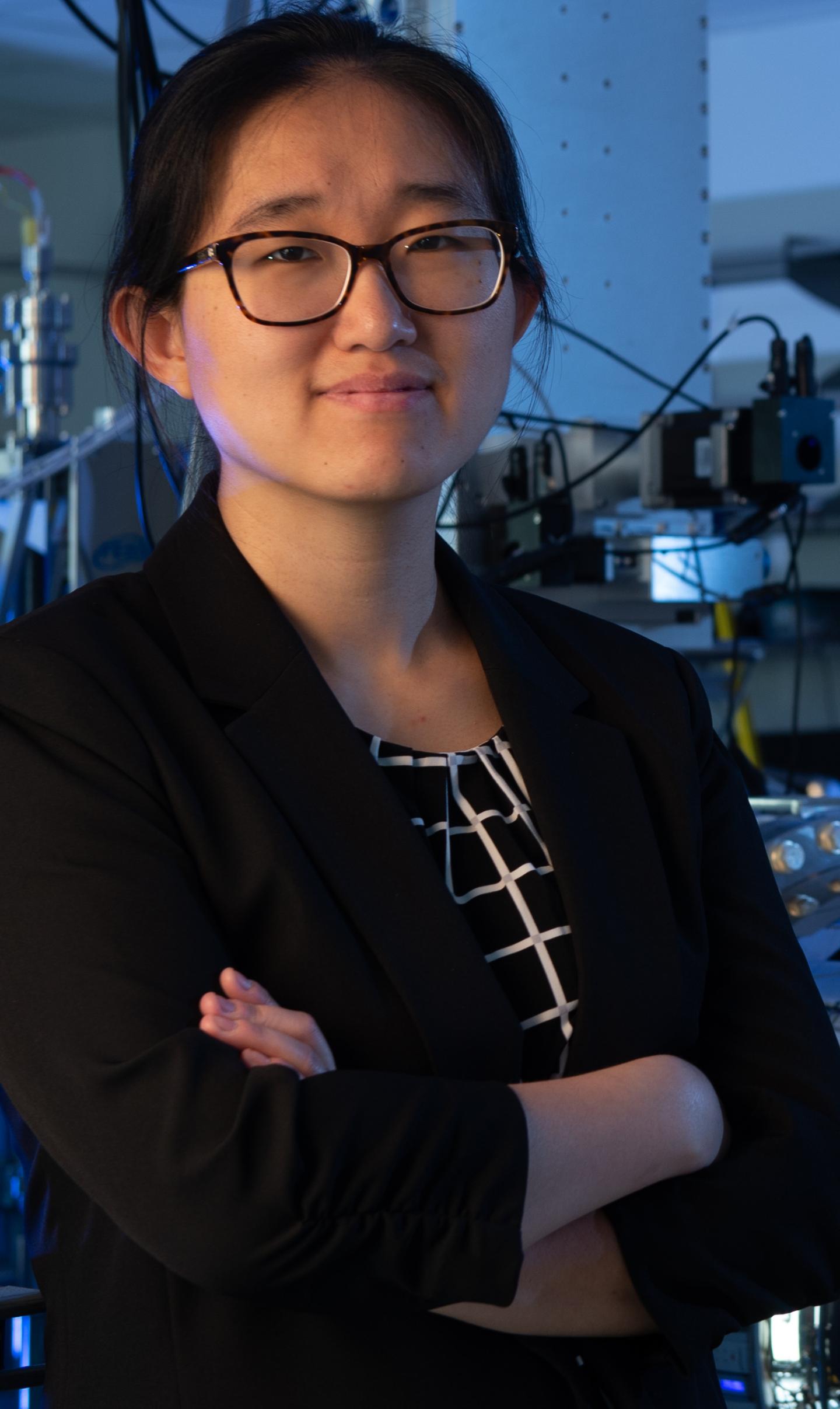
Credit: Jeff FItlow/Rice University
HOUSTON – (June 23, 2020) – The Department of Energy’s Office of Basic Energy Sciences has awarded Rice University experimental physicist Ming Yi a five-year grant to explore the details of magnetism in two-dimensional materials.
She is one of 76 Early Career awardees, 50 of them from American universities and the rest at national laboratories. The grant to Yi for $750,000 follows a major Moore Foundation grant she received earlier this year.
Yi’s lab employs a technique called angle-resolved photoemission spectroscopy (ARPES) to study the behavior of electrons at the nanoscale. In some materials, the electrons interact strongly with each other, leading to exotic quantum phenomena. “ARPES directly maps the distribution of electrons in solid crystalline materials, from which we can learn about the emergent collective behaviors of electrons that lead to exotic properties of the materials,” she said.
With the new grant, she and her colleagues seek to learn the origin of magnetism in bulk materials that are exfoliated for use as low-dimensional materials, how the key ingredients for magnetism evolve as materials go from 3D to 2D and how the 2D magnetic properties can be perturbed and tuned.
“One of the ultimate goals for the quantum materials community is to be able to design materials on demand, which is to say, ‘I want this kind of property, can you make a material that does that?'” Yi said. “In order to do so, we need to have an accurate theoretical model for real materials and an understanding of the key parameters to input that will give the material properties we want. For 2D magnetic materials and other correlated materials, that process is not yet well-understood.
“These materials are also very tunable, which means when people perturb them by applying a field or strain, their properties are predicted to change a lot,” she said. “The question is why.”
Yi said the key to 2D tuning lies in understanding the fundamental physics of what occurs as exfoliated materials go from bulk 3D to 2D, as happened when scientists used adhesive tape to pull graphene from a lump of graphite. Her approach is experimental rather than theoretical.
“I propose to measure the materials’ electronic structures with ARPES to study how they change from 3D to 2D, and to see how that relates to their magnetic, electric and optical properties,” said Yi, an assistant professor of physics and astronomy.
To be eligible for the Early Career award, a researcher must be an untenured, tenure-track assistant or associate professor at a U.S. academic institution or a full-time employee at a Department of Energy national laboratory who received a Ph.D. within the past 10 years.
“The Department of Energy is proud to support funding that will sustain America’s scientific workforce, and create opportunities for our researchers to remain competitive on the world stage,” said Under Secretary for Science Paul Dabbar. “By bolstering our commitment to the scientific community, we invest into our nation’s next generation of innovators.”
###
This news release can be found online at https:/
Follow Rice News and Media Relations via Twitter @RiceUNews.
Related materials:
Yi Research Group: https:/
Department of Physics and Astronomy: https:/
Wiess School of Natural Sciences: https:/
Image for download:
https:/
CAPTION: Ming Yi. (Credit: Jeff Fitlow/Rice University)
Located on a 300-acre forested campus in Houston, Rice University is consistently ranked among the nation’s top 20 universities by U.S. News & World Report. Rice has highly respected schools of Architecture, Business, Continuing Studies, Engineering, Humanities, Music, Natural Sciences and Social Sciences and is home to the Baker Institute for Public Policy. With 3,962 undergraduates and 3,027 graduate students, Rice’s undergraduate student-to-faculty ratio is just under 6-to-1. Its residential college system builds close-knit communities and lifelong friendships, just one reason why Rice is ranked No. 1 for lots of race/class interaction and No. 4 for quality of life by the Princeton Review. Rice is also rated as a best value among private universities by Kiplinger’s Personal Finance.
Media Contact
Jeff Falk
[email protected]
Original Source
https:/