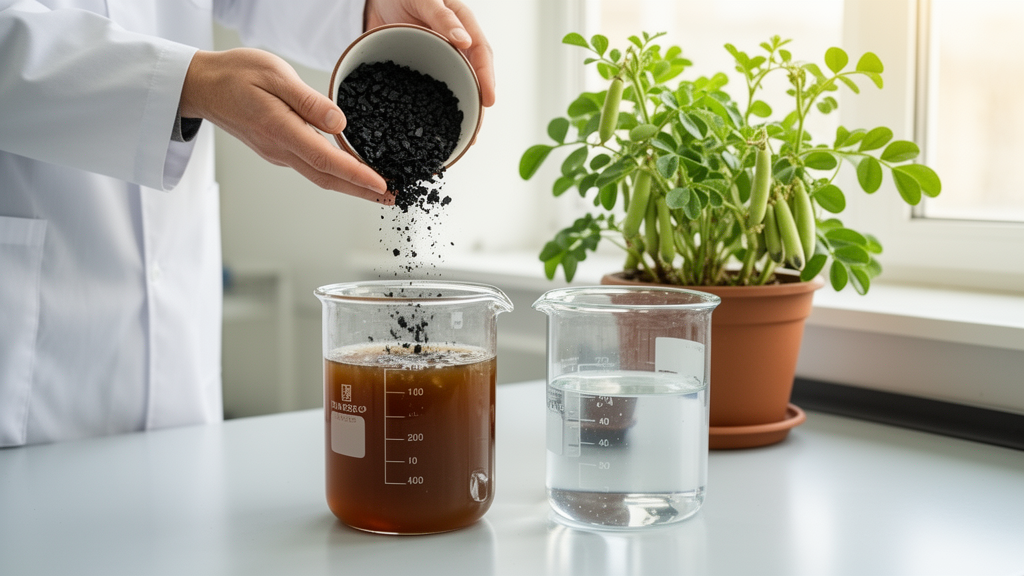
Researchers in India have turned an agricultural waste problem into a water treatment solution, showing that biochar made from rice hulls can strip most of the toxic hexavalent chromium from tannery wastewater in a single batch treatment. The study, published in Biotechnology for Sustainable Materials, reports that under optimized conditions of pH 4, a biosorbent dose of 0.8 grams per liter, and a contact time of 120 minutes, rice hull biochar achieved 91% removal of Cr(VI), with a maximum adsorption capacity of 10.54 milligrams per gram. In a follow-up germination experiment, chickpea seeds watered with diluted treated effluent grew better than controls, hinting that the cleaned water and spent biochar could find a second life on farms.
The motivation is twofold. Hexavalent chromium is classified as a Class I human carcinogen, and exposure can cause respiratory and gastrointestinal ailments, skin allergies, and disrupted growth in plants and animals. The leather industry in India discharges chromium-laden effluent, and conventional removal techniques such as precipitation, solvent extraction, reverse osmosis, and ion exchange are costly and energy intensive. At the same time, burning rice hulls is a major environmental problem in states like Punjab, Haryana, and Uttar Pradesh, releasing greenhouse gases including carbon dioxide, methane, and nitrous oxide. Rice hulls account for 10 to 20% of the global annual rice production of roughly 500 million metric tons, so converting them into an adsorbent addresses both streams at once.
The preparation itself was deliberately simple. Rice hulls collected from local farmers were washed, sun-dried, oven-dried, ground, and sieved, then pyrolyzed at 400 degrees Celsius for just two minutes in a muffle furnace before being cooled and powdered. The team, led by Smriti Yadav and colleagues with senior author Neelam Jain, ran batch sorption experiments in triplicate in 50 milliliter Falcon tubes shaken at 120 rpm, using a 0.01 M sodium chloride electrolyte and chromium concentrations from 100 to 500 parts per million. Chromium levels were measured with the diphenylcarbazide colorimetric method at 540 nanometers on a UV-VIS spectrophotometer.
Optimization experiments mapped out how each parameter shaped performance. Across a pH range of 2 to 8, removal climbed to a maximum of 80% at pH 4, because at low pH the dominant chromate species, HCrO4− and Cr2O7²−, are attracted to protonated, positively charged sites on the biochar surface, while at higher pH deprotonated surfaces repel anionic chromate and hydroxyl ions compete for binding sites. Increasing the initial chromium concentration from 100 to 500 parts per million cut the removal rate from 85% to 67%, a pattern the authors attribute to a fixed pool of binding sites that saturates faster at higher metal loads. Varying the biochar dose from 0.2 to 1.2 grams per liter produced a rise-and-fall curve, peaking at 90% removal at 0.8 grams per liter before slipping to 84% at 1.2 grams per liter, likely due to particle aggregation, screening effects, and reduced mass transfer at high suspension densities.
Kinetics told a two-phase story. Removal reached 83% within 30 minutes, then crept up to 91% by 120 minutes. Fitting the data showed the process follows pseudo-second-order kinetics with R² above 0.98, indicating chemisorption, meaning chemical bond formation between chromate ions and surface functional groups, rather than simple physical adsorption, dominates. Intraparticle diffusion modeling revealed two distinct linear stages: an initial boundary layer diffusion phase in which ions move through the liquid film to the particle surface, followed by a slower intraparticle diffusion phase as ions penetrate the pore network. Non-zero intercepts in both stages confirmed that neither external nor internal transport alone controls the overall rate.
Characterization explained why the material works so well. BET analysis gave a specific surface area of 81.80 square meters per gram, a pore volume of 0.12 cubic centimeters per gram, and an average pore size of 3.32 nanometers, with a Type IV nitrogen isotherm and H4 hysteresis loop indicating slit-shaped mesopores alongside micropores. That average pore diameter comfortably exceeds the hydrated radii of the chromate species, roughly 0.4 nanometers for HCrO4−, easing internal diffusion. FTIR spectroscopy identified hydroxyl, amine, and carbonyl groups on the surface, with the hydroxyl stretch shifting from 3235 to 3385 per centimeter after chromium loading, evidence of chemical interaction. SEM images showed a rough, irregular surface studded with macro- and micropores that remained structurally intact after treatment, while EDS detected carbon, oxygen, iron, calcium, aluminum, and potassium, elements the authors suggest may enable ion exchange and even catalytic reduction of Cr(VI) to the less toxic Cr(III).
Isotherm analysis added a nuance. The data fit both the Langmuir model (R² = 0.95, qmax 10.54 milligrams per gram) and the Freundlich model (R² = 0.96) almost equally well, pointing to a heterogeneous process that monolayer adsorption alone cannot describe. The Freundlich exponent of 1/n = 1.133 exceeds 1, which the authors interpret as cooperative adsorption, where initial chromate binding apparently makes neighboring sites more accessible, a departure from the 0.1 to 0.5 range typical of most reported biochars. The Langmuir constant of 4.040 liters per milligram indicated moderately strong affinity, and calculated separation factors well below 1 across the tested concentration range confirmed favorable adsorption conditions.
The second half of the study asked what happens to the water and the spent biochar afterward. Tannery effluent collected from common effluent treatment plant outlets in Manpura Mancheri village near Jaipur, Rajasthan, was mixed with an aqueous extract of the biochar residue at dilution ratios of 1:1, 1:2, 1:3, and 1:4, then applied to sterilized chickpea seeds in triplicate. At the strongest effluent concentration (1:1), growth was minimal, suggesting residual chromium toxicity overwhelmed the system. At 1:2 and 1:3, growth improved slightly. But at the 1:4 ratio, 20% effluent and 80% biochar residue, seedlings showed significantly enhanced root length, shoot length, leaf number, nodule formation, and both fresh and dry biomass compared with controls.
The authors read this as evidence that the biochar detoxified the chromium while simultaneously releasing nutrients such as potassium, calcium, magnesium, and iron detected in its composition, turning the spent adsorbent into a growth-promoting soil amendment. Enhanced nodulation is particularly notable because legume nodulation is highly sensitive to heavy metal stress. The team is careful to flag the limits, however: the germination work was a lab trial, direct measurement of chromium in plant tissues was not performed, and field trials under realistic soil conditions plus long-term studies of chromium remobilization would be needed before any agricultural reuse.
Even with those caveats, the numbers make a case. Compared with biochars that need higher doses or longer equilibration times, rice hull biochar reached 91% removal at a modest 0.8 grams per liter in 120 minutes, and the authors suggest it is best suited to moderately to low concentration wastewaters in the 100 to 300 parts per million range, with two-stage treatment for stronger effluents. The researchers call for pilot-scale testing, regeneration studies, techno-economic analysis, and chemical or thermal modification to push capacity further. For now, the work stands as a lab-scale demonstration that a two-minute pyrolysis of an abundant crop residue can yield a competitive chromium biosorbent, and that its use need not end when the wastewater is clean.
Subject of Research: Removal of hexavalent chromium from tannery effluent using rice hull biochar and its effect on chickpea seed germination
Article Title: A green approach for remediation of hexavalent chromium [Cr (VI)] from tannery effluent using rice hull biochar and assessing its impact on germination of Cicer arietinum (Chickpea)
Article References: Yadav, S., Kundu, N., Bhattacharya, A., Khinvasara, P., Aseri, G. K., & Jain, N. (2026). A green approach for remediation of hexavalent chromium [Cr (VI)] from tannery effluent using rice hull biochar and assessing its impact on germination of Cicer arietinum (Chickpea). Biotechnology for Sustainable Materials, 3(1), Article 8. https://doi.org/10.1186/s44316-026-00058-1
Image Credits: AI Generated
DOI: 10.1186/s44316-026-00058-1
Keywords: rice hull biochar, hexavalent chromium, tannery effluent, biosorption, water treatment, chickpea germination, adsorption kinetics, agricultural waste, circular economy, heavy metal remediation, pyrolysis, wastewater reuse
News Source: Alan Morgan. (October 29, 2026). Rice Hull Biochar Strips Toxic Chromium from Tannery Wastewater and Boosts Chickpea Growth. Scienmag.