Credit: Staffan Widstrand/Rewilding Europe
Urbanisation, biodiversity loss, climate change: just some of the worldwide problems 'rewilding' – i.e. restoring food chains by returning 'missing' species to the landscape – can help tackle. Researcher Liesbeth Bakker (NIOO-KNAW) has edited a theme issue of the world's oldest life sciences journal, Phil Trans B, on rewilding, together with a Danish expert. The issue is now available online.
When animals become extinct or disappear from an area, their unique role in nature is often lost. "There is increasing evidence that this global wildlife loss does not only imply the loss of charismatic animals, but also the functions they have in ecosystems", argues ecologist Liesbeth Bakker (NIOO-KNAW).
The consequences can be disastrous. Wildfires, for instance, have been an increasingly serious problem: without large herbivores to eat the plant material more of it remains, meaning more 'fuel' for such fires.
"Since the world-wide expansion of modern humans began", explains Bakker, "humans have overexploited large vertebrates. From the Late Pleistocene extinctions of terrestrial megafauna to the current poaching of elephants and rhinos."
From debate to data
If we are to restore nature, the role of these animals in the food web is crucial. One approach to obtaining a healthy food web (again) is by reintroducing 'missing' species. 'It's called trophic rewilding," says Bakker. "There are other kinds of rewilding as well."
An example of the ripple-effect caused by trophic rewilding is the reintroduction of wolves in Yellowstone National Park in the United States in the 1990s, which is even said to have changed the course of some rivers. The wolves brought down the deer/elk population, river banks suffered less erosion, and with the rivers fixed in their course more biodiversity-rich pools formed.
The story has become part of the rather romantic and fashionable image attached to rewilding. But while plenty of people may dabble or express opinions, "scientific data on the effects of explicit rewilding efforts have until now remained scarce", says Bakker. The theme issue of Phil Trans B which she and Danish researcher Jens-Christian Svenning (University of Aarhus) have guest-edited is meant to change that.
Elk and bison
In the theme issue, researchers from all over the world share their data. Among their findings is that in the Arctic, large herbivores such as reindeer and muskoxen can actually mitigate the impact of rising temperatures.
Other examples demonstrate a similarly positive impact. Replacing ruminant livestock with non-ruminant wildlife will reduce the emission of methane – a greenhouse gas – in rangeland farming, beavers can enhance wetland plant diversity, and re-introductions of native carnivores can be an effective method for suppressing invasive carnivores and invasive herbivores.
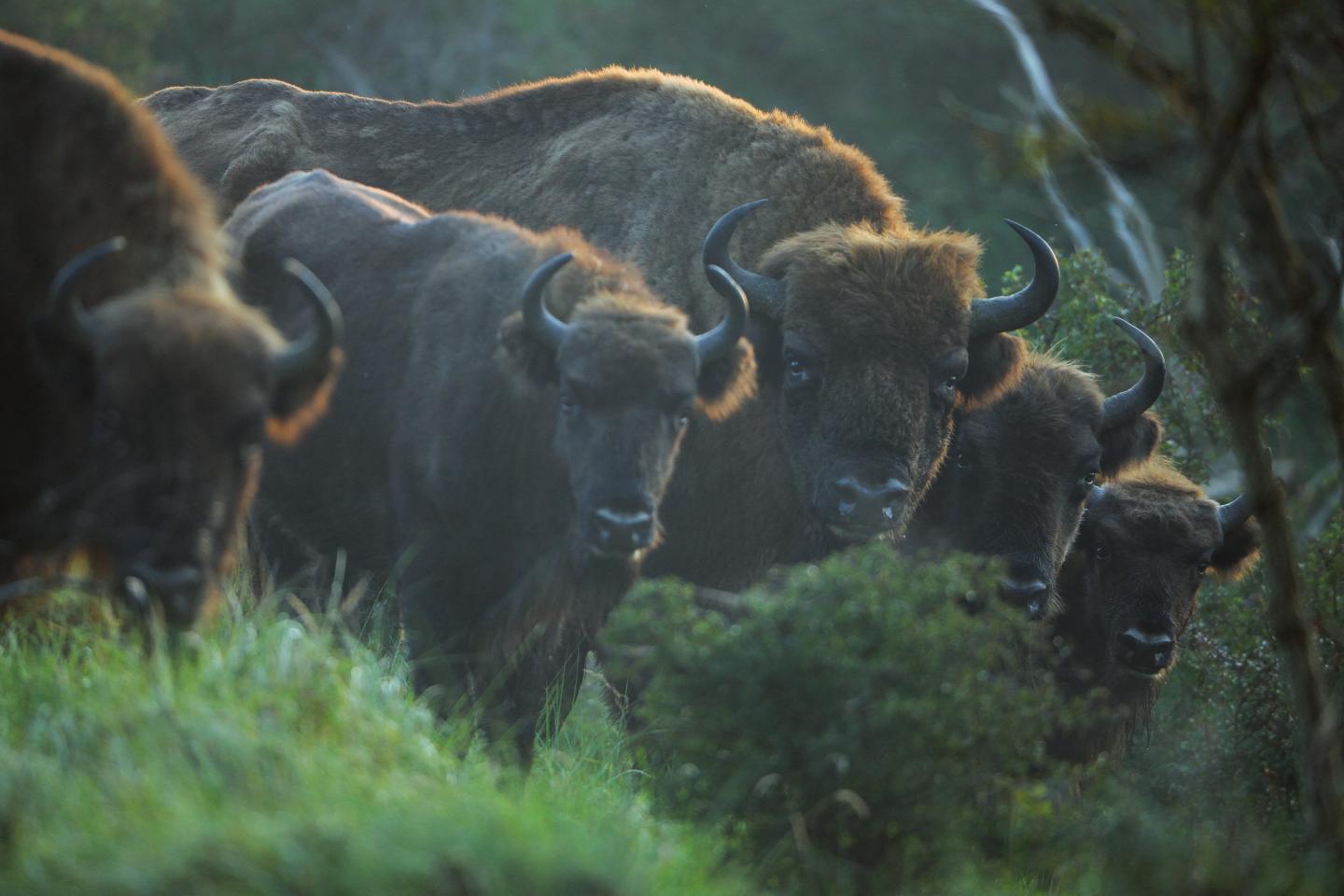
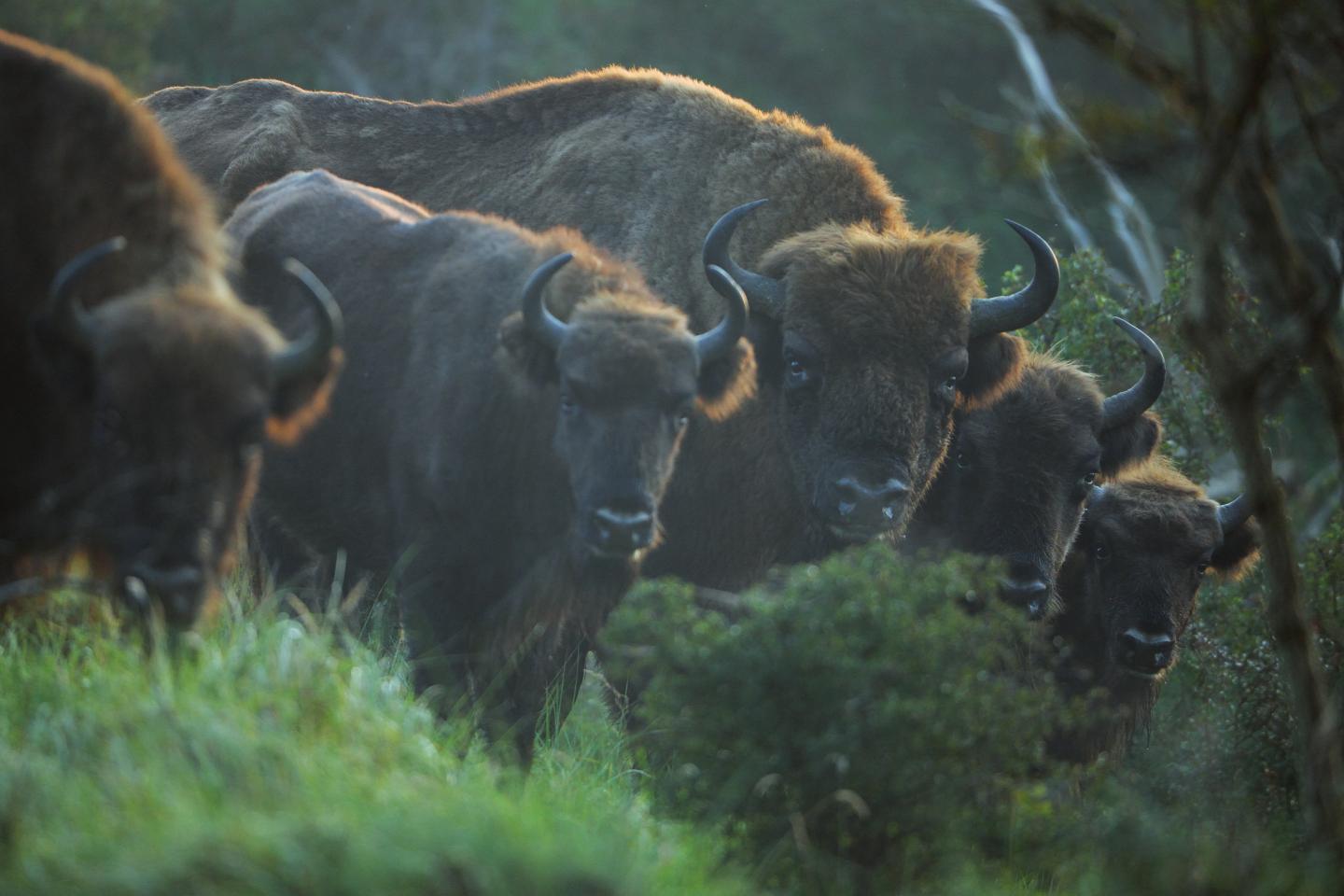
Bakker adds: "Climate change doesn't form an impediment to the reintroduction of large animals in most cases. In the Netherlands, for instance, species such as the European bison and the elk feel right at home." She hopes rewilding will become an increasingly 'transdisciplinary' field, in which scientific and practical applications keep pace with each other and there's room for ecology, sociology, geography and economics.
Successful recipe
"These studies demonstrate that trophic rewilding is a promising tool to mitigate negative impacts of global change on ecosystems and their functioning", concludes Bakker. In due time it may even help to provide solutions for other global issues as well, including urbanisation and biodiversity loss. "But it's also clear that implementing trophic rewilding alone will not solve these problems."
Altered land-use – e.g. providing more space for rivers to follow their natural temporal and spatial dynamics – plays an important role in recipes for successful rewilding. So does scale. "Generally, it emerges that large-scale trophic rewilding produces the best results, whereas in human-dominated, fragmented landscapes a certain level of management of ecosystems may still be needed."
But even under these circumstances, concludes Bakker, "a gradual increase in naturalness of ecosystems over time is achievable." And that's even true for the Netherlands, which despite its small size and issues of overpopulation and overexploitation continues to be one of the trailblazers for rewilding.
###
With more than 300 staff members and students, the Netherlands Institute of Ecology (NIOO-KNAW) is one of the largest research institutes of the Royal Netherlands Academy of Arts and Sciences (KNAW). The institute specialises in water and land ecology. As of 2011, the institute is located in an innovative and sustainable research building in Wageningen, the Netherlands. NIOO has an impressive research history that stretches back 60 years and spans the entire country, and beyond.
Theme issue:
'Trophic rewilding: consequences for ecosystems under global change', guest editors Liesbeth Bakker and Jens-Christian Svenning, Philosophical Interactions of the Royal Society B, volume 373, issue 1761, 5 December 2018 (online now: 10.1098/rstb/373/1762), http://rstb.royalsocietypublishing.org/content/373/1761. NB. During Open Access Week, starting 22 October, all articles are being made available as Open Access.
Editorial overview:
Trophic rewilding: impact on ecosystems under global change, Elisabeth S. Bakker & Jens-Christian Svenning, http://rstb.royalsocietypublishing.org/content/373/1761/20170432
Media Contact
Froukje Rienks
[email protected]
31-610-487-481
@niooknaw
http://www.nioo.knaw.nl
Original Source
https://nioo.knaw.nl/en/press/rewilding-landscapes-can-help-solve-more-one-problem-once http://dx.doi.org/10.1098/rstb/373/1761