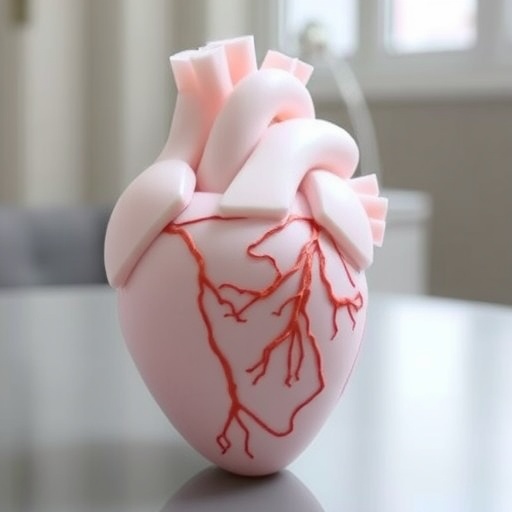
A team of researchers at the University of New South Wales (UNSW) Sydney has unveiled a remarkable advance in cardiovascular research: a fully synthetic soft robotic model of the human heart’s left side. This pioneering device replicates the intricate architecture and dynamic motions of the heart, including crucial internal components such as artificial valves, papillary muscles, and chordae tendineae. This comprehensive emulation of the heart’s physiology offers an unprecedented platform to study complex heart diseases and could revolutionize the future of medical device development, clinical diagnostics, and patient-specific treatment planning.
Unlike traditional benchtop models, which often simplify cardiac structures, UNSW’s soft robotic heart integrates the valve mechanisms critical for unidirectional blood flow. The mitral valve, modeled as a pair of swinging doors, prevents backward leakage of blood—a function essential for maintaining cardiac efficiency. By incorporating artificial musculature controlled hydraulically, the device mimics the heart’s contraction and twisting, producing motion patterns indistinguishable from actual cardiac function. This nuanced replication enables researchers to simulate pathological states, such as mitral valve prolapse and regurgitation, where valve dysfunction leads to compromised blood flow and heightened risk of heart failure.
Heart failure with preserved ejection fraction (HFpEF) remains an enigmatic and devastating condition, constituting about 50% of all heart failure cases. Characterized by the heart’s reduced capacity to relax and fill properly despite maintained pumping function, HFpEF often coexists with systemic comorbidities like hypertension and diabetes. The UNSW soft robotic model can simulate the hallmark features of HFpEF, including the delayed ventricular filling and increased intracardiac pressures observed in patients. This capability provides clinicians and researchers a powerful tool to investigate HFpEF mechanisms and explore novel therapeutic strategies tailored to this complex syndrome.
The engineering breakthrough underpinning this model lies in its use of flexible silicone membranes and layered soft robotic artificial muscles arranged to replicate the heart’s natural muscle fiber architecture. These hydraulic artificial muscles receive precisely regulated pressure inputs to contract and relax in coordination, enabling the ventricular walls to deform and twist as in a genuine heartbeat. The inner membranes form the heart’s chambers and contain simulated blood, allowing for realistic pumping dynamics with in-and-out flow paths. This biomimetic design elevates the fidelity of cardiac simulations far beyond previous mechanical analogues.
One particularly groundbreaking aspect is the system’s adjustable artificial papillary muscles, which support and regulate the mitral valve. By altering the tension in these muscles, the researchers can precisely recreate valve malfunctions and study their impacts on cardiac mechanics and blood flow. This mechanistic insight is vital, as valve pathologies are a common contributor to heart failure progression. The ability to tune valve behavior in a controlled setting allows device developers to test prosthetics and surgical interventions more effectively before transitioning to animal models or clinical trials.
Validation of the synthetic heart involved extensive testing using ultrasound imaging and invasive measurements of pressure and flow to compare its performance against physiological benchmarks. The results were striking—the artificial heart produced realistic waveforms of pressure and blood flow characteristic of healthy and diseased states alike. Moreover, the model’s compatibility with non-invasive clinical techniques such as echocardiography underscores its potential as a translational research tool, bridging laboratory experiments and patient care.
Beyond modeling disease mechanics, the platform serves as a testing ground for emergent cardiovascular technologies. Demonstrating this, the UNSW team evaluated a novel soft robotic cardiac catheter within the beating model. The catheter could navigate precisely inside the artificial heart, sensing contact with moving anatomic structures. This demonstrated the system’s utility for iterative design and validation of surgical devices, potentially accelerating innovation in minimally invasive cardiac therapies with improved safety profiles.
Ethical concerns and high costs have long hampered preclinical testing relying on animal models, limiting throughput and translational efficiency. The synthetic heart’s controllable and reproducible environment offers a humane and cost-effective alternative for early-stage device evaluation. By faithfully reproducing specific disease phenotypes, such as HFpEF, the technology could reduce dependence on animal testing, accelerating development timelines while preserving scientific rigor.
Looking forward, the researchers envision personalizing these soft robotic hearts using patient-derived medical imaging data. Such bespoke models could inform clinical decision-making by enabling surgeons to trial different interventions in a risk-free setting tailored to each patient’s unique cardiac anatomy and physiology. This aligns perfectly with the burgeoning field of precision medicine, where treatments are customized for maximal efficacy and safety.
While this soft robotic heart represents a significant technological milestone, the team acknowledges that it remains a proof-of-concept rather than a fully clinical device. Future iterations will aim to integrate more sophisticated materials, refine control systems for enhanced realism, and incorporate patient-specific geometric complexities. The crucial next step involves comprehensive validation against a broad spectrum of clinical data to establish the model’s predictive accuracy across diverse cardiac conditions and anatomies.
The integration of expertise from biomedical engineering and clinical cardiology, including collaboration with leading clinicians, underscores the translational potential of this technology. The resulting platform offers a versatile, high-fidelity testbed for advancing cardiovascular research, improving device safety, and ultimately improving patient outcomes. As soft robotics and bioengineering converge, the dream of a truly functional artificial heart model that serves as a clinical decision and treatment tool moves closer to reality.
In conclusion, UNSW’s soft robotic heart blends innovation in materials science, robotics, and clinical insights to create a biomimetic device capable of simulating complex cardiac physiology and pathology with unprecedented accuracy. By enabling detailed study of valve mechanics, heart muscle dynamics, and disease progression, it stands to revolutionize cardiovascular research. More importantly, it paves the way for personalized treatment approaches that could substantially reduce the burden of cardiovascular disease globally, offering new hope to millions suffering from heart failure.
Subject of Research: Not applicable
Article Title: Compliance modulation of a soft robotic atrioventricular model of heart failure with preserved ejection fraction
News Publication Date: 1-Jun-2026
Web References:
Nature Communications article: https://www.nature.com/articles/s41467-026-73791-w
Advanced Science article: https://advanced.onlinelibrary.wiley.com/doi/abs/10.1002/advs.75382
References:
UNSW Medical Robotics Lab
UNSW School of Biomedical Engineering
Image Credits: UNSW/Richard Freeman
Keywords
Cardiovascular disorders, Bioengineering, Biomedical engineering, Heart failure with preserved ejection fraction (HFpEF), Soft robotic heart, Mitral valve disease, Cardiac biomechanics, Medical device development, Patient-specific models, Soft robotics, Cardiovascular research
Tags: advanced cardiac disease modelingartificial mitral valve simulationcardiovascular diagnostics innovationchordae tendineae in roboticsdynamic heart motion emulationheart failure with preserved ejection fraction researchhydraulic heart contraction mechanismmedical device testing platformpapillary muscles replicationpatient-specific cardiac treatment planningsoft robotic heart modelsynthetic cardiovascular device