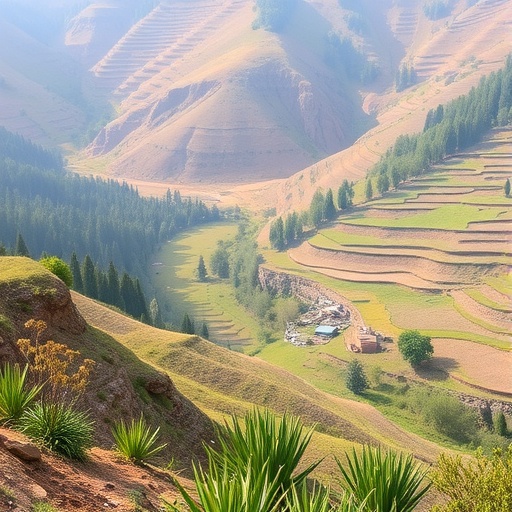
In the picturesque setting of the Central Himalayas, the Urgam Valley emerges as a living laboratory for sustainable agriculture, as revealed by recent groundbreaking research conducted by A.K. Meena and R.K. Maikhuri. Their study paints a vivid portrait of how traditional agriculture in this region can provide crucial ecosystem services, thereby contributing to both environmental sustainability and economic resilience. The emphasis on integrating sustainable practices into farming not only supports local biodiversity but also enhances food security for communities relying on agriculture as their primary livelihood.
At first glance, the breathtaking landscapes of the Urgam Valley may appear untouched, but beneath the surface lies a complex interplay of agricultural practices that date back centuries. The researchers meticulously documented the patterns of crop production in the valley, revealing a diverse array of species cultivated by local farmers. This polyculture approach not only minimizes the reliance on synthetic fertilizers and pesticides but also fortifies the ecosystem, allowing various organisms to thrive and coexist in harmony.
The study further highlights how agricultural practices in the Urgam Valley can directly influence the provisioning of ecosystem services. These services, which include food production, pollination, and soil fertility, are essential for sustaining both agriculture and the wider environment. By harnessing local resources and traditional knowledge, farmers in the region are able to implement techniques that enhance the natural processes, thereby improving productivity while preserving the integrity of their environment.
A striking finding from the research is the intricate relationship between sustainable agricultural practices and economic viability. The farmers in Urgam Valley have demonstrated that embracing ecologically friendly practices does not come at the cost of profitability. Instead, the study reveals a clear alignment between ecological health and economic outcomes. Farmers who adopt sustainable methods tend to yield higher returns while simultaneously safeguarding their natural resources for future generations. This aspect of the research carries significant implications for policymakers and agricultural development programs.
The use of agroecological methods has also contributed to a remarkable increase in the resilience of cropping systems in the valley. As climate change continues to pose challenges to agriculture globally, the insights gleaned from Urgam Valley may serve as a beacon for other regions grappling with similar issues. By promoting biodiversity through varied crop cultivation and sustainable land management, farmers can create systems that better withstand the shocks of unpredictable weather events, pests, and diseases.
Moreover, the research sheds light on the social dimensions of sustainable agriculture in the Urgam Valley. The collaborative efforts among farmers, sharing knowledge and resources, have fostered a sense of community and empowerment. This solidarity is crucial in a world where individual farmers often face overwhelming pressures from commercial agriculture and globalization. The collective action observed in Urgam Valley not only fortifies local resilience but also inspires similar movements in other farming communities across the globe.
The economic analysis included in the study provides a detailed examination of the cost-benefit dynamics associated with various agricultural practices. The researchers found significant disparities between conventional farming and sustainable alternatives in relation to input costs, yield stability, and environmental impact. These financial insights underscore the long-term viability of sustainable practices, positioning them as not merely an ethical choice but a practical one for farmers seeking to enhance their livelihoods while being stewards of the land.
Importantly, the research posits that policy frameworks need to evolve in response to the evidence presented. While the findings advocate for the adoption of sustainable practices, they also call for a concerted effort from governments and organizations to provide the necessary support and infrastructure. This includes incentives for farmers who commit to eco-friendly practices and investment in research that continues to drive innovation in sustainable agriculture.
As the global community grapples with the dual threats of climate change and food insecurity, the case study of the Urgam Valley stands as a testament to the power of local knowledge and practices. The evidence suggests that a shift towards sustainability not only prevents environmental degradation but also nurtures economic growth and social cohesion. For a world increasingly disconnected from its agricultural roots, Urgam Valley serves as an inspiring reminder of the richness and efficacy of traditional knowledge.
The agricultural practices highlighted in this research extend beyond merely growing crops; they encompass a holistic view of rural development that intertwines economic prosperity with environmental stewardship. This perspective is invaluable for academic discourse and practical application in agricultural development initiatives, bridging the gap between scientific research and on-the-ground impact.
In conclusion, the findings of Meena and Maikhuri underscore the critical importance of sustainable agriculture in the context of global ecological challenges. Their research not only champions the existing efforts of farmers in the Urgam Valley but also lays the groundwork for further exploration and advocacy for sustainable practices worldwide. The implications of their research are far-reaching, providing a template for harmonizing agricultural production with environmental integrity, which is essential for the future of food security.
The synergy between agriculture and nature heralded by this study encourages practitioners, policymakers, and academics to rethink traditional agricultural paradigms. As the importance of protecting our ecosystems becomes ever more apparent, the path forward is one illuminated by the pioneering spirit of local farmers and their deep-rooted connection to the land they cultivate.
This vital research is a clarion call for a global transformation towards sustainable agricultural practices that respect the finite resources of our planet while fostering a thriving economic landscape within rural communities.
Subject of Research: Sustainable agriculture and its role in provisioning ecosystem services in Urgam Valley, Central Himalayas.
Article Title: Sustainable agriculture and provisioning ecosystem services in the Urgam Valley, Central Himalayas: patterns, productivity, and economic insights.
Article References:
Meena, A.K., Maikhuri, R.K. Sustainable agriculture and provisioning ecosystem services in the Urgam Valley, Central Himalayas: patterns, productivity, and economic insights.
Discov Agric 3, 243 (2025). https://doi.org/10.1007/s44279-025-00411-4
Image Credits: AI Generated
DOI: https://doi.org/10.1007/s44279-025-00411-4
Keywords: Sustainable Agriculture, Ecosystem Services, Economic Insights, Urgam Valley, Biodiversity, Climate Change Resilience, Agroecology.
Tags: agricultural resilience in rural communitiesbiodiversity and food securityecosystem health and agricultureecosystem services in farmingenvironmental sustainability in agriculturefood production and ecosystem servicesintegration of traditional and modern farminglocal crop diversitypolyculture farming benefitssustainable agriculture in Urgam Valleysustainable farming research Himalayastraditional farming practices Himalayas