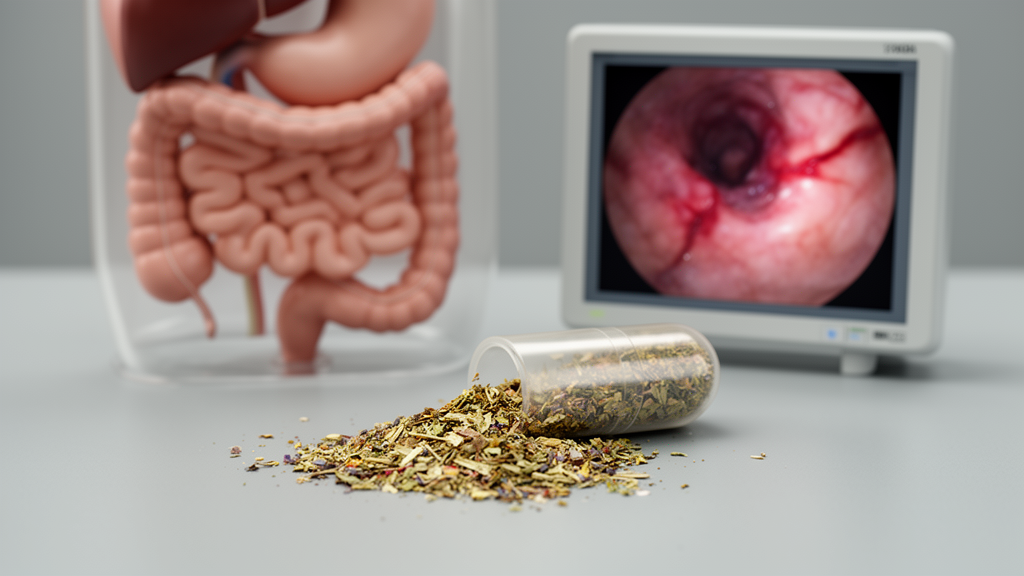
A five-material Chinese patent medicine formulated to release its contents in the colon has produced preliminary signals of benefit in ulcerative colitis, but a critical review concludes that the evidence is not yet strong enough to establish durable efficacy or broad safety. The product, described in the literature as five-flavor Sophora flavescens enteric-coated capsules, Wuwei Kushen, Fufangkushen colon-coated capsules or composite Sophora colon-soluble capsules, combines dried roots of Sophora flavescens and Sanguisorba officinalis with processed Indigo naturalis, the tuber of Bletilla striata, and the root and rhizome of Glycyrrhiza uralensis. The authors identify a coherent traditional treatment rationale, a colon-targeted dosage form and modern experimental evidence as the product’s strongest attributes, while inconsistent product identification and chemical characterization remain central weaknesses.
The review was published in Frontiers in Pharmacology on 22 October 2026. It is a critical narrative synthesis rather than a prospectively registered systematic review, and its authors searched PubMed, Web of Science, ScienceDirect, CNKI, Wanfang and reference lists through May 2026, followed by a targeted update through 18 August. They grouped evidence by experimental unit: complete-product studies, studies of individual ingredients or defined extracts, and adjacent research on related prescriptions, delivery systems or disease mechanisms. This hierarchy was designed to prevent findings about a purified compound or an authenticated plant material from being presented as proof that the complete capsule works. The review also had no duplicate independent screening, formal risk-of-bias instrument or new quantitative synthesis and therefore did not provide pooled effect estimates or grade certainty.
Within traditional Chinese medicine, ulcerative colitis has no exact one-to-one equivalent, but its symptoms overlap with categories such as dysentery, diarrhea and intestinal wind. The syndrome commonly called intestinal damp-heat describes frequent urgent stools containing mucus or blood, abdominal discomfort, tenesmus and a feeling of incomplete evacuation. The five materials are assigned complementary roles within that framework: Sophora flavescens is the principal heat-clearing and damp-drying ingredient; Sanguisorba officinalis is associated with cooling blood and reducing bleeding; Indigo naturalis is used for heat-clearing and blood-cooling functions; Bletilla striata contributes hemostatic and tissue-repair functions; and licorice is intended to harmonize the combination. These roles generate testable hypotheses, including whether control of bleeding is accompanied by reduced mucosal inflammation, rather than replacing biomedical diagnosis or established measures of disease severity.
The capsule is defined by both its ingredients and its pharmaceutical design. Its enteric coating is intended to protect the contents during passage through the upper gastrointestinal tract and increase delivery to the distal bowel. That design remains a formulation hypothesis rather than a demonstrated exposure profile. Active ulcerative colitis can alter transit and luminal pH, while fed conditions, proton-pump inhibitors, coating thickness and batch variability may also affect disintegration. The review therefore calls for sequential dissolution testing under gastric, small-intestinal and colonic conditions, stability data for intact capsules and, ideally, confirmation of release in humans. Measurements should extend beyond plasma because the relevant effects may arise from luminal action, mucosal exposure or systemic immune modulation. For a colon-targeted product, plasma concentration alone may underestimate mucosal exposure, while high systemic concentrations may be more relevant to toxicity.
Complete-formulation experiments offer more direct evidence than ingredient studies. In mouse models of chemically induced colitis, recognizable versions of the product have been associated with improvements in disease activity, colonic injury, inflammatory mediators, barrier proteins and microbial metabolites. More recent studies report a butyrate–GPR43–NCR-positive group 3 innate lymphoid cell axis, inhibition of NLRP3 inflammasome and STAT3-related signaling, changes in AGE-RAGE/NF-κB pathways, and ferroptosis-related endpoints. These findings connect microbial metabolism, epithelial integrity, inflammatory amplification and regulated cell death in biologically coherent ways. However, most experiments used small samples and acute disease models, administered treatment preventively or otherwise failed to reproduce clinical induction, and did not fully characterize the tested batches. Correlations between pathway markers and improved outcomes do not establish that each pathway is an independent target or causal mediator. Causal validation would require perturbations such as receptor antagonism, genetic manipulation, metabolite rescue or microbiota transfer.
Studies of individual ingredients broaden the biological plausibility while leaving the capsule’s effects unresolved. Matrine and oxymatrine have been associated in experimental systems with inflammatory signaling, oxidative stress, barrier protection and ferroptosis-related changes, and Sophora flavonoids have affected T-cell balance, epithelial pathways and microbial communities. Indigo naturalis, a processed source of indigoid compounds including indigo and indirubin, has shown short-term efficacy in a multicenter randomized trial involving people with active ulcerative colitis and may influence aryl hydrocarbon receptor pathways involved in mucosal defense. Sanguisorba extracts, Bletilla polysaccharides and licorice constituents have likewise produced supportive experimental findings. Yet these studies involve different doses, preparations, release profiles and safety conditions. Neither the presence of a compound in the capsule nor activity in a purified experimental system establishes that it reaches diseased tissue at a clinically relevant concentration or explains the complete product’s effect.
Clinical evidence comes mainly from older randomized studies. A multicenter single-blind trial reported efficacy for a composite Sophora colon-soluble capsule, and a later double-blind, double-dummy study involving 320 participants compared Fufangkushen colon-coated capsules with mesalazine over roughly eight weeks, finding broadly comparable short-term clinical and mucosal outcomes. Double-dummy masking is useful when dosage forms differ because it can help preserve participant and assessor blinding. However, a lack of a statistically significant difference does not prove equivalence unless an equivalence or noninferiority margin, adequate power, adherence, analysis population and confidence interval were specified in advance. The studies also had limited follow-up, older reporting standards and incomplete batch data. Meta-analyses reporting favorable “clinical effective rate” and traditional-pattern outcomes increase statistical precision but cannot remove small-study bias, selective publication, endpoint heterogeneity or uncertainty over whether different preparations were studied.
More recent clinical information remains provisional. A 2026 single-center cohort examined FSEC in combination with vedolizumab during induction and reported favorable week-14 clinical and endoscopic signals. Longer-term findings were sensitive to the analysis population, with a per-protocol signal not reproduced in the intention-to-treat analysis. Because treatment allocation was not randomized, baseline severity, clinician preference, affordability, prior response and adherence could have influenced the results; missing data could also have altered apparent durability. Such cohorts remain useful for feasibility, adherence, subgroup hypotheses and rare harms, but they cannot establish that FSEC adds benefit to biologic therapy. A prospective randomized add-on design would be needed to separate the capsule’s effect from concurrent treatment, regression to the mean and unequal follow-up.
Safety is particularly important because several ingredients carry recognizable hazards. Experimental matrine exposure has been linked to oxidative stress, mitochondrial apoptosis, disruption of Nrf2/GPX4 defenses, ferroptosis-related toxicity and altered cholesterol synthesis, although these findings cannot quantify clinical incidence in FSEC. Indigo naturalis has been associated with liver injury and pulmonary arterial hypertension, and ischemic colitis has also been reported during its use, a complication made difficult to recognize because worsening abdominal pain and bleeding can resemble an ulcerative colitis flare. Licorice metabolites can produce mineralocorticoid-like effects, including sodium retention, edema, hypertension, hypokalemia, metabolic alkalosis and arrhythmia. Risk may rise with prolonged use, older age, slow intestinal transit and exposure to other licorice products. Trials and pharmacovigilance should therefore document the exact product, batch, dose, duration, concomitant medicines and laboratory findings while actively monitoring liver chemistry, blood pressure, potassium, respiratory symptoms and cardiovascular events.
The review’s proposed next step is a linked chain from reproducible product to exposure, mechanism and clinical outcome. The first stage requires a reference dossier documenting botanical and processed-material identity, source, medicinal parts, preparation, excipients, quantitative multi-marker assays, chromatographic fingerprints, contaminants, stability and release performance. The same characterized batch should then be used for exposure studies, causal mechanism experiments and clinical assessment. A prospective multicenter randomized trial could evaluate clinical remission together with centrally read endoscopic improvement at week 8 or 12, with histology, fecal calprotectin, corticosteroid-free remission, quality of life, pharmacokinetics and safety as secondary outcomes. Maintenance follow-up would need to address relapse, hospitalization, colectomy and cumulative adverse events. Until such evidence is available, the review concludes that FSEC is a plausible and testable colon-targeted ethnopharmacological intervention, not a proven replacement for standard ulcerative colitis care.
Subject of Research: Evaluation of a five-material enteric-coated Chinese patent medicine for ulcerative colitis
Article Title: Five-flavor Sophora flavescens enteric-coated capsules for ulcerative colitis: ethnopharmacological rationale, pharmacology, clinical evidence, and safety
Article References: Ma, C., & Yang, C. (2026). Five-flavor Sophora flavescens enteric-coated capsules for ulcerative colitis: ethnopharmacological rationale, pharmacology, clinical evidence, and safety. Frontiers in Pharmacology, 17, 1972684. https://doi.org/10.3389/fphar.2026.1972684
Image Credits: AI Generated
DOI: 10.3389/fphar.2026.1972684
Keywords: ulcerative colitis, Sophora flavescens, Wuwei Kushen, Chinese patent medicine, ethnopharmacology, gut microbiome, colon-targeted delivery, clinical trials, drug safety, inflammatory signaling, Five-flavor, Sophora
News Source: Louis Brooks. (October 22, 2026). Review finds preliminary evidence for five-flavor ulcerative colitis capsule. Scienmag.