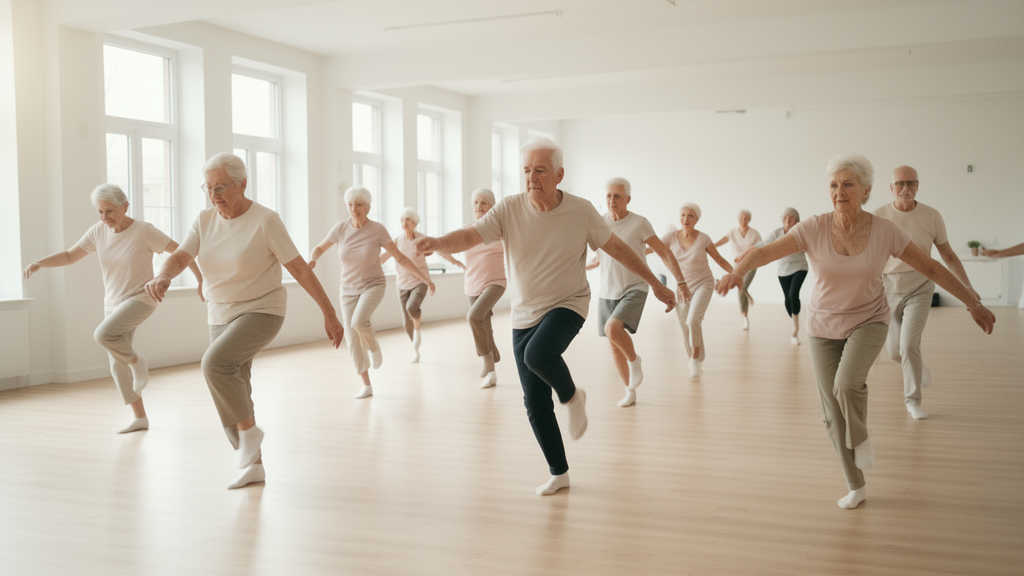
A comprehensive narrative review published in Frontiers in Psychiatry indicates that structured dance-based exercise functions as an integrated multidomain intervention that may strengthen executive cognitive performance, dynamic balance, and functional mobility in aging populations. Synthesizing international trial literature published through July 2026, researchers Ziqi Wei and Qiaofeng Wang from Xi‘an Peihua University evaluated how combining cardiovascular exertion with continuous motor learning, rhythmic synchronization, spatial navigation, and social interaction influences neurological resilience. Rather than isolating physical fitness or cognitive training into separate regimens, the authors examined how the simultaneous engagement of motor, sensory, affective, and social neural systems supports functional maintenance across later adulthood. The evidence indicates that dance training produces its most consistent behavioral adaptations in higher-order executive subdomains, including task-switching, mental flexibility, and attentional allocation, while consistently enhancing postural control and gait stability. However, the synthesis emphasizes that these cognitive and physical gains represent short-term functional adaptations rather than verified disease-modifying barriers against neurodegenerative progression, highlighting notable methodological heterogeneity and variable superiority over structured active exercise controls across published clinical investigations.
The theoretical framework guiding the investigation shifts away from traditional disease-avoidance paradigms toward an active model of brain resilience and functional compensation. Within modern geriatric neuroscience, healthy brain aging is defined not merely by the absence of diagnostic psychiatric or neurological pathologies, but by the continuous capacity of neural systems to adapt, reorganize, and preserve functional independence despite inevitable age-associated biological alterations such as cortical atrophy, reduced white matter integrity, and microvascular decline. Cognitive reserve serves as a foundational construct in this framework, describing the brain’s ability to optimize task performance and mitigate neuropathological burden through flexible recruitment of alternative or compensatory neural circuits. While lifelong educational attainment and occupational complexity have historically represented classical markers of reserve, the review argues that cognitively demanding, novel physical activities serve as dynamic late-life contributors to adaptive reserve networks. Because dance continually confronts participants with evolving choreographic patterns and environmental cues, it creates an ecologically valid environment where sensorimotor processing and executive regulation must operate in unison to maintain motor accuracy and behavioral coordination.
To evaluate the biological pathways underlying these observed adaptations, the authors established a structured three-tiered mechanistic classification that delineates direct empirical evidence from theoretical extrapolations. Directly demonstrated pathways comprise mechanisms empirically confirmed within targeted dance trials, specifically task-specific neuroplasticity, sensorimotor network integration, and modulated levels of brain-derived neurotrophic factor where directly assayed. The second tier encompasses extrapolated exercise cascades, incorporating well-documented physiological responses established in generic aerobic and resistance literature, such as AMP-activated protein kinase signaling, peroxisome proliferator-activated receptor gamma coactivator 1-alpha activation, mitochondrial biogenesis, reduced systemic inflammatory mediators including interleukin-6 and tumor necrosis factor-alpha, and hypothalamic-pituitary-adrenal axis regulation. The third tier covers systemic theoretical constructs, particularly long-term cognitive reserve accumulation, which represent overarching conceptual models rather than isolated physiological events. While physical movement generally enhances cerebral blood flow and peripheral metabolic signaling, dance uniquely recruits frontoparietal, frontostriatal, basal ganglia, and cerebellar circuits through ongoing real-time error correction, auditory-motor synchronization, and action sequencing, potentially stimulating activity-dependent synaptic remodeling across distributed associative networks.
Within the cognitive domain, randomized controlled trials demonstrate that dance training exerts its strongest and most reliable effects on executive functions rather than uniform improvements across broad cognitive screening batteries. In a representative 24-week trial involving 89 older adults aged over 70 years, participants assigned to dance-based cognitive-physical training achieved superior improvements in executive control and working memory compared with an active control group performing multicomponent physical exercise alone, with functional adaptations successfully maintained at a one-year follow-up. In contrast, trials evaluating less choreographically demanding regimens, such as a 12-week Zumba study in middle-aged women, observed improvements in postural control without measurable changes in reaction time or working memory. These selective outcomes demonstrate that executive networks are uniquely sensitive to tasks requiring constant cognitive-motor integration, while highlighting that cognitive gains are not guaranteed across all dance modalities or participant demographics.
A critical nuance identified in the synthesis is the distinction between within-group pre-to-post improvements and statistically verified between-group superiority over active physical comparators. In an active-control investigation comparing 12 weeks of Dance/Movement Training against structured aerobic cycling and treadmill exercise in 62 inactive older adults, dance participants exhibited significant cognitive gains alongside the aerobic group, despite achieving smaller increases in maximal oxygen uptake. This divergence demonstrates that cognitive adaptations following dance cannot be explained solely by cardiorespiratory fitness gains. Conversely, a 24-week trial involving 180 older adults aged 60 to 79 revealed that while social dance promoted enhanced white matter integrity in late-myelinating fiber tracts relative to active stretching, behavioral episodic memory gains did not achieve statistically significant superiority over brisk walking. Furthermore, researchers emphasize that improvements observed on standardized neuropsychological instruments reflect near-transfer effects within trained executive and attentional domains, cautioning that existing data remain insufficient to confirm far-transfer to unpracticed everyday cognitive activities or generalized protection against neuropathology.
Regarding physical capacity, postural stability, and mobility preservation, dance interventions consistently produce clinically meaningful improvements across diverse older adult cohorts. In an eight-week study of Turkish folkloric dance involving women aged 65 and older, participants exhibited marked gains in six-minute walking distance, chair-rise capacity, and physical quality of life compared with waitlist controls. Mechanistically, dance challenges anticipatory postural adjustments through continuous weight shifts, rapid multidirectional stepping, and rotational trunk movements that mirror real-world mobility challenges more closely than linear, repetitive exercises like stationary cycling. However, when compared directly against dedicated balance training or progressive resistance exercise, dance regimens frequently demonstrate equivalence rather than superior balance adaptations, and prospective evidence confirming direct reductions in actual fall incidence remains limited across the synthesized literature.
The review highlights particularly meaningful functional adaptations among clinically vulnerable cohorts, specifically individuals presenting with mild cognitive impairment, pre-frailty, or physical frailty. In a 12-week randomized trial examining 92 older adults with mild cognitive impairment, dance-based aerobic training yielded statistically significant improvements in Montreal Cognitive Assessment scores, verbal fluency, and executive task execution alongside significant reductions in composite clinical frailty scores relative to health education controls. A separate 12-week trial in 66 pre-frail and frail seniors similarly recorded reductions in Fried frailty phenotype indicators, documenting improvements in habitual gait speed, muscular weakness, and exhaustion. Because physical frailty and cognitive deterioration share interconnected biological drivers, including chronic low-grade inflammaging, impaired microvascular perfusion, and cellular metabolic failure, multidomain dance programs appear to intervene across both functional axes concurrently. Nevertheless, the authors caution that observed benefits in vulnerable cohorts reflect acute functional optimization and improved proxy measures rather than genuine clinical disease modification or altered long-term dementia trajectories.
Beyond motor and cognitive endpoints, the psychosocial and affective components of dance-based exercise provide distinct therapeutic avenues relevant to geriatric psychiatry and community health. Because dance is fundamentally structured as a collaborative, expressive, and partner- or group-oriented activity, it provides continuous opportunities for interpersonal communication, nonverbal attunement, and collective belonging. Controlled trials evaluating Turkish folklore dance and Indonesian Poco-poco dance combined with relaxation have demonstrated significant reductions in depressive symptoms and anxiety alongside gains in health-related quality of life. Furthermore, large observational analyses involving community-based collective practices, such as Guozhuang dance across 520 older adults, indicate that dance self-efficacy and shared group identity serve as crucial psychological mediators connecting participation frequency to subjective well-being. Enhanced self-efficacy has also been prospectively linked to higher class attendance and program satisfaction, suggesting that the inherently pleasurable and socially supportive nature of dance helps overcome common motivational barriers to long-term exercise adherence, even though quantitative trial findings specifically measuring loneliness remain mixed.
The clinical applicability of dance-based interventions extends to established neurodegenerative conditions, although outcomes vary substantially depending on pathological stage and primary functional deficits. In Parkinson’s disease, rhythmic auditory cueing, external guidance for movement, and repeated sensorimotor integration may support compensatory engagement of cortical motor pathways, thereby partially counteracting impaired basal ganglia function. Conversely, trials involving individuals diagnosed with advanced Alzheimer’s disease report modest gains restricted primarily to mood stabilization, social engagement, and basic activities of daily living, while objective cognitive performance rarely demonstrates marked recovery. These clinical patterns reinforce the conclusion that dance-based multidomain interventions yield their highest preventative utility during preclinical or prodromal phases, such as mild cognitive impairment, when neural plasticity and cognitive reserve mechanisms retain sufficient compensatory capacity to reorganize functional networks.
Despite the growing body of encouraging data, the review identifies critical methodological limitations and unresolved research gaps that currently constrain clinical translation and broad guideline development. Published intervention literature is characterized by widespread heterogeneity in choreographic complexity, training duration, weekly frequency, and participant baseline physical and cognitive status, preventing the establishment of a standardized, evidence-based intervention dose. Furthermore, existing studies rely heavily on small sample sizes, brief follow-up intervals ranging from 8 to 24 weeks, passive control groups, and subjective screening assessments susceptible to ceiling effects in healthy cohorts. The authors advocate for future rigorously controlled, longitudinal dismantling trials capable of isolating the specific contributions of cognitive complexity, musical rhythm, and social interaction from general physical exertion. Incorporating objective neuroimaging methodologies, such as functional near-infrared spectroscopy equipped with motion-artifact correction, alongside fluid biomarkers of neuroplasticity and neuroinflammation, will be essential to establish whether regular dance participation can tangibly alter biological brain aging trajectories or primarily serves as an enjoyable strategy for short-term functional enhancement.
Subject of Research: Multidomain dance-based exercise interventions and healthy brain aging mechanisms in older adults
Article Title: Dance-based exercise for healthy brain aging in older adults: integrating neuroplasticity, cognitive reserve, physical fitness, social engagement, and mental well-being
Article References: Wei, Z., & Wang, Q. (2026). Dance-based exercise for healthy brain aging in older adults: integrating neuroplasticity, cognitive reserve, physical fitness, social engagement, and mental well-being. Frontiers in Psychiatry, 17, Article 1944960. https://doi.org/10.3389/fpsyt.2026.1944960
Image Credits: AI Generated
DOI: 10.3389/fpsyt.2026.1944960
Keywords: dance-based exercise, healthy brain aging, executive function, cognitive reserve, neuroplasticity, postural balance, functional mobility, mild cognitive impairment, geriatric psychiatry, multidomain interventions, sensorimotor integration, frailty reduction, working memory, motor coordination, brain-derived neurotrophic factor, social connectedness, frontoparietal networks, geriatric health
News Source: Beatrice Stafford. (November 14, 2026). Review Finds Multidomain Dance Interventions Strengthen Executive Function and Balance in Aging. Scienmag.