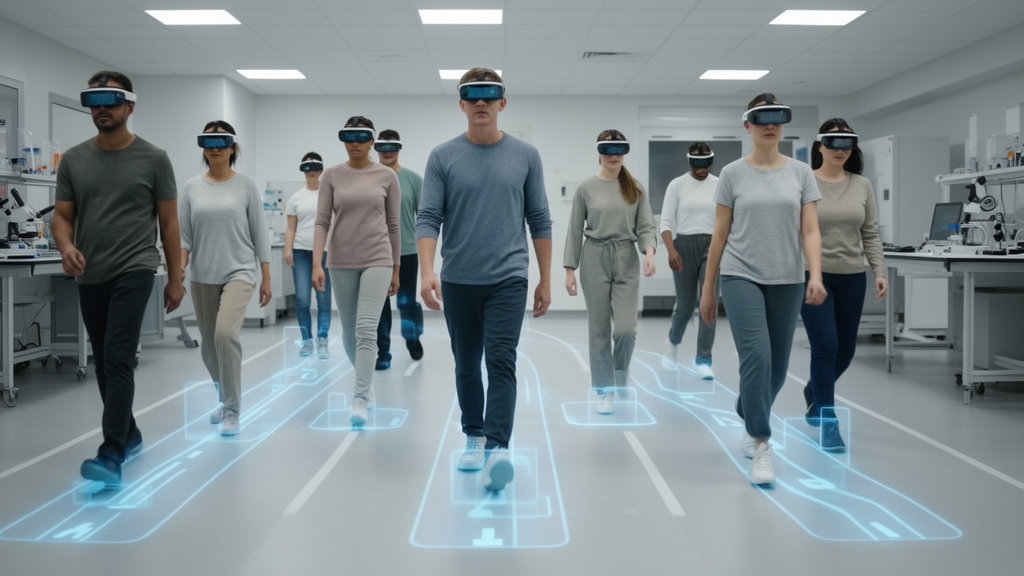
Clinical walking tests conducted in an augmented-reality environment demonstrated equivalent completion times to real-world assessments across healthy young and older adults, successfully meeting a predefined equivalence criterion of plus or minus 1.0 second for all evaluated tasks and conditions. The study, published in the Journal of NeuroEngineering and Rehabilitation by Flavie Le Rouzic and colleagues, evaluated the within-session intra-rater reliability and ecological validity of an instrumented walking test battery.
The researchers noted that while several clinical walking tests are routinely used to assess mobility and fall-related function in older adults, their clinimetric properties remain insufficiently documented across different task conditions and assessment environments. Although augmented-reality technology has been proposed to support standardized, instrumented mobility evaluations, its ecological validity when directly compared with physical real-world performance had remained unclear.
To examine these properties, the research team analyzed a cohort of 35 healthy young adults and 26 healthy older adults. Each participant completed four standard clinical walking assessments: a straight-walking test, the Figure-of-8 Walk, the Timed Up-and-Go test, and an obstacle-crossing evaluation. The full battery of tests was administered in both physical real-world and augmented-reality settings to allow direct comparisons between environments.
The assessments were performed under two distinct task demands: a baseline single-task condition and an arithmetic dual-task condition. The investigators used completion time as the primary outcome measure to assess within-session intra-rater reliability, agreement, and equivalence. Equivalence between the real-world and augmented-reality environments was evaluated using a predefined margin of plus or minus 1.0 second.
Across both physical and augmented-reality environments, completion times among young adults demonstrated moderate-to-excellent intra-rater reliability, with intraclass correlation coefficients ranging from 0.740 to 0.948 across the test battery. In addition, completion times in young adults met the predefined equivalence criterion between real-world and augmented-reality setups across all evaluated walking tasks and conditions.
Among older adults, single-task reliability was generally good-to-excellent, with the exception of obstacle crossing in augmented reality, which yielded an intraclass correlation coefficient of 0.719. Under arithmetic dual-task conditions, performance in older adults showed greater variability, particularly in augmented reality, where intraclass correlation coefficients ranged from 0.605 to 0.925. Despite this variability, all walking tests and task conditions in older adults met the predefined equivalence criterion between real-world and augmented-reality testing.
The authors concluded that augmented-reality walking assessments demonstrated favourable agreement with real-world performance across the evaluated tests, age groups, and task conditions. However, the researchers noted that dual-task performance variability in older adults may reflect both reliability limits and behavioral adaptive strategies, indicating that further validation is needed before augmented-reality walking tests can be used to inform clinical fall-risk assessments.
The investigation underscores how cognitive load influences assessment consistency when transitioning from physical testing to instrumented virtual environments. Although walking completion times across both age cohorts satisfied the predefined equivalence criterion, the divergence between single-task stability and dual-task variability highlights important clinimetric considerations. In older individuals, performing concurrent arithmetic operations during testing revealed potential reliability limits alongside participant adaptive strategies.
These findings provide valuable documentation regarding how instrumented environments capture functional mobility across diverse task conditions. Because intra-rater reliability proved more variable during dual-task walking in older adults, with lower reliability observed for some augmented-reality tests, the authors emphasize that further validation across varied assessment environments remains necessary before augmented-reality walking test batteries can reliably inform clinical fall-risk assessment.
Subject of Research: Augmented reality walking test reliability and validity in adults
Article Title: Augmented-reality-based walking test battery in young and older adults: intra-rater reliability and ecological validity
Article References: Le Rouzic, F., Lacroix, J., Ehrmann, A., Boujut, A., & Perrochon, A. (2026). Augmented-reality-based walking test battery in young and older adults: intra-rater reliability and ecological validity. Journal of NeuroEngineering and Rehabilitation. https://doi.org/10.1186/s12984-026-02169-2
Image Credits: AI Generated
DOI: 10.1186/s12984-026-02169-2
Keywords: augmented reality, walking tests, intra-rater reliability, ecological validity, older adults, young adults, Timed Up-and-Go, Figure-of-8 Walk, straight-walking, obstacle crossing, dual-task walking, single-task walking, completion time, intraclass correlation coefficient, fall-risk assessment, mobility assessment, Journal of NeuroEngineering and Rehabilitation
News Source: Ophelia Keating. (November 20, 2026). Augmented Reality Walking Tests Match Real-World Times Across Age Groups. Scienmag.