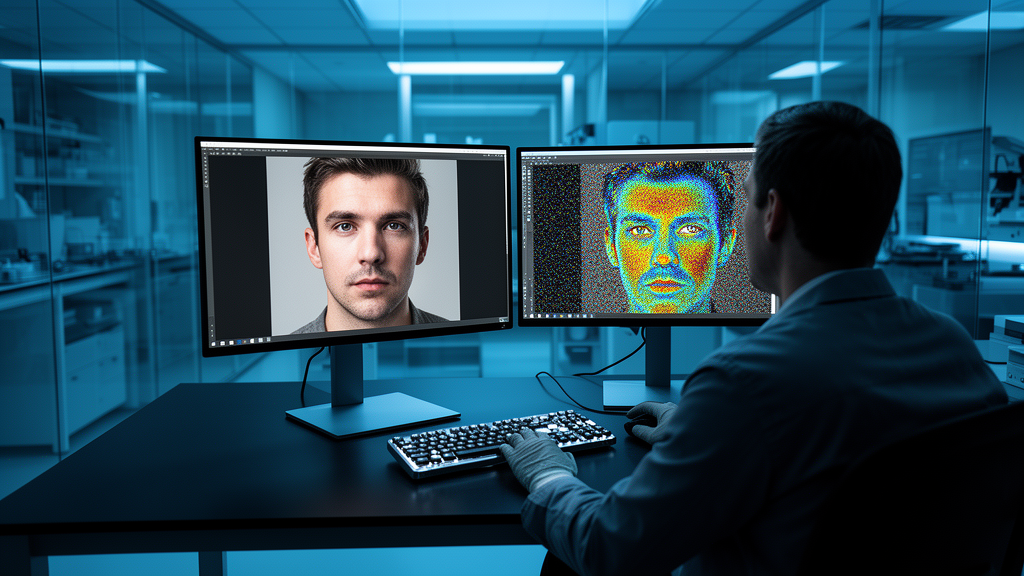
A systematic review of multimodal artificial intelligence systems designed to detect digital image manipulations reveals that integrating large language models with visual analysis frequently produces plausible yet fabricated explanations, severely limiting their reliability in forensic media verification. Researchers Thobeka Langa and Hein S. Venter conducted a comprehensive survey across major academic databases to evaluate the state of the art in image forgery detection using multimodal language models. Their analysis demonstrates that while these models extend natural language understanding and general reasoning to visual authenticity verification, existing implementations suffer from widespread hallucinations. In multimodal forgery detection, hallucinations occur when models generate textual verdicts, manipulation localizations, or forensic explanations that are unsupported by or inconsistent with the physical evidence contained within the evaluated image, fundamentally undermining trust in automated forensic workflows.
The proliferation of sophisticated digital editing software, deepfake architectures, and generative artificial intelligence tools has dramatically simplified the creation of highly realistic manipulated images, driving an urgent need for reliable verification technologies across journalism, biometric security, social media, and law enforcement. In response, artificial intelligence researchers have adapted multimodal large language models, including architectures such as GPT-4, Google Gemini, and Meta LLaMA2 equipped with visual encoders, to distinguish genuine images from deceptive manipulations. However, digital image tampering detection fundamentally differs from semantic object recognition: instead of analyzing high-level scene composition, forensic detection requires identifying subtle, low-level artifacts such as pixel inconsistencies, noise variations, and boundary anomalies left by splicing, copy-move actions, or generative synthesis. When general-purpose foundation models process these visual inputs, the semantic gap between low-level visual traces and high-level linguistic concepts frequently induces cross-modal inconsistencies that yield convincing but factually incorrect analytical outputs.
To rigorously investigate the current landscape, the authors executed a structured literature search spanning publications indexed between 2021 and 2025 across Elsevier, IEEE Xplore, Google Scholar, Springer, and ACM, supplemented by relevant digital repositories. Guided by PRISMA reporting standards, the search strategy incorporated three coordinated keyword clusters covering digital manipulation forensics, multimodal language models, and forensic analysis tasks. From an initial identification of forty-two database publications and three external records, six duplicates were removed. Subsequent screening of the remaining thirty-nine records led to the exclusion of eleven papers due to insufficient methodological detail, general survey designs, or misalignment with practical detection objectives. The screening process yielded nineteen core studies that proposed and evaluated concrete, practical solutions for multimodal language model-based image tamper detection, providing an empirical foundation for assessing technical design choices across the research community.
To structure their investigation, the researchers established a systematic taxonomy linking the four fundamental stages of the language model development lifecycle—data, training, model architecture, and inference—to the specific forensic tasks where model failures manifest. Within this taxonomy, the authors drew a strict formal distinction between classification errors and forensic hallucinations. Misclassification refers to predicting the wrong authenticity class, resulting in standard false positive or false negative determinations. In contrast, hallucination represents an epistemic failure in which the model generates unsupported or fabricated reasoning, pointing to nonexistent tampering traces or asserting ungrounded manipulation sources regardless of whether the final authenticity label is correct. Because an artificial intelligence system may output a correct classification based on entirely fabricated explanations, conventional accuracy metrics fail to measure forensic reliability, demanding rigorous verification against objective indicators such as pixel-level segmentation masks.
Analysis of the experimental data used across the nineteen evaluated studies revealed critical imbalances in dataset composition and preprocessing rigor. Forgery methods were categorized into traditional tampering—involving direct splicing, object removal, copy-move modifications, and manual editing—and sophisticated generation, encompassing deepfakes and algorithmic synthesis. The review found that sixty-nine percent of the evaluated articles concentrated on generative manipulations, whereas only thirty-one percent addressed traditional tampering methods, with merely five studies evaluating traditional operations. Furthermore, fifty-nine percent of the studies trained and evaluated models exclusively on human face images, leaving general imagery such as landscapes, everyday scenes, and physical objects represented in only forty-one percent of papers. Because facial structures offer predictable anatomical landmarks that facilitate anomaly detection, models struggle when applied to unstructured general imagery. The authors also noted that several models were trained solely on real images or exclusively on fake samples, introducing severe dataset bias that directly induces hallucinations when evaluating omitted classes.
Examining the training and architectural methodologies of the surveyed systems revealed significant technical divergences that impact detection efficacy. While all nineteen studies utilized pretrained language models, only twelve implemented task-specific fine-tuning on specialized forensic datasets, while seven queried baseline models directly without domain adaptation. Additionally, only three studies applied continual pre-training to expand the foundational forensic understanding of their models. Architecturally, thirteen studies introduced specialized framework innovations, integrating supplementary components to assist visual feature processing or applying structured prompt engineering strategies, such as few-shot and chain-of-thought prompting. However, four studies omitted essential ablation studies, preventing verification of their individual architectural contributions. Crucially, in benchmark comparisons against conventional deep learning methods, only five language model implementations consistently outperformed baseline forensic tools across all tested datasets, with specialized tools like FreDect and GramNet demonstrating superior precision in detecting algorithmic artifacts and genuine images on specific benchmarks.
Evaluation practices at the inference stage exhibited pronounced asymmetries across forensic subtasks, with researchers overwhelmingly prioritizing binary classification over explainable reasoning. Authenticity detection was implemented and evaluated in seventeen of the nineteen studies, representing eighty-nine point five percent of the corpus and confirming its dominance as the primary benchmark objective. Explainability was incorporated in eighteen studies, representing ninety-four point seven percent, yet only seven studies formally evaluated the accuracy and factual fidelity of the generated explanations. Manipulation localization was implemented in ten studies and evaluated in seven, whereas forgery attribution remained the least examined task, implemented in seven studies and evaluated in only three. Furthermore, eight studies generated explanatory text without providing visual localization coordinates, disconnecting textual narratives from localized pixel evidence. Only five studies implemented an integrated pipeline combining detection, localization, explainability, and attribution, while robustness testing against common distortions like compression or adversarial attacks was virtually absent, addressed by only one paper.
Synthesizing these findings, the review identified thirteen explicit research gaps spanning the multimodal pipeline: insufficient data diversity, lack of rigorous data preprocessing, pervasive class imbalance bias, insufficient domain customization, uneven evaluation of forensic reasoning outputs, inadequate grounding between visual cues and linguistic reasoning, lack of integrated multi-task pipelines, poor performance in standalone unaugmented models, absence of confidence-versus-uncertainty metrics, limited attribution traceability, minimal robustness evaluations against perturbations, variable accuracy across challenging datasets, and the complete absence of standardized forensic evaluation benchmarks. To overcome these deficiencies, the authors proposed thirteen coordinated technical solutions prioritized sequentially across the lifecycle: foundational data enhancement, rigorous fine-tuning, specialized model architecture integration, and optimized inference decoding. The authors concluded that addressing these structural gaps through hybrid architectures combining specialized forensic feature extractors with multimodal language models represents the most viable path toward achieving reliable, hallucination-resistant media verification.
The technical challenge of multimodal forgery detection stems from a fundamental representational divide between visual and linguistic processing. Language modeling evolved through four distinct historical stages: statistical language models, neural language models, pretrained language models, and large language models. These architectures estimate the generative probability of word sequences to emulate human communication and general reasoning. When researchers extend these systems into computer vision, an architectural discrepancy arises: image encoders capture low-level forensic cues such as noise patterns and pixel-level inconsistencies, while language models interpret high-level semantic concepts. Without specialized alignment across data preparation, model architecture, and inference mechanisms, this cross-modal gap prevents models from accurately associating subtle visual artifacts with their linguistic interpretations, directly producing fabricated rationales.
To bridge this gap, the review highlights the potential of hybrid architectures that integrate specialized deep learning models with multimodal language models. In conventional digital forensics, specialized deep learning tools successfully detect manipulation-specific visual cues. Recent investigations have demonstrated the effectiveness of mixture-of-experts frameworks utilizing parameter-efficient adaptation for facial forgery detection, as well as parameter-efficient methods that improve generalization against unseen deepfake techniques. Other specialized forensic frameworks combine semantic-level and noise-level features to localize tampered regions or exploit pixel inconsistencies to identify manipulations. By coupling these specialized feature extractors with multimodal models, hybrid systems can leverage fine-grained visual traces while retaining the high-level semantic reasoning and natural language explanation capabilities of large language models.
The authors also established a clear operational hierarchy among the four developmental components, arguing that their influence on model reliability is sequential and cumulative. Data serves as the primary foundation because models cannot learn to detect realistic forgeries without exposure to balanced, high-quality training sets. Training and task-specific fine-tuning follow directly, providing the essential learning processes needed to extract meaningful patterns from that data. In contrast, architectural innovations cannot compensate for poor data or deficient training, while inference optimizations primarily enhance execution speed and operational usability rather than core detection accuracy. Stronger data improves training, stronger training unlocks model capacity, stronger architectures extract finer details, and stronger inference maximizes performance. The authors noted that direct benchmark comparisons across the reviewed studies were precluded by disparate datasets, forgery types, and metrics, reinforcing the need for standardized evaluation benchmarks.
Subject of Research: Systematic review of multimodal large language models in digital image forgery detection and hallucination mitigation
Article Title: State of the art in image forgery detection using large language models to identify gaps for improving accuracy and reducing hallucinations
Article References: Langa, T., & Venter, H. S. (2026). State of the art in image forgery detection using large language models to identify gaps for improving accuracy and reducing hallucinations. Discover Artificial Intelligence, 6(1), Article 1918. https://doi.org/10.1007/s44163-026-02174-3
Image Credits: AI Generated
DOI: 10.1007/s44163-026-02174-3
Keywords: Image Forgery Detection, Multimodal LLMs, Digital Forensics, Hallucination Mitigation, Deepfake Detection, Image Tampering, AI Explainability, Computer Vision, Visual Evidence Grounding, Forensic Localization, Image Attribution, Machine Learning Security, Cross-Modal Alignment, Artificial Intelligence, Benchmark Evaluation, Model Robustness
News Source: Blake Davidson. (November 19, 2026). Review Finds Language Models Detecting Image Forgeries Face Pervasive Hallucination Challenges. Scienmag.