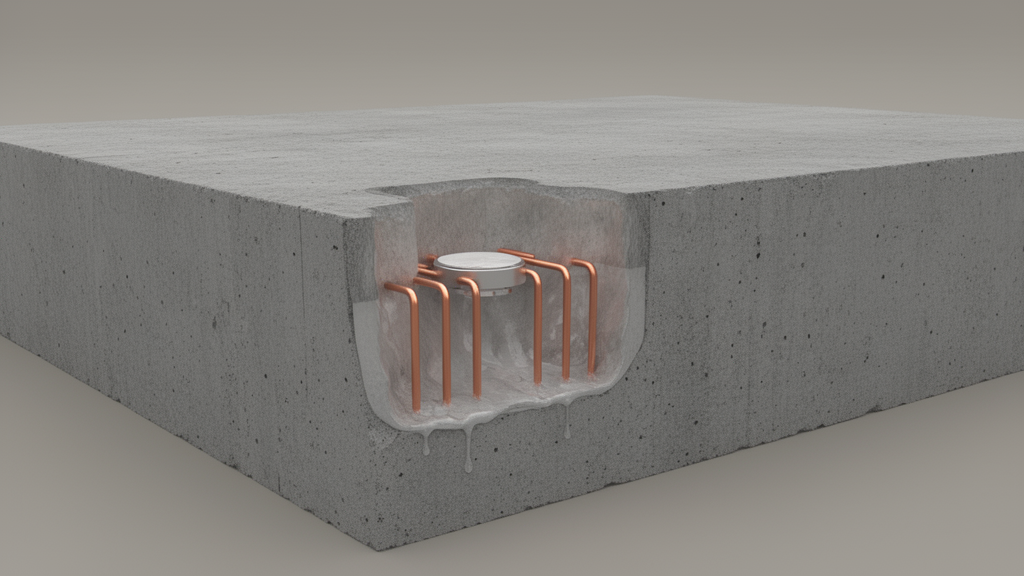
During mass concrete construction, the critical stage of lift-surface treatment requires freshly placed material to remain exposed to ambient weather for roughly ten hours while crews repair surface defects, remove heavy machinery, and position formal curing equipment. According to a laboratory investigation published by researchers Wenbin Xu, Yitong Huang, Qingbin Li, Juan Wang, Wenqiang Xu, and Deyong Hu, this initial window of unsealed exposure to variable ambient temperature, humidity, and airflow can trigger significant moisture loss that permanently stunts later-age compressive strength development. Structural failures such as the extensive through-cracks observed across more than seventy-seven meters of the overflow dam section at the Xiaorongjiang Water Conservancy Project have previously underscored the severe consequences of thermal and environmental exposure at lift surfaces. To address the challenge of evaluating this early damage nondestructively, the research team developed and tested a theoretical dielectric constant-strength prediction framework capable of tracking moisture variations and estimating subsequent strength progression under coupled environmental conditions.
The underlying mechanism of concrete hardening centers on the chemical hydration reactions between mixing water and clinker compounds, predominantly tricalcium silicate, dicalcium silicate, tricalcium aluminate, and tetracalcium aluminoferrite. As these mineral phases react with water, they produce solid binding agents, principally calcium silicate hydrate gel, which progressively bind aggregate particles together and fill the capillary void space within the paste. Under normal circumstances, the total initial mixing water partitions into four distinct physical and chemical forms over the course of curing: chemically bound water consumed directly in forming hydration products, physically adsorbed water held in a monomolecular layer along the surfaces of newly generated cementitious solids, free water residing inside capillary pores available to sustain ongoing hydration, and evaporated water lost across open boundary surfaces into the atmosphere. When severe ambient exposure draws free moisture out of the surface zone before hydration can mature, the deficit of reactant water halts gel formation and impairs mechanical performance.
To capture these complex water dynamics without destructive sampling, the authors established a multi-stage analytical model connecting the rate of cementitious gel generation to measurable dielectric properties. In the theoretical derivation, post-placement history was segmented into three operational periods: Stage I, representing initial placement and compaction where hydration is negligible and strength is treated as zero; Stage II, representing the ten-hour unsealed lift-surface exposure period subject to evaporation; and Stage III, representing subsequent curing where specimens are covered to suppress moisture loss. By establishing that the quantity of physically adsorbed water scales with the mass of generated hydration products and applying an established average proportionality coefficient, the mathematical formulation isolated the relationship between water consumption, cumulative evaporation, and residual free water. Crucially, intermediate empirical proportionality coefficients were eliminated algebraically, yielding a model where the later-age strength index directly correlates with the volumetric free-water index and inversely mirrors the evaporated-water volume index accumulated by the conclusion of the initial exposure stage.
Because free capillary water cannot be monitored directly on active construction sites using routine gravimetric or oven-drying techniques without disrupting the material, the investigators incorporated waveform-digitizing time-domain reflectometry as an indirect sensing method. Time-domain reflectometry relies on measuring the apparent dielectric constant of the bulk material, an electrical property governed predominantly by the volume of unbound, highly polar water molecules present within the pore network. Using experimental calibrations on fresh mixtures with water contents ranging between 59.60 and 145.06 kilograms per cubic meter, the authors observed that dielectric permittivity followed a strong quadratic distribution across the broad moisture regime with determination coefficients exceeding 0.99 for five, ten, and fifteen centimeter sensor probes. Within the intermediate water-content band of 70 to 140 kilograms per cubic meter, the relationship exhibited an approximate linear response with an upper-limit dielectric constant of 11.82, permitting the direct substitution of dielectric readings into the analytical strength equations.
The experimental campaign tested standard 150-millimeter cubic specimens cast from ordinary Portland cement concrete with a fixed water-to-cement ratio of 0.55, incorporating 197.45 kilograms of water, 359 kilograms of cement, 608 kilograms of sand, and 1216 kilograms of gravel coarse aggregate per cubic meter. The research team evaluated five discrete curing regimes during the simulated ten-hour Stage II exposure window inside a precision environmental control chamber: Group A1 served as the baseline control held at 20 degrees Celsius and near-saturated 100 percent relative humidity under calm conditions; Group A2 lowered the temperature to 5 degrees Celsius at saturated humidity; Group A3 raised the temperature to 35 degrees Celsius at saturated humidity; Group A4 reduced relative humidity to 60 percent at 20 degrees Celsius without wind; and Group A5 combined 20 degrees Celsius and 60 percent relative humidity with a forced wind speed of 6 meters per second generated by a variable-speed ducted fan.
Gravimetric measurements taken during the ten-hour exposure confirmed that the combination of unsaturated air and moving wind drastically escalated surface drying rates. Under the calm, 60 percent relative humidity environment of Group A4, specimen evaporation began at 20.8 grams in the opening hour before dropping to 5.80 grams per hour by the seventh hour, culminating in a cumulative ten-hour moisture loss of 77.8 grams. Introducing a six-meter-per-second wind in Group A5 heightened initial one-hour evaporation to 27.6 grams and drove total cumulative water loss over ten hours to 141 grams, representing a 1.81-fold increase over the windless unsaturated condition. Complementary low-field nuclear magnetic resonance testing performed on cylindrical companion specimens tracking the transverse relaxation time spectrum corroborated these trends, showing that the free-water volume index plummeted from roughly 0.976 to 0.368 under windy unsaturated exposure, starving the hydrating paste of essential reactant water.
Mechanical testing conducted in accordance with Chinese hydraulic concrete standards up to fourteen days of subsequent film-covered curing demonstrated that moisture loss incurred during the initial ten hours caused permanent strength deficits. Under saturated humidity, specimens displayed continuous, rapid compressive strength development, with elevated temperatures accelerating early crystal growth. Conversely, under unsaturated exposure, strength growth remained severely depressed even after specimens were sealed under polyethylene film and cured at 20 degrees Celsius and over 95 percent relative humidity. By day fourteen, the unsealed calm group attained a compressive strength of only 22.5 megapascals, while the windy unsaturated specimens exhibited the lowest overall strength values across all test ages. Overall, adverse environmental conditions restricted to the initial ten-hour lift-surface treatment stage produced an irreversible reduction of approximately 10 to 24 percent in fourteen-day compressive strength compared to saturated baseline controls.
Multiphase thermodynamic and kinetic simulations carried out on the CemGEMS platform using the Hydration-PK model and Cemdata18 thermodynamic databases provided microscopic insight into the observed mechanical divergence. Accounting for effective initial water contents after deducting early evaporation losses, the chemical simulations tracked the time-dependent consumption of unhydrated clinker minerals alongside the accumulation of solid hydration products over one thousand hours. Under saturated moisture, the continuous supply of pore water enabled substantial reactant consumption, leaving residual reactant masses near 42 to 43 grams and supporting product masses up to 190 grams. In contrast, under windy unsaturated exposure, rapid drying truncated chemical dissolution and precipitation pathways, leaving product accumulation substantially below control levels and directly matching the stunted macroscopic strength gains recorded on the physical testing frame.
Fitting the empirical dataset to the derived dielectric constant-strength expression revealed strong linear correlations across the experimental groups within the calibrated moisture boundaries. For the saturated humidity groups where the cumulative evaporated-water index equaled zero, the fitted trajectories shared identical slopes and intercepts, whereas higher evaporation indices under unsaturated conditions produced flatter fitted slopes reflecting diminished strength gain per unit increase in dielectric response. In evaluating the empirical model exponent governing product bonding efficiency, the literature baseline value of unity delivered the best agreement for saturated conditions with a coefficient of determination of 0.825, while yielding determination coefficients of 0.983 and 0.917 for the unsaturated calm and windy conditions, respectively. Normalizing the experimental results across all five environmental exposure regimes allowed the authors to establish a unified dimensionless mathematical equation linking the strength index, the initial evaporation index, and the measured dielectric constant.
The authors explicitly emphasized several structural and experimental limitations regarding the current state of the model. All empirical parameters were calibrated from a single concrete proportioning system using small 150-millimeter cube specimens, which exhibit vastly different thermal mass, heat of hydration retention, moisture diffusion lengths, and internal restraint compared to full-scale mass concrete dams. Furthermore, the entire laboratory dataset was utilized to calibrate model coefficients and assess in-sample goodness of fit, meaning the formulation currently lacks predictive validation against an entirely independent experimental or field dataset. Re-evaluating digitized data points indicated that extrapolating dielectric values beyond the quadratic upper calibration boundary of 13.68 increased mean absolute errors by roughly 70 percent, prompting the authors to designate this threshold as a strict boundary for quantitative prediction. Consequently, the proposed workflow serves as an exploratory research concept for monitoring site-cast companion specimens, requiring comprehensive recalibration and large-scale validation before direct implementation in field quality control.
Subject of Research: Dielectric monitoring and strength modeling of concrete under early surface exposure
Article Title: A dielectric constant-strength model based on the moisture variation mechanism of concrete under initial surface exposure
Article References: Xu, W., Huang, Y., Li, Q., Wang, J., Xu, W., & Hu, D. (2026). A dielectric constant-strength model based on the moisture variation mechanism of concrete under initial surface exposure. Case Studies in Construction Materials, 25, Article e06729. https://doi.org/10.1016/j.cscm.2026.e06729
Image Credits: AI Generated
DOI: 10.1016/j.cscm.2026.e06729
Keywords: concrete curing, mass concrete, dielectric constant, time-domain reflectometry, compressive strength, moisture evaporation, lift-surface treatment, hydration kinetics, cement hydration, nondestructive testing, nuclear magnetic resonance, water-cement ratio, pore structure, shrinkage cracking, companion specimens, construction materials, multiphase modeling, CemGEMS simulation
News Source: Denise Maddox. (November 19, 2026). Dielectric Sensor Model Tracks Moisture Loss to Predict Concrete Strength During Curing. Scienmag.