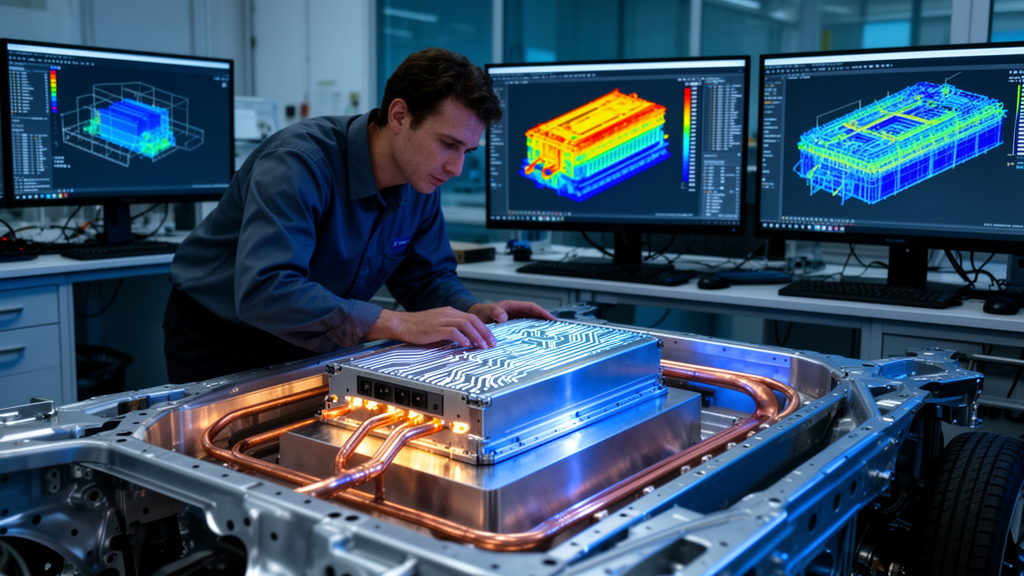
Researchers Sunil Kumar Gupta and Basudha Dewan have published a system-level review in Discover Applied Sciences analyzing computational modeling and simulation techniques for electric vehicle electronic and energy systems. The authors emphasize that developing high-efficiency, reliable, and high-performance electronic and energy subsystems is essential to support the rapid growth of electric vehicles as a major solution for sustainable transportation.
The review examines how computational modeling and simulation tools support the analysis, design, and optimization of critical electric vehicle subsystems. These focus areas include battery energy storage systems, power electronic converters, semiconductor devices, electric drives, and vehicle-level energy management architectures.
The authors review the fundamental principles of multiple modeling approaches, including electrochemical, electro-thermal, electromagnetic, multiphysics, and multiscale modeling. According to the study, these methods enable researchers to predict system behavior, operating efficiency, component degradation, thermal stability, and overall reliability under realistic operating conditions.
To accelerate performance prediction and optimization, the review discusses numerical methods such as finite element analysis, finite volume methods, and finite difference methods. These conventional numerical approaches are increasingly integrated with data-based and machine learning-assisted simulation techniques to deliver fast and reliable simulation results.
The review also highlights emerging industry trends, specifically the adoption of wide-bandgap semiconductor devices, advanced control techniques, and integrated simulation platforms. The authors note that employing these technologies aims to enhance operational efficiency while achieving sizeable reductions in electric vehicle development costs.
Alongside these technological opportunities, the study highlights persistent challenges, including scalability issues, model accuracy constraints, computational complexity, and difficulties in experimental verification. To address these barriers, the authors point to emerging research directions such as digital twins, real-time simulations, and artificial intelligence-based predictive modeling to advance future electric vehicle technologies.
The review is published in Discover Applied Sciences, an open access journal, and is currently available as an early sharing version. This status indicates that the article has undergone peer review and is citable with a permanent DOI, though it remains subject to further edits before the final Version of Record is released.
Subject of Research: Computational modeling and simulation techniques for electric vehicle electronic and energy systems
Article Title: A system-level review of computational modeling and simulation techniques for EV electronic and energy systems
Article References: Gupta, S. K., & Dewan, B. (2026). A system-level review of computational modeling and simulation techniques for EV electronic and energy systems. Discover Applied Sciences. https://doi.org/10.1007/s42452-026-09565-2
Image Credits: AI Generated
DOI: 10.1007/s42452-026-09565-2
Keywords: electric vehicles, computational modeling, simulation techniques, battery energy storage systems, power electronic converters, semiconductor devices, electric drives, energy management systems, electrochemical modeling, electro-thermal modeling, multiphysics modeling, multiscale modeling, finite element analysis, finite volume method, finite difference method, wide-bandgap semiconductors, digital twins, real-time simulation
News Source: Faith Mcneil. (November 12, 2026). Review Examines Computational Modeling and Simulation for Electric Vehicle Electronic Systems. Scienmag.