Ciliates, a group of single-celled ciliated eukaryotes, have been studied since the dawn of light microscopy, with over 10,000 species described. Cilia are the key feature of ciliates and contribute to their diversity. They vary in length, covering the cell surface or specific parts, or can bundle to form cirri. Staining cilia and basal bodies is a common procedure in ciliate morphology research, using techniques like silver impregnation and immunofluorescence staining with antibodies associated with tubulin.
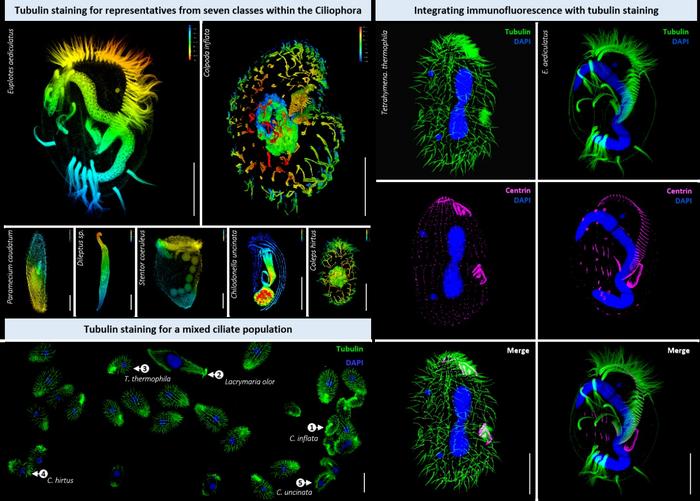
Credit: Tingting Pan, et al.,
Ciliates, a group of single-celled ciliated eukaryotes, have been studied since the dawn of light microscopy, with over 10,000 species described. Cilia are the key feature of ciliates and contribute to their diversity. They vary in length, covering the cell surface or specific parts, or can bundle to form cirri. Staining cilia and basal bodies is a common procedure in ciliate morphology research, using techniques like silver impregnation and immunofluorescence staining with antibodies associated with tubulin.
Live-cell tubulin dyes, commonly used in human cells, require cell permeabilization reagents to enter the cells. However, these reagents are ineffective in ciliates. In ciliate cells, the dyes are usually ingested through phagocytosis and end up in membrane-enclosed organelles, posing a challenge in delivering the dyes.
In a study published in the KeAi journal Water Biology and Security, a team of researchers from China developed a straightforward and adaptable method for tubulin/cilia staining that yields excellent results in ciliates.
“Our method entails utilizing live-cell tubulin dyes to stain fixed ciliate cells, presenting a highly efficient and practical option for ciliate research,” shares lead author Tingting Pan. “Moreover, it allows for seamless integration immunofluorescence staining with antibodies when required.”
This new tubulin-staining method offers the ciliate research community four significant advantages. (1) It boosts cell biology studies in ciliates, particularly in cytoskeleton research, as tubulin cytoskeletons are prevalent in these organisms; (2) It simplifies the staining process, benefiting morphology and taxonomy studies and making it accessible to most ciliate taxonomy laboratorie;. (3) When combined with confocal microscopy, the method allows for detailed exploration of basal body patterns — crucial taxonomic features — using only a few cells and bypassing the complexities of traditional silver impregnation methods; and (4) Ecological studies of ciliates stand to benefit from this method.
“The method flexibility enables the staining of mixed cell populations from aquatic environments, post-enrichment using a plankton net,” adds Pan. “As high-throughput fluorescence imaging advances, our staining method could seamlessly integrate with machine learning-based classification systems due to its capacity to images with clear backgrounds.”
###
Contact the author:Wei Miao([email protected]), Chuanqi Jiang([email protected])
Affiliation: Institute of Hydrobiology, Chinese Academy of Sciences
The publisher KeAi was established by Elsevier and China Science Publishing & Media Ltd to unfold quality research globally. In 2013, our focus shifted to open access publishing. We now proudly publish more than 100 world-class, open access, English language journals, spanning all scientific disciplines. Many of these are titles we publish in partnership with prestigious societies and academic institutions, such as the National Natural Science Foundation of China (NSFC).
Journal
Water Biology and Security
DOI
10.1016/j.watbs.2024.100274
Method of Research
Experimental study
Subject of Research
Cells
Article Title
An improved method for tubulin staining of ciliated eukaryotes
COI Statement
The authors declare no conflict of interest