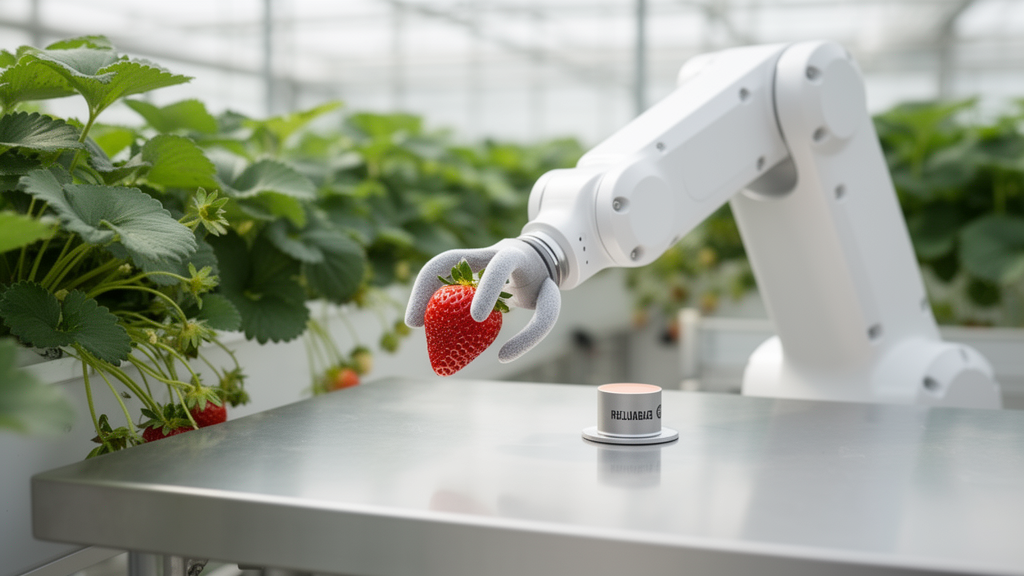
Robotic agriculture has advanced rapidly over the past two decades, with autonomous systems now capable of detecting, grasping, and harvesting delicate crops with increasing precision. Strawberry harvesting, however, remains a particularly challenging benchmark for these machines due to the fruit’s fragility and the complex geometry of the plant. While commercial prototypes and research units have demonstrated significant progress in field conditions, the broader development of these technologies has been hindered by a persistent lack of standardized, reusable testing environments. This bottleneck makes it difficult for engineers to validate new algorithms and mechanical designs without incurring high costs and generating significant crop waste. A new study published in Communications Engineering addresses this critical gap by introducing a reusable artificial strawberry stem made from hot melt adhesives, offering a practical solution for standardized harvesting tests.
The primary obstacle in developing robotic harvesters is the need for large sample sizes to ensure statistical significance in performance metrics. Traditional testing methods require fresh produce, which is expensive, perishable, and limited by seasonal availability and field access. Each test cycle consumes a portion of the crop, meaning that extensive validation requires substantial agricultural resources. Furthermore, the variability inherent in biological tissues complicates the isolation of specific mechanical variables, making it difficult to determine whether a failure in harvesting is due to the robot’s mechanics or the natural inconsistency of the plant material. This lack of a consistent testbed slows down the iterative design process, keeping many promising robotic solutions in the laboratory phase.
The research team, comprising scientists from institutions in Mexico, the United Kingdom, and Italy, proposed a surrogate material that mimics the mechanical behavior of a real strawberry stem. They selected hot melt adhesives (HMAs) for this purpose, a class of thermoplastic materials known for their ease of fabrication and consistent mechanical properties. By using HMAs, the researchers created a stem that can be repeatedly cut, healed, and detached without losing its structural integrity. This reusability allows for thousands of test cycles on a single unit, drastically reducing the cost and waste associated with traditional biological testing. The artificial stem serves as a controlled medium where variables such as stiffness and diameter can be precisely managed.
A key technical challenge in creating a biological surrogate is matching the stiffness of the natural tissue. The study found that HMA does not fully match the natural stiffness of a strawberry stem at the same diameter. However, the researchers demonstrated that by increasing the diameter of the artificial stem by a factor of 2.0 to 3.0 times that of a real stem, the static behavior could be closely reproduced. This scaling approach allows the artificial stem to exhibit similar deflection and curvature under load, which are critical factors in how a robotic gripper interacts with the plant. The team measured curvature errors between 3.39% and 11.01% of the stem length using normalized root mean square deviation, confirming a close agreement with the biological counterparts despite the material difference.
Healing behavior is another crucial aspect of the reusable stem’s functionality. In a real harvesting scenario, the stem is severed, and the plant continues to grow or remain intact in the field. For a testbed to be useful, the artificial stem must be able to recover its structural strength after being cut. The researchers analyzed this by evaluating the consistency of the cutting force required to sever the stem and the peak tensile load required to detach it across repeated cycles. The results showed that the HMA stems maintained their mechanical properties over multiple use cycles, ensuring that the test conditions remained consistent throughout the validation process. This consistency is vital for comparing different robotic algorithms and mechanical designs under identical conditions.
Fabrication repeatability was also a significant focus of the study. To ensure that the testbed could be deployed in multiple laboratories without requiring specialized custom manufacturing, the team assessed the variability of peak cutting force across independently fabricated stems from the same mold. The findings indicated that the manufacturing process was robust enough to produce stems with consistent mechanical characteristics. This standardization is essential for creating a shared benchmark in the field of agricultural robotics, allowing researchers from different institutions to compare their results with confidence. The use of a mold-based fabrication method also keeps the cost of producing these test stems low, making the technology accessible to a wider range of research groups.
The implications of this reusable stem extend beyond simple cost savings. By providing a realistic and repeatable crop testbed, the technology facilitates the development of more reliable autonomous harvesting systems. Engineers can now test edge cases, such as stems with varying orientations or occlusions, without the logistical constraints of field access. This accelerated development cycle could lead to faster commercialization of robotic harvesters, which are increasingly needed to address labor shortages in the agricultural sector. The ability to validate systems in a controlled environment also reduces the risk of damaging actual crops during the testing phase, preserving the integrity of the agricultural supply chain.
The study highlights the importance of interdisciplinary collaboration in solving complex agricultural challenges. The team included experts from mechanical engineering, agronomy, and robotics, reflecting the multifaceted nature of the problem. The funding for this work was provided by the Innovate UK-funded project Agri-OpenCore, underscoring the strategic importance of open-core technologies in advancing smart agriculture. The authors, including Juan Pablo Espejel, Leonardo Guevara, Srikishan Vayakkattil, Luis Soriano, Carlos Juárez-Balderas, Daniel A. Perez-DeLaMora, and Marcello Calisti, have made the data and supplementary materials available to the scientific community, promoting transparency and reproducibility.
As agricultural robotics continues to evolve, the need for standardized testing protocols will only grow. The introduction of a reusable, low-cost, and realistic crop testbed represents a significant step forward in this domain. By addressing the limitations of biological testing, this technology paves the way for more rigorous and efficient development of robotic harvesters. The findings suggest that surrogate materials can be effectively used to mimic biological tissues for mechanical testing, opening up new avenues for research in other agricultural applications. This work not only advances the specific field of strawberry harvesting but also contributes to the broader goal of making agriculture more sustainable and efficient through the application of advanced robotics and materials science.
Subject of Research: Development of a reusable artificial strawberry stem for robotic harvesting validation
Article Title: A reusable strawberry stem based on hot melt adhesives for robotic harvesting applications
Article References: Espejel, J. P., Guevara, L., Vayakkattil, S., Soriano, L., Juárez-Balderas, C., Perez-DeLaMora, D. A., & Calisti, M. (2026). A reusable strawberry stem based on hot melt adhesives for robotic harvesting applications. Communications Engineering. https://doi.org/10.1038/s44172-026-00804-3
Image Credits: AI Generated
DOI: 10.1038/s44172-026-00804-3
Keywords: agricultural robotics, strawberry harvesting, hot melt adhesives, crop testbed, mechanical engineering, autonomous systems, smart agriculture, materials science, reusable, strawberry, stem, based
News Source: Denise Maddox. (October 18, 2026). Reusable Adhesive Stems Solve Robotic Strawberry Harvesting Testbed Gap. Scienmag.