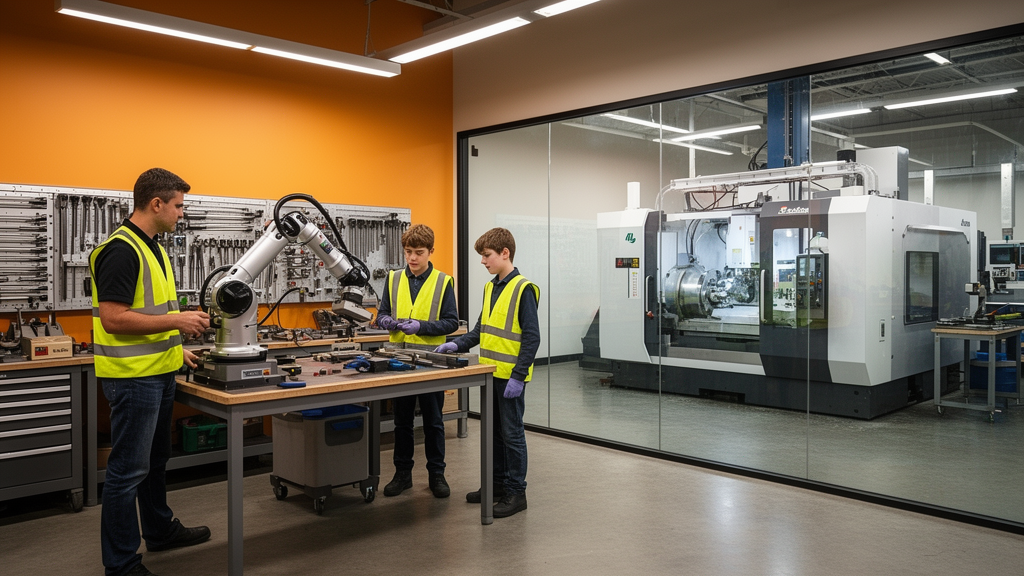
One of the most stubborn problems in modern economies is that industry moves faster than education. New technologies and occupations emerge continuously, while vocational schools need years to design programs, adjust curricula, and train graduates. The result is a persistent structural mismatch between the skills students acquire and the skills employers actually need. A new study published in Discover Artificial Intelligence proposes a computational answer to this coordination problem: a Multi-Agent Co-Evolution Algorithm, or MACEA, that models enterprises, schools, and students as autonomous agents evolving together in a synthetic labor market.
The study, authored by Mingyan Chen of the Faculty of Education at Beijing Normal University, does not attempt to predict real-world employment outcomes. Instead, it functions as a mechanism simulation, a stress test of different coordination rules under identical conditions. The central question is whether joint, local adjustment by all three parties can outperform static planning, centralized optimization, and unilateral adaptation, particularly when the system is hit by sudden shocks to industrial skill demand.
MACEA’s architecture rests on three heterogeneous agent types. Enterprise agents carry job categories, skill requirement vectors, planned recruitment numbers, salary levels, and a technology evolution rate. Their fitness function balances the skill fit of hired talent against recruitment and salary costs. School agents hold program offerings, curriculum vectors, enrollment quotas, and faculty quality, and their fitness combines graduate employment rates, reputation change, and education investment efficiency. Student agents, the most heterogeneous group, are defined by interest vectors, acquired skills, employment status, and wage expectations, with personal utility built from salary satisfaction, skill-job matching, and cosine similarity between interests and job features.
The co-evolutionary cycle itself is a closed loop of evaluation, matching, adjustment, and update. In each iteration, the platform computes all agents’ fitness in parallel and performs a delayed acceptance matching of students to positions, a mechanism borrowed from stable matching theory that guarantees no unmatched student-firm pair would prefer each other over current matches. Agents whose fitness falls below a group-specific threshold, defined as the population mean minus one standard deviation, are flagged for strategy revision. Enterprises raise wages when recruitment completion lags; schools expand or shrink enrollment based on employment rate differentials; students redirect skill learning and temper wage expectations. All skill variables are constrained to a range of 0 to 1, and school enrollment cannot exceed 120 percent of initial capacity.
The simulation environment comprised 50 enterprise agents, 10 school agents, and 1,000 student agents, each configuration subjected to 30 independent runs under uniform initial conditions and identical random seeds. At round 100, a uniform external shock raised skill requirements in 3 of 10 skill dimensions by 30 percent, calibrated against the historical maximum monthly fluctuation range of China’s Manufacturing Purchasing Managers’ Index between 2018 and 2023. After the shock, agents could only adjust based on market conditions observed in the next round, with no foresight.
The headline result is striking. MACEA achieved an overall matching degree of 0.82 plus or minus 0.03, significantly outperforming the Static Matching Model at 0.48 plus or minus 0.05, the Genetic Algorithm-Based Global Optimization Model at 0.71 plus or minus 0.04, and the Decentralized Adaptive Baseline at 0.67 plus or minus 0.04, with all differences significant at p less than 0.001. MACEA stabilized after approximately 78 rounds, compared with 125 for the centralized genetic model and 82 for the adaptive baseline, while the static model never met the stability criterion within 200 rounds.
Recovery from the external shock revealed the mechanism’s resilience most vividly. MACEA’s overall fit dropped from 0.82 to 0.75, recovered to 0.82 by round 110, and reached 0.84 by round 115. The genetic model needed until round 130 to regain 0.71, and the static model until round 150 to return to 0.48. The long-term mismatch rate, tracking students unmatched for five consecutive rounds, fell from 35.1 percent to 4.5 percent after 80 rounds under MACEA, compared with 12.4 percent for the genetic model and 31.8 percent for the static model by round 200.
Ablation experiments confirmed that the advantage is emergent rather than mechanical. Disabling student adjustment reduced the matching coefficient from 0.82 to 0.69; disabling firm and school adjustments reduced it to 0.71 and 0.73 respectively. Crucially, a control retaining all three adjustment mechanisms but randomly swapping market signals among same-type entities produced only 0.63, demonstrating that the correspondence between signals and agent states, not merely the number of adjustable agents, drives performance. Sensitivity analysis across fitness weights, agent scales up to 100 enterprises, 20 schools, and 2,000 students, and shock intensities up to 0.50 kept overall fit between 0.78 and 0.84, a maximum variation of roughly 4.9 percent.
The study is explicit about its limits. The environment uses parameterized synthetic data rather than a real micro-survey of 50 enterprises, 10 schools, and 1,000 students from a specific region, and the author cautions that results reflect computational performance of coordination mechanisms, not empirical validation of real-world policy effects. Real hiring records, program catalogs, graduate tracking, and student surveys would need to be standardized through a unified occupation-major-skill coding system before behavioral parameters could be re-estimated. Yet as a proof of mechanism, the work offers a compelling vision: a labor market in which enterprises, schools, and students continuously co-evolve, each responding to observable signals, could in principle keep vocational education in step with an industry that never stands still.
Subject of Research: Application of multi-agent co-evolution algorithm in dynamic matching system between vocational education and industrial demand
Article Title: Application of multi-agent co-evolution algorithm in dynamic matching system between vocational education and industrial demand
Article References: Chen, M. (2026). Application of multi-agent co-evolution algorithm in dynamic matching system between vocational education and industrial demand. Discover Artificial Intelligence, 6(1), Article 1541. https://doi.org/10.1007/s44163-026-02450-2
Image Credits: AI Generated
DOI: 10.1007/s44163-026-02450-2
Keywords: Application, multi-agent, co-evolution, algorithm, dynamic, matching, system, between, vocational, education, industrial, demand
News Source: Denise Maddox. (October 18, 2026). Co-evolving agents could keep vocational training in step with industry. Scienmag.