• HOME
  • NEWS
  • EXPLORE
    • CAREER
      • Companies
      • Jobs
    • EVENTS
    • iGEM
      • News
      • Team
    • PHOTOS
    • VIDEO
    • WIKI
  • BLOG
  • COMMUNITY
    • FACEBOOK
    • INSTAGRAM
    • TWITTER
Saturday, February 7, 2026
BIOENGINEER.ORG
No Result
View All Result
  • Login
  • HOME
  • NEWS
  • EXPLORE
    • CAREER
      • Companies
      • Jobs
        • Lecturer
        • PhD Studentship
        • Postdoc
        • Research Assistant
    • EVENTS
    • iGEM
      • News
      • Team
    • PHOTOS
    • VIDEO
    • WIKI
  • BLOG
  • COMMUNITY
    • FACEBOOK
    • INSTAGRAM
    • TWITTER
  • HOME
  • NEWS
  • EXPLORE
    • CAREER
      • Companies
      • Jobs
        • Lecturer
        • PhD Studentship
        • Postdoc
        • Research Assistant
    • EVENTS
    • iGEM
      • News
      • Team
    • PHOTOS
    • VIDEO
    • WIKI
  • BLOG
  • COMMUNITY
    • FACEBOOK
    • INSTAGRAM
    • TWITTER
No Result
View All Result
Bioengineer.org
No Result
View All Result
Home NEWS Science News Chemistry

Rethinking how cholesterol is integrated into cells

Bioengineer by Bioengineer
September 20, 2019
in Chemistry
Reading Time: 2 mins read
0
IMAGE
Share on FacebookShare on TwitterShare on LinkedinShare on RedditShare on Telegram

IMAGE

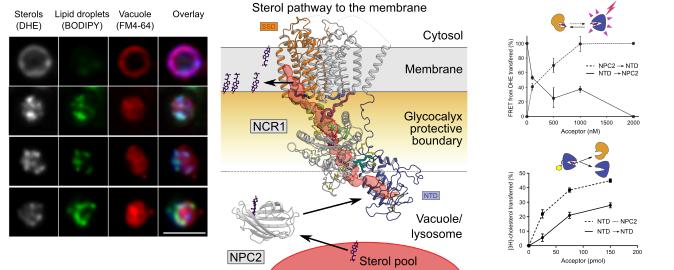
Credit: Bjørn Panyella Pedersen, Aarhus University

Most people have heard of “cholesterol levels” and the dangers of high blood cholesterol, which is one of the main causes of cardiovascular disease. But besides the harmful side effects of high cholesterol, cholesterol is an essential component of all cells and fundamental to a host of important functions of the body. Hormones like estrogen and testosterone are made from cholesterol, for example.

It has been known for a long time that cholesterol is transported around the body in the blood as small particles consisting of fat and protein. In the body’s cells, these particles are broken down and cholesterol is released and integrated as part of the cell. Although this process is essential, not just for humans, but for all animals and plants, surprisingly little is known about how cholesterol is actually incorporated into the cells after the breakdown of these particles.

In recent years, interest in how cholesterol is integrated and incorporated – and not least how this process is regulated – has grown tremendously. This is partly due the huge pharmaceutical potential in regulating this process, as shown with blockbuster drugs such as Zetia, which regulate cholesterol uptake from food. In addition, it has been shown that many viruses, including Ebola, uses the same process to infect cells.

During the past five years, researchers from Aarhus University have collaborated with researchers from the University of Southern Denmark and the University of Leeds to investigate how cholesterol is incorporated into cells, using biophysical and structural biological methods. The results have led to a groundbreaking insight into the process and to a new model for how cholesterol is integrated and incorporated that fundamentally changes our prior understanding of the process.

The results have just been published in the world leading journal Cell.

###

“Structural insight into eukaryotic sterol transport through Niemann-Pick type C proteins”

Mikael B. L. Winkler, Rune T. Kidmose, Maria Szomek, Katja Thaysen, Shaun Rawson, Stephen P. Muench, Daniel Wüstner, Bjørn Panyella Pedersen.

Cell (2019), https://doi.org/10.1016/j.cell.2019.08.038

Media Contact
Bjørn Panyella Pedersen
[email protected]

Original Source

http://mbg.au.dk/en/news-and-events/news-item/artikel/rethinking-how-cholesterol-is-integrated-and-incorporated-into-cells/

Related Journal Article

http://dx.doi.org/10.1016/j.cell.2019.08.038

Tags: BiochemistryBiologyBiotechnologyCell BiologyGeneticsMicrobiologyMolecular Biology
Share14Tweet9Share3ShareShareShare2

Related Posts

blank

Breakthrough in Environmental Cleanup: Scientists Develop Solar-Activated Biochar for Faster Remediation

February 7, 2026
blank

Cutting Costs: Making Hydrogen Fuel Cells More Affordable

February 6, 2026

Scientists Develop Hand-Held “Levitating” Time Crystals

February 6, 2026

Observing a Key Green-Energy Catalyst Dissolve Atom by Atom

February 6, 2026
Please login to join discussion

POPULAR NEWS

  • Robotic Ureteral Reconstruction: A Novel Approach

    Robotic Ureteral Reconstruction: A Novel Approach

    82 shares
    Share 33 Tweet 21
  • Digital Privacy: Health Data Control in Incarceration

    63 shares
    Share 25 Tweet 16
  • Study Reveals Lipid Accumulation in ME/CFS Cells

    57 shares
    Share 23 Tweet 14
  • Breakthrough in RNA Research Accelerates Medical Innovations Timeline

    53 shares
    Share 21 Tweet 13

About

We bring you the latest biotechnology news from best research centers and universities around the world. Check our website.

Follow us

Recent News

Succinate Receptor 1 Limits Blood Cell Formation, Leukemia

Palmitoylation of Tfr1 Drives Platelet Ferroptosis and Exacerbates Liver Damage in Heat Stroke

Oxygen-Enhanced Dual-Section Microneedle Patch Improves Drug Delivery and Boosts Photodynamic and Anti-Inflammatory Treatment for Psoriasis

Subscribe to Blog via Email

Enter your email address to subscribe to this blog and receive notifications of new posts by email.

Join 73 other subscribers
  • Contact Us

Bioengineer.org © Copyright 2023 All Rights Reserved.

Welcome Back!

Login to your account below

Forgotten Password?

Retrieve your password

Please enter your username or email address to reset your password.

Log In
No Result
View All Result
  • Homepages
    • Home Page 1
    • Home Page 2
  • News
  • National
  • Business
  • Health
  • Lifestyle
  • Science

Bioengineer.org © Copyright 2023 All Rights Reserved.