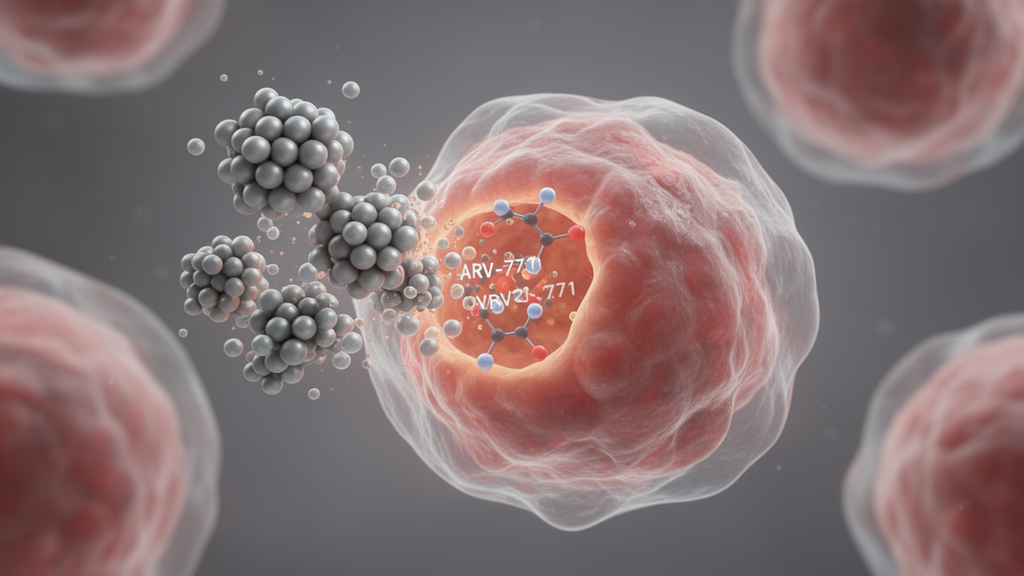
A hyaluronic acid-modified, glutathione-responsive nanoparticle system delivered the proteolysis targeting chimera ARV-771 into tumor cells, where the carrier broke apart and released the drug, enabling degradation of the target protein BRD4. The work is presented as a proof-of-concept nanocarrier for improving the targetability and controlled release of a PROTAC therapeutic.
The researchers developed a degradable dendritic mesoporous organosilicone nanoparticle system and assembled it with ARV-771 and hyaluronic acid in a stepwise process. The resulting nanocomplex was designated DMONs-NH2@ARV-771@HA. Its organosilicone core served as the carrier for ARV-771, while the hyaluronic acid modification provided a means of directing the complex toward tumor cells.
According to the study abstract, the hyaluronic acid-modified nanoparticles transported cargo into tumor cells through CD44 receptor-mediated endocytosis. The authors described this as a specific and efficient route for cellular delivery. The result connected the carrier’s surface modification with targeted uptake, although the supplied evidence does not provide comparative uptake measurements or the performance of an uncoated formulation.
Payload release was designed around the cellular reducing environment. Glutathione reacted with the nanoparticle framework through a redox response, causing the DMONs-NH2 carrier to break up and release ARV-771 controllably. This response was intended to couple carrier disassembly with the cellular environment rather than relying on a mechanism that does not respond to glutathione.
Released ARV-771 was associated with degradation of BRD4 and selective action within tumor cells in the proof-of-concept experiments. The reported findings therefore link three stages of the platform: hyaluronic acid-mediated targeting, glutathione-responsive carrier disassembly and release of the PROTAC, and degradation of its target protein. The abstract does not quantify the extent of BRD4 degradation or establish whether the carrier improved efficacy relative to a standard delivery method.
The broader motivation for the work was the set of limitations associated with PROTAC delivery: unfavorable aqueous solubility, limited cell-membrane permeability, poor tissue selectivity and adverse side effects. The nanoparticle system was constructed to address these issues through targeted transport and responsive release. It did not independently demonstrate improved clinical safety or efficacy, and the reported results should not be interpreted as evidence of benefit in people.
Research on this platform remains at an early proof-of-concept stage. The supplied article summary reports delivery into tumor cells, carrier breakup following interaction with glutathione, ARV-771 release and BRD4 degradation, but it does not describe animal testing, human participants, dosing, toxicity measurements or long-term outcomes. The evidence consequently supports the behavior of the carrier in the reported experimental setting rather than its use as a clinical treatment.
By combining a hyaluronic acid targeting layer with a glutathione-responsive degradable organosilicone carrier, the researchers devised a two-function delivery system for ARV-771. The design uses cellular uptake to bring a PROTAC into tumor cells and intracellular redox conditions to trigger release. Whether this approach can improve PROTAC delivery in more complete biological models or overcome the broader limitations of PROTAC therapeutics remains unestablished in the supplied evidence.
Subject of Research: A responsive nanoparticle carrier for targeted delivery of the PROTAC ARV-771
Article Title: Hyaluronic acid-modified and glutathione-responsive degradable dendritic mesoporous organosilicone nanoparticles for augmenting targetability and degradation potency of PROTAC
Article References: Huang, L., Jiang, L., Li, W., Qin, G., Zhang, J., Wang, Y., Tang, Z., & Wang, Y. (2026). Hyaluronic acid-modified and glutathione-responsive degradable dendritic mesoporous organosilicone nanoparticles for augmenting targetability and degradation potency of PROTAC. Journal of Nanoparticle Research, 28(11), Article 275. https://doi.org/10.1007/s11051-026-06796-7
Image Credits: AI Generated
DOI: 10.1007/s11051-026-06796-7
Keywords: PROTAC, ARV-771, nanoparticle delivery, hyaluronic acid, CD44, glutathione response, BRD4 degradation, organosilicone, tumor targeting, Hyaluronic, acid-modified, glutathione-responsive
News Source: Nathaniel Bowman. (October 20, 2026). Responsive nanoparticles deliver ARV-771 to tumor cells. Scienmag.