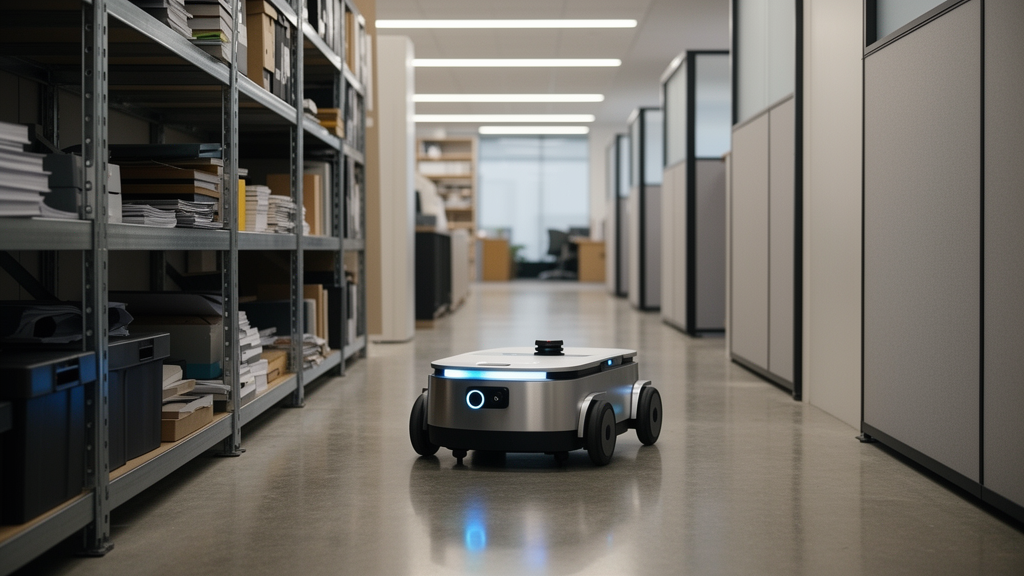
Autonomous mobile robots frequently stall when navigating tightly constrained indoor environments, where narrow corridors and moving obstacles shrink the feasible motion space until local controllers trigger repetitive recovery behaviors. To address these stalling events, researchers developed MSTR-PPO, a multi-scale temporal residual controller designed to mitigate freezing failures while operating within standard robotic control architectures.
The study attributes local freezing to three distinct operational mechanisms and introduces dedicated modules to target each failure mode. An insufficient path horizon is paired with a Multi-Scale Path Transformer, motion ambiguity arising from single-frame sensory input is addressed through a First-Order Temporal High-Pass Filter, and unstable learned velocity commands are stabilized using a Bounded Residual Action mechanism.
Rather than adopting an unconstrained end-to-end policy, the MSTR-PPO architecture learns a bounded correction around a nominal Pure Pursuit action. This structural constraint enables the system to integrate directly into existing sensor-path-velocity-command interfaces without replacing classical motion control pipelines.
The researchers evaluated eight learned local-control configurations alongside three classical baseline systems across nine Gazebo simulation environments featuring dynamic obstacles. Each learned controller variant was trained using three independent random seeds, and the resulting policies were implemented as C++ controllers within the ROS 2 Nav2 navigation framework.
In simulation trials, MSTR-PPO navigated both designated freeze-prone test environments with essentially no stack-level recovery interventions, whereas the best default-parameter classical baseline failed to do so. Across the primary seven-world evaluation suite, the controller achieved an average success rate of 92.1 ± 1.3 percent—the highest among all evaluated learned variants—while sustaining real-time control frequencies on a central processing unit.
Stress testing highlighted an operational limitation when the system encountered continuous-curvature navigation paths. A preliminary Unitree Go2 test transfers successfully at the same interface.
Beyond proposing the architectural components, the authors provide empirical evidence directly linking each module to its corresponding operational failure mode.
Subject of Research: Robotic local navigation in freeze-prone indoor environments
Article Title: MSTR-PPO: A Multi-Scale Temporal Residual PPO Controller for Freeze-Prone Indoor Navigation
Article References: Chen, J., Kou, Y., Che, W., Ning, Y., Qin, X., Zheng, J., & Yang, M. (2026). MSTR-PPO: A Multi-Scale Temporal Residual PPO Controller for Freeze-Prone Indoor Navigation. Journal of Intelligent & Robotic Systems. https://doi.org/10.1007/s10846-026-02468-9
Image Credits: AI Generated
DOI: 10.1007/s10846-026-02468-9
Keywords: MSTR-PPO, robot navigation, local control, indoor navigation, Pure Pursuit, residual reinforcement learning, Multi-Scale Path Transformer, temporal high-pass filter, Bounded Residual Action, ROS 2 Nav2, Gazebo simulation, dynamic obstacles, recovery behaviors, Unitree Go2, continuous-curvature paths, motion ambiguity
News Source: Denise Maddox. (November 18, 2026). Residual Navigation Controller Reduces Robot Freezing Failures in Constrained Indoor Environments. Scienmag.