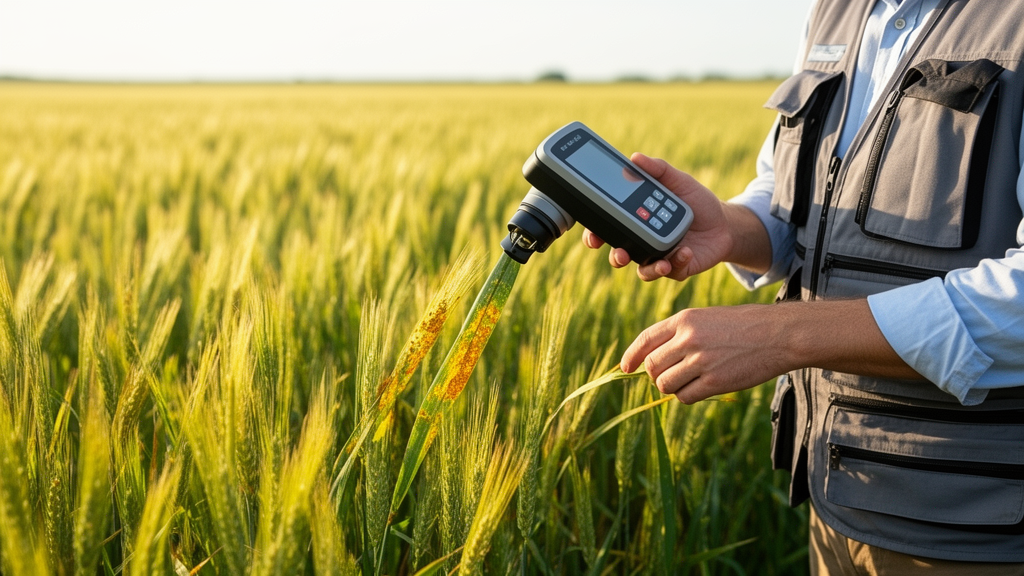
A new research study has introduced a hybrid deep learning framework, dubbed HYRNet, designed to classify the severity of yellow rust disease in wheat crops across four distinct progression stages: healthy, early, middle, and advanced. Yellow rust, caused by the fungus Puccinia striiformis, poses a significant threat to global food security, potentially damaging over 50 percent of crop yields in established infestations. While traditional methods of identifying the disease rely on the subjective expertise of plant pathologists surveying vast fields, the introduction of automated, scalable diagnostic tools has become a critical priority. The researchers behind HYRNet developed a pipeline that fuses a MobileNetV2 convolutional neural network (CNN) backbone for local feature extraction with a convolutional block attention mechanism (CBAM) and a vision transformer (ViT) branch for global contextual reasoning. This design specifically aims to provide fine-grained, stage-aware severity classification rather than the binary healthy-versus-infected identification commonly found in existing agricultural machine learning literature.
The study utilized the publicly available YellowRust-19 dataset, which contains 15,000 RGB images of wheat leaves, as the primary gold standard. The team restructured this dataset to align with the progression stages defined by agronomists and the Cobb’s scale of disease severity, creating four classes. During the training phase, the model employed a class-imbalance-aware strategy, utilizing balanced class-weighted cross-entropy loss along with label smoothing and a two-phase curriculum of frozen and unfrozen backbone layers. The researchers allocated 12,000 images for training and 3,000 images for testing, ensuring no overlap existed between the two sets to provide an accurate reflection of the algorithm’s generalization capabilities.
The architecture of the proposed model integrates three distinct components to leverage both local texture features and global spatial relationships. The MobileNetV2 backbone is used for initial local feature extraction, while the CBAM module facilitates spatial and channel-wise attention, allowing the model to focus on pustule regions rather than background noise. Simultaneously, a vision transformer branch operates in parallel, processing the input images in non-overlapping 16 by 16 patches to capture long-range dependencies across the entire leaf surface. This hybrid pipeline ensures that the model retains the computational efficiency of MobileNetV2 while adding the necessary representational capacity to distinguish between subtle disease stages. The final classification head, which follows the concatenated output of the CNN and ViT branches, uses a softmax output layer to generate the four-class probabilities.
Performance results on the modified YellowRust-19 dataset indicated an overall testing accuracy of 93.13 percent, with macro F1-scores and weighted F1-scores reaching 0.93. The confusion matrix analysis revealed that the model maintained high specificity across all severity levels, with the healthy class achieving the highest precision and sensitivity. While the advanced stage achieved a recall of 90 percent, some misclassifications occurred between the middle and advanced stages, reflecting the subtle visual differences inherent in the gradual progression of yellow rust. Statistical robustness was further confirmed through 5-fold cross-validation and bootstrap resampling with 1,000 iterations, which produced a mean accuracy of 92.62 percent with a 95 percent confidence interval between 91.68 percent and 93.47 percent.
To evaluate the model’s efficiency, the researchers analyzed computational complexity and inference latency. The hybrid design resulted in approximately 3.14 million parameters, representing a 21.5 percent increase over the baseline MobileNetV2 model. Despite this, the computational cost, measured in GFLOPs per image, rose by only 4.9 percent, from 0.327 to 0.343. The inference latency increased from 4.40 milliseconds to 5.49 milliseconds per image, yielding a throughput of 182 images per second. The authors concluded that the marginal increase in computational burden was well-justified by the improved performance metrics and the architecture’s suitability for edge-deployment scenarios, where network connectivity and hardware resources are typically limited.
A critical component of the research involved validating the model on an independent real-world dataset. The team tested the algorithm against 87 wheat field images collected across Punjab, India, between January 2024 and February 2026. These images, scored by experts from Punjab Agricultural University, included various real-world environmental factors such as background noise from soil and non-leaf structures. Upon evaluation, the model recorded an accuracy of 37.78 percent on these field-collected samples. The application of test-time augmentation (TTA) marginally improved this validation accuracy to 38.53 percent. This significant performance drop highlights the substantial domain shift between controlled lab-based image datasets and the variable conditions encountered in real agricultural settings.
To gain further insights into the model’s internal decision-making process, the researchers employed explainable AI techniques, specifically Grad-CAM visualizations. These heatmaps demonstrated that the model correctly focused on infected leaf regions rather than background noise. A quantitative analysis of these heatmaps revealed that the model exhibited the strongest focus, or activation energy, on the healthy class, followed by the advanced stage, both of which contain distinct visual characteristics. Conversely, the early and middle stages demonstrated lower activation energy, which aligns with the biological reality that early-stage symptoms are often subtle and can be easily confused with other forms of plant stress. The findings showed a positive correlation between the model’s spatial precision and its confidence, ruling out the possibility that high-confidence predictions were merely based on irrelevant image features.
The study underscored that the primary challenge for early disease detection does not necessarily lie in the learned representations of deep learning models, but rather in the visual complexity and environmental variability inherent in uncontrolled field data. The researchers noted that while hybrid models improve feature representation, future advancements will require larger, more diverse datasets that specifically incorporate varied sunlight, camera angles, and real-time weather conditions typical of commercial farming environments. Improving the validation accuracy will likely require further fine-tuning of baseline model layers and potentially incorporating more feature-specific techniques to improve discriminative power in the early infection stages.
In conclusion, the research provides a novel approach to yellow rust classification by moving beyond binary healthy-versus-infected frameworks toward a stage-aware scoring system that reflects the practical needs of plant pathologists and farmers. The development of an efficient, hybrid deep learning pipeline demonstrates that it is possible to balance representational capacity with computational constraints suitable for deployment on edge devices. While the performance gap between controlled laboratory datasets and real-world field conditions remains a significant hurdle, this study establishes a foundational benchmark for future agricultural monitoring systems. The findings pave the way for the integration of such models into broader agricultural management networks involving UAV- or rover-based imaging, sensor technologies, and geospatial mapping to support the early identification of fungal infestations.
Beyond algorithmic design, the investigation addressed specific epidemiological conditions associated with yellow rust spread. Conducive environments, specifically cool and humid climates with temperatures between 5 and 23 degrees Celsius, facilitate the airborne transmission of fungal spores from mountain foothills to plains, contributing to global wheat yield losses estimated at 5.47 million metric tons annually. To align classification with agronomic standards, the authors adapted Cobb’s scale by merging resistant and moderately resistant categories into an early-stage designation. Model training was conducted on a hardware setup featuring a 40-gigabyte GPU, 90 gigabytes of RAM, and 15 CPU cores. The training pipeline incorporated horizontal and vertical flips, color jitter, and contrast adjustments while leaving the test partition unaugmented. Unfreezing the final 30 layers of the MobileNetV2 backbone improved training accuracy by 5 to 6 percent, with early stopping concluding execution at epoch 22 after validation loss reached an optimal minimum of 0.5224 at epoch 17.
An ablation analysis across 15 epochs systematically isolated the specific contributions of each architectural component. Baseline MobileNetV2 established an initial benchmark accuracy of 91.83 percent. Integrating the convolutional block attention module provided the single largest performance gain, raising accuracy to 93.60 percent and demonstrating the critical importance of localized feature attention on leaf surfaces. In contrast, adding the vision transformer branch alone yielded 91.93 percent accuracy, showing that global context without attention guidance is insufficient. Although the integrated HYRNet reached 92.97 percent during this fixed window, it achieved more balanced performance across all four disease progression stages rather than overfitting to specific patterns. Furthermore, all four variants completed training within roughly 165 to 170 seconds, demonstrating that the added attention and transformer modules incur negligible training overhead.
Model stability was further verified through five-fold cross-validation and paired t-tests against the baseline architecture. HYRNet achieved a mean cross-validation accuracy of 93.23 percent and a mean Cohen’s kappa of 0.9064, demonstrating consistent performance across dataset splits. Paired t-tests showed t-statistics ranging from 12.6 to 15.7 across accuracy, precision, recall, and F1 score, with significance values well below 0.05. Receiver operating characteristic curves showed class-wise area-under-the-curve metrics of 0.9961 for healthy leaves, 0.9938 for early infection, 0.9802 for middle stage, and 0.9840 for advanced stage, yielding a macro-average of 0.9874. Parameter accounting confirmed that both models shared 542,528 non-trainable weights, while the 556,355 additional trainable parameters expanded model disk size from 10.09 to 12.24 megabytes.
Subject of Research: Deep learning-based stage-aware classification of wheat yellow rust severity
Article Title: HYRNet- hybrid yellow rust stage-aware severity classification XAI enabled deep learning framework
Article References: Kaur, G., Panesar, J., & Kaur, J. (2026). HYRNet- hybrid yellow rust stage-aware severity classification XAI enabled deep learning framework. Journal of the Saudi Society of Agricultural Sciences, 25(6), Article 92. https://doi.org/10.1007/s44447-026-00186-0
Image Credits: AI Generated
DOI: 10.1007/s44447-026-00186-0
Keywords: HYRNet, yellow rust, wheat disease, deep learning, CNN, vision transformer, CBAM, precision agriculture, agricultural technology, crop disease, plant pathology, disease severity classification, XAI, Grad-CAM, field validation, computational efficiency, Wheat rust, Puccinia striiformis
News Source: Alan Morgan. (November 18, 2026). Hybrid Deep Learning Framework Provides Stage-Aware Yellow Rust Detection in Wheat. Scienmag.