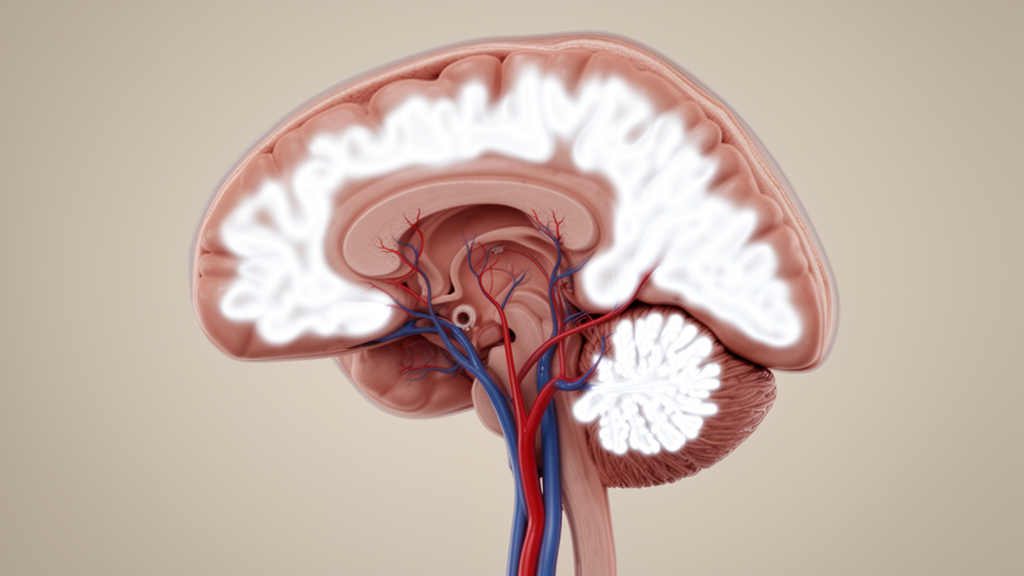
The anatomical location of atherosclerotic arterial stenosis is significantly associated with the distribution of white matter hyperintensities in the brain, according to a retrospective neuroimaging study in BMC Medical Imaging. Researchers investigated whether stenosis affecting different cerebral arteries correlates with white matter changes in periventricular or deep tissue regions. The findings demonstrate that middle cerebral artery narrowing links primarily to periventricular changes, whereas internal carotid artery narrowing and combined arterial lesions associate predominantly with deep white matter hyperintensities.
The investigation evaluated 199 patients who had unilateral atherosclerotic stenosis confirmed by high-resolution vessel wall imaging. Based on the arterial sites affected, researchers categorized participants into three clinical cohorts. The middle cerebral artery stenosis group comprised 120 patients. An additional 29 patients presented with isolated internal carotid artery stenosis, while a third group of 50 patients exhibited combined atherosclerotic stenosis involving both the middle cerebral artery and the internal carotid artery.
To characterize white matter changes, the research team assessed periventricular and deep white matter hyperintensities on fluid-attenuated inversion recovery magnetic resonance imaging. Severity was stratified using the Fazekas scale. Within the study cohort, 65 patients were categorized as Fazekas Grade 1, 115 patients were classified as Grade 2, and 19 individuals demonstrated advanced Grade 3 severity.
Statistical analyses utilized logistic generalized estimating equations to compare standardized prevalence across the groups while accounting for regional correlation. The primary effect measure was the adjusted prevalence ratio, with multiple comparisons corrected via the Holm method. In the adjusted model, the interaction between patient group and anatomical region was statistically significant, yielding a Wald chi-squared value of 32.33 with two degrees of freedom and a P value below 0.001.
The observed raw prevalence rates revealed clear differences across anatomical groups. Observed periventricular white matter hyperintensity prevalence was highest in the middle cerebral artery group at 93.3 percent and lowest in the internal carotid artery group at 69.0 percent. In contrast, observed deep white matter hyperintensity prevalence peaked in the combined middle cerebral and internal carotid group at 90.0 percent, whereas it was lowest in the middle cerebral artery group at 56.7 percent.
Following multivariable adjustment, patterns of relative prevalence remained consistent. Compared with the middle cerebral artery group, the internal carotid and combined groups exhibited lower adjusted periventricular prevalence, with adjusted prevalence ratios of 0.68 and 0.85, respectively. Conversely, adjusted deep white matter hyperintensity prevalence was higher in the internal carotid group at 1.42 and in the combined group at 1.62. The difference in deep white matter hyperintensity between the combined and internal carotid groups was not statistically significant, showing an adjusted prevalence ratio of 1.14 and a P value of 0.271.
Within-group assessments demonstrated that only the middle cerebral artery group had a significantly higher adjusted prevalence of periventricular changes than deep changes, with an adjusted prevalence ratio of 1.68 and a P value below 0.001. Exploratory analyses indicated that Fazekas grade might modify these relationships, but the authors cautioned that these subgroup evaluations were limited by small sample sizes and remain hypothesis-generating. Because this was an observational study, all findings reflect statistical associations rather than causal effects, requiring confirmation in future research.
Subject of Research: Association between arterial stenosis sites and cerebral white matter hyperintensity distribution
Article Title: A study on the correlation between atherosclerotic stenosis sites and the distribution of high signal intensity in the cerebral white matter
Article References: Gao, M., An, K., Liu, F., & Qian, Y. (2026). A study on the correlation between atherosclerotic stenosis sites and the distribution of high signal intensity in the cerebral white matter. BMC Medical Imaging. https://doi.org/10.1186/s12880-026-03061-0
Image Credits: AI Generated
DOI: 10.1186/s12880-026-03061-0
Keywords: atherosclerotic stenosis, white matter hyperintensity, high-resolution vessel wall imaging, middle cerebral artery, internal carotid artery, periventricular white matter, deep white matter, FLAIR imaging, Fazekas scale, generalized estimating equations, adjusted prevalence ratio, cerebral atherosclerosis, neuroimaging, vascular stenosis, ischemic white matter changes, cerebrovascular disease, arterial stenosis distribution
News Source: Ophelia Keating. (November 18, 2026). Cerebral Artery Stenosis Location Correlates With Distinct White Matter Hyperintensity Patterns. Scienmag.