• HOME
  • NEWS
  • EXPLORE
    • CAREER
      • Companies
      • Jobs
    • EVENTS
    • iGEM
      • News
      • Team
    • PHOTOS
    • VIDEO
    • WIKI
  • BLOG
  • COMMUNITY
    • FACEBOOK
    • INSTAGRAM
    • TWITTER
Wednesday, July 1, 2026
BIOENGINEER.ORG
No Result
View All Result
  • Login
  • HOME
  • NEWS
  • EXPLORE
    • CAREER
      • Companies
      • Jobs
        • Lecturer
        • PhD Studentship
        • Postdoc
        • Research Assistant
    • EVENTS
    • iGEM
      • News
      • Team
    • PHOTOS
    • VIDEO
    • WIKI
  • BLOG
  • COMMUNITY
    • FACEBOOK
    • INSTAGRAM
    • TWITTER
  • HOME
  • NEWS
  • EXPLORE
    • CAREER
      • Companies
      • Jobs
        • Lecturer
        • PhD Studentship
        • Postdoc
        • Research Assistant
    • EVENTS
    • iGEM
      • News
      • Team
    • PHOTOS
    • VIDEO
    • WIKI
  • BLOG
  • COMMUNITY
    • FACEBOOK
    • INSTAGRAM
    • TWITTER
No Result
View All Result
Bioengineer.org
No Result
View All Result
Home NEWS Science News Biology

Researchers use remote sensing to estimate nitrogen deposition in North China

Bioengineer by Bioengineer
January 6, 2020
in Biology
Reading Time: 2 mins read
0
IMAGE
Share on FacebookShare on TwitterShare on LinkedinShare on RedditShare on Telegram

IMAGE

Credit: Zhen Wang


Northern China, a hotspot of air pollution, has always been an area of great interest to study owing to the significant impacts on human health, the climate and ecosystems.

“However, most studies have focused on the sources and the formation mechanisms, which cannot provide us with knowledge on the fate of various species like reactive nitrogen, i.e., nitrogen deposition,” says Masters student Zhen Wang, from the Institute of International Earth System Science, Nanjing University. “Therefore, in our study we estimated the nitrogen deposition in northern China through a combination of remote sensing data and atmospheric chemical transport model simulations.”

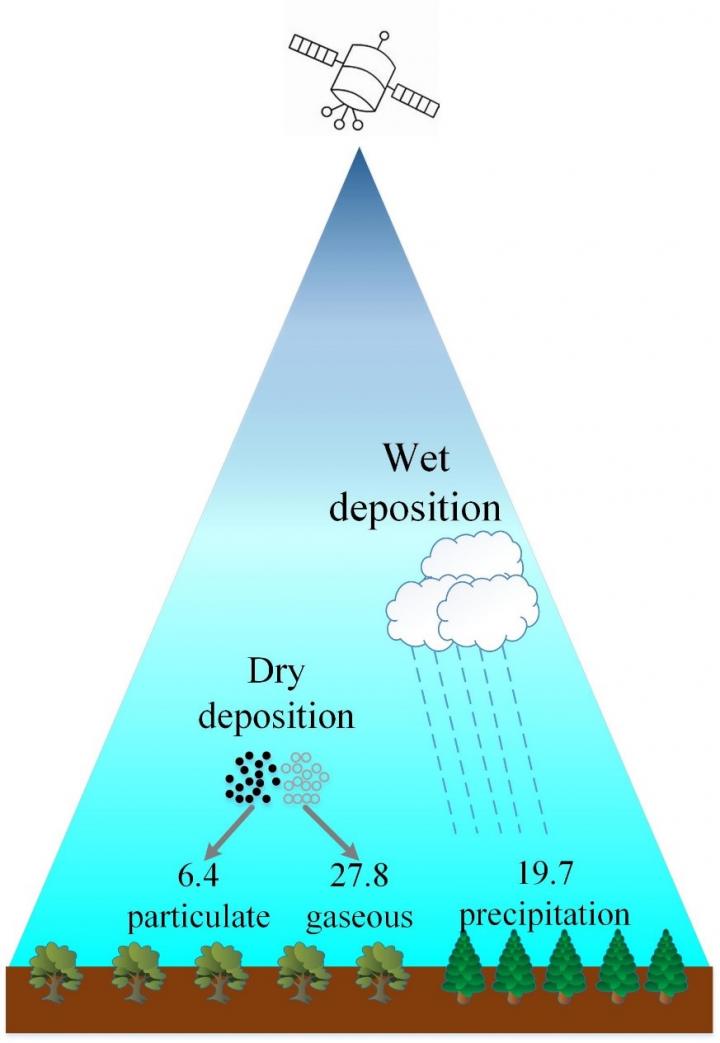
Wang and his coauthors interpreted the spatial and seasonal patterns of inorganic nitrogen deposition using NO2 and NH3 column measurements from satellites and the Model for Ozone and Related Chemical Tracers, version 4 (MOZART-4). The result was a unique “top-down” estimation of nitrogen deposition in northern China, and the findings have been published in Atmospheric and Oceanic Science Letters.

According to this study, the average nitrogen deposition flux in northern China was 54.5 kg N per hectare (ranging from 16.3 to 106.5 kg N per hectare). That is equal to 10% of the annual nitrogen application for the rotation of winter wheat-summer maize in this region. Of the total nitrogen deposition, 36% was deposited via precipitation and 64% was deposited through dry deposition.

According to Wang, this estimated nitrogen deposition flux will be helpful in determining the magnitude and pollution status in northern China without ground measurements, supporting the construction plan for environmental monitoring in the future. In addition, the generated spatial and seasonal patterns of nitrogen deposition in northern China provide basic information for evaluating the influence of nitrogen enrichment on regional biogeochemical cycles, such as forests, grasslands, and farmland ecosystems.

“Although the method of remote sensing can provide us with general knowledge regarding the spatial pattern of nitrogen deposition, the current resolution still has difficulty in identifying hotspots,” adds Dr. Xiuying Zhang, the corresponding author of the study. “Therefore, further research from our group will focus on atmospheric nitrogen deposition inversion with high spatial and temporal resolution.”

###

Media Contact
Ms. Zheng Lin
[email protected]
86-108-299-5053

Original Source

http://159.226.119.58/aosl/EN/news/news27.shtml

Related Journal Article

http://dx.doi.org/10.1080/16742834.2019.1701385

Tags: Atmospheric ScienceChemistry/Physics/Materials SciencesEarth SciencePollution/Remediation
Share12Tweet8Share2ShareShareShare2

Related Posts

KAIST Creates AI That Interprets Animal Behavior as a Language — Biology

KAIST Creates AI That Interprets Animal Behavior as a Language

July 1, 2026
New Study Uncovers 3D Genome Organization During Germ Cell Formation Across Evolutionary Time — Biology

New Study Uncovers 3D Genome Organization During Germ Cell Formation Across Evolutionary Time

July 1, 2026

Promising New HIV Vaccine Shows Remarkable Success in Primate Trials

July 1, 2026

UMaine Researchers Discover Woodcocks Charge Deer to Protect Their Nests

June 30, 2026
Please login to join discussion

POPULAR NEWS

  • Detection of EDCs in Breast Milk and Infant Urine Up to Six Months Highlights Early Exposure Risks

    77 shares
    Share 31 Tweet 19
  • Saying Goodbye to PGY-6: Pediatric Fellowship Realities

    103 shares
    Share 41 Tweet 26
  • New Drug Candidate Developed at McMaster Shows Potential for Treating Brain Cancer

    58 shares
    Share 23 Tweet 15
  • KTU Researchers Explore Ultrasound’s Role in Enhancing Blood Flow Beyond Diagnostics

    53 shares
    Share 21 Tweet 13

About

We bring you the latest biotechnology news from best research centers and universities around the world. Check our website.

Follow us

Recent News

New Study Identifies Spring Break as the Most Hazardous Period for Holiday Travel in Florida

Persistent Back Pain? Major Clinical Trial Highlights the Effectiveness of Self-Management Strategies

High-Dose IV Vitamin C Reduces Mortality and Sepsis Risk in Trauma Patients

Subscribe to Blog via Email

Enter your email address to subscribe to this blog and receive notifications of new posts by email.

Join 82 other subscribers
  • Contact Us

Bioengineer.org © Copyright 2023 All Rights Reserved.

Welcome Back!

Login to your account below

Forgotten Password?

Retrieve your password

Please enter your username or email address to reset your password.

Log In
No Result
View All Result
  • Homepages
    • Home Page 1
    • Home Page 2
  • News
  • National
  • Business
  • Health
  • Lifestyle
  • Science

Bioengineer.org © Copyright 2023 All Rights Reserved.