Process offers a simple and scalable approach to particle self-assembly
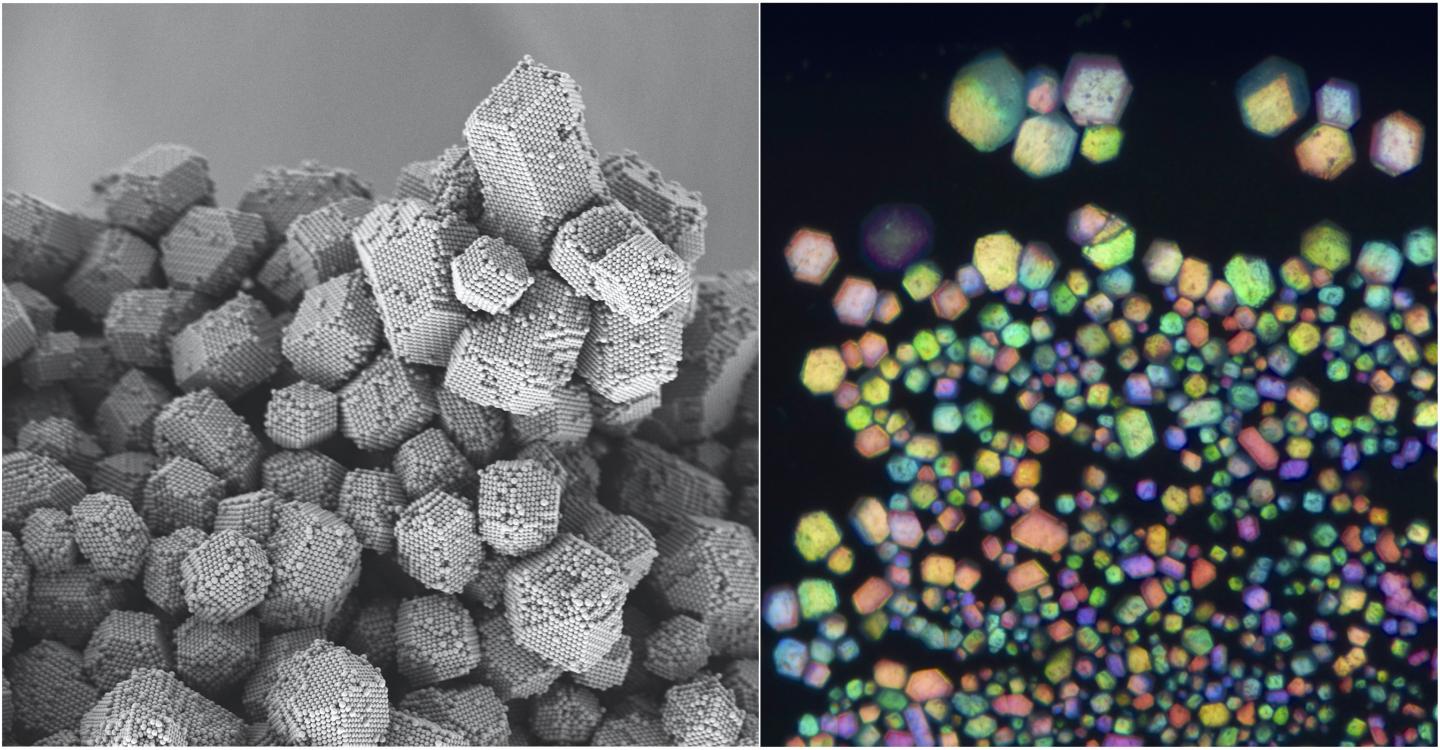
Credit: Theodore Hueckel, Sacanna Lab at NYU
Using just electrostatic charge, common microparticles can spontaneously organize themselves into highly ordered crystalline materials–the equivalent of table salt or opals, according to a new study led by New York University chemists and published in Nature.
“Our research shines new light on self-assembly processes that could be used to manufacture new functional materials,” said Stefano Sacanna, associate professor of chemistry at NYU and the study’s senior author.
Self-assembly is a process in which tiny particles recognize each other and bind in a predetermined manner. These particles come together and assemble into something useful spontaneously, after a triggering event, or a change in conditions.
One approach to programming particles to assemble in a particular manner is to coat them with DNA strands; the genetic code instructs the particles on how and where to bind with one another. However, because this approach requires a considerable amount of DNA, it can be expensive and is limited to making very small samples.
In their study in Nature, the researchers took a different approach to self-assembly using a much simpler method. Instead of using DNA, they used electrostatic charge.
The process is similar to what happens when you mix salt into a pot of water, Sacanna explained. When salt is added to water, the tiny crystals dissolve into negatively charged chlorine ions and positively charged sodium ions. When the water evaporates, the positively and negatively charged particles recombine into salt crystals.
“Instead of using atomic ions like those in salt, we used colloidal particles, which are thousands of times bigger. When we mix the colloidal particles together under the right conditions, they behave like atomic ions and self-assemble into crystals,” said Sacanna.
The process allows for making large quantities of materials.
“Using the particles’ natural surface charge, we managed to avoid doing any of the surface chemistry typically required for such elaborate assembly, allowing us to easily create large volumes of crystals,” said Theodore Hueckel, postdoctoral researcher at NYU and the study’s first author.
In addition to creating salt-like colloidal materials, the researchers used self-assembly to create colloidal materials that mimic gemstones–in particular, opals. Opals are iridescent and colorful, a result of their inner crystalline microstructure and its interaction with light. In the lab, the researchers created their test-tube gemstones with very similar inner microstructures to opals.
“If you take a highly magnified image of an opal, you will see the same tiny spherical building blocks lined up in a regular fashion,” added Hueckel.
Using electrostatic charge for self-assembly enables researchers to both mimic materials found in nature but also has advantages beyond what naturally occurs. For instance, they can adjust size and shape of the positively and negatively charged particles, which allows for a wide range of different crystalline structures.
“We’re inspired by nature’s ionic crystals, but we believe we’ll move beyond their structural complexity by utilizing all of the design elements uniquely available to colloidal building blocks,” said Hueckel.
###
In addition to Sacanna and Hueckel, study authors include Glen M. Hocky of NYU and Jérémie Palacci of University of California, San Diego. The research was funded by a National Science Foundation CAREER award (DMR-1653465) and the NSF-funded NYU Materials Research Science and Engineering Center (DMR-1420073).
Media Contact
Rachel Harrison
[email protected]
Related Journal Article
http://dx.