• HOME
  • NEWS
  • EXPLORE
    • CAREER
      • Companies
      • Jobs
    • EVENTS
    • iGEM
      • News
      • Team
    • PHOTOS
    • VIDEO
    • WIKI
  • BLOG
  • COMMUNITY
    • FACEBOOK
    • INSTAGRAM
    • TWITTER
Saturday, May 30, 2026
BIOENGINEER.ORG
No Result
View All Result
  • Login
  • HOME
  • NEWS
  • EXPLORE
    • CAREER
      • Companies
      • Jobs
        • Lecturer
        • PhD Studentship
        • Postdoc
        • Research Assistant
    • EVENTS
    • iGEM
      • News
      • Team
    • PHOTOS
    • VIDEO
    • WIKI
  • BLOG
  • COMMUNITY
    • FACEBOOK
    • INSTAGRAM
    • TWITTER
  • HOME
  • NEWS
  • EXPLORE
    • CAREER
      • Companies
      • Jobs
        • Lecturer
        • PhD Studentship
        • Postdoc
        • Research Assistant
    • EVENTS
    • iGEM
      • News
      • Team
    • PHOTOS
    • VIDEO
    • WIKI
  • BLOG
  • COMMUNITY
    • FACEBOOK
    • INSTAGRAM
    • TWITTER
No Result
View All Result
Bioengineer.org
No Result
View All Result
Home NEWS Science News Biology

Researchers unveil sperm release mechanism in bryophytes

Bioengineer by Bioengineer
June 3, 2024
in Biology
Reading Time: 3 mins read
0
MpMLO1 localized on the plasma membrane of tip cells induces cytoplasmic Ca2+ increase
Share on FacebookShare on TwitterShare on LinkedinShare on RedditShare on Telegram

Using liverwort (Marchantia polymorpha) as a model, researchers led by Prof. LI Hongju from the Institute of Genetics and Developmental Biology of the Chinese Academy of Sciences have explored the molecular mechanism of sperm release in bryophytes.
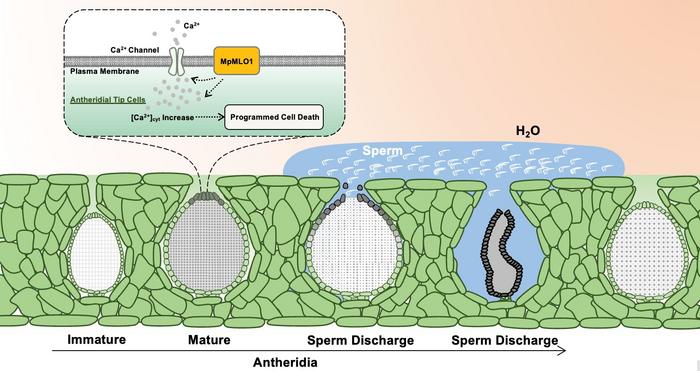
MpMLO1 localized on the plasma membrane of tip cells induces cytoplasmic Ca2+ increase

Credit: LI Hongju’s group

Using liverwort (Marchantia polymorpha) as a model, researchers led by Prof. LI Hongju from the Institute of Genetics and Developmental Biology of the Chinese Academy of Sciences have explored the molecular mechanism of sperm release in bryophytes.

The study was published in Nature Plants.

Sexual reproduction is essential for the environmental adaptation and evolution of plants. Unlike angiosperms, which rely on pollen tube growth to deliver immotile sperm cells to the embryo sac for fertilization, motile sperm in the basal land plants, bryophytes, are released into the water and swim to the egg cell in the archegonia. While the fertilization process in bryophytes has intrigued many researchers, the factors that regulate sperm release have remained unknown.

In this study, the researchers used RNA sequencing and analysis to identify four Mildew Resistance Locus O (MpMLO) proteins that are specifically expressed in the reproductive tissues of Marchantia. Expression pattern analysis revealed that these MpMLOs are expressed only in antheridia, which contain the sperm cells.

Using the CRISPR/Cas9 system, the researchers generated the Mpmlo1 mutant, which failed to release sperm. Subcellular localization revealed that MpMLO1-Citrine first localizes to the plasma membrane of tip cells at the end of the antheridia jacket layer, which causes cell death of these cells.

In contrast, the researchers found that tip cells in the Mpmlo1 mutant do not undergo cell death after antheridia maturation and continue to enlarge even after antheridia degeneration due to antheridia aging. By introducing the Ca2+ sensor R-GECO1 into both wild-type and Mpmlo1 mutant plants, the researchers were able to study the dynamic variation of Ca2+ in antheridia jacket cells.

They recorded high Ca2+ levels in the tip cells that burst open to release the sperm, while they found reduced cytoplasmic Ca2+ levels in the tip cells of the Mpmlo1 mutant that failed to release sperm.

In conclusion, the researchers found that programmed cell death (PCD) is a prerequisite for sperm release from Marchantia antheridia. MpMLO1, expressed in tip cells, increases the cytoplasmic Ca2+ levels and induces PCD in these cells. Subsequent water entry into the antheridial pore transports the sperm mucilage to the receptacle surface for further fertilization.

This study sheds light on the molecular basis of sperm discharge in ancestral land plants and highlights the evolutionary conservation of the MLO-Ca2+ signaling module, which can be traced back to the last common ancestor of liverworts and flowering plants.


Journal

Nature Plants

DOI

10.1038/s41477-024-01703-1

Method of Research

Experimental study

Subject of Research

Not applicable

Article Title

MpMLO1 controls sperm discharge in liverwort

Article Publication Date

3-Jun-2024

Share12Tweet8Share2ShareShareShare2

Related Posts

Ohio Wall Lizards Overcame Genetic Bottleneck Through Reproduction, Study Finds — Biology

Ohio Wall Lizards Overcame Genetic Bottleneck Through Reproduction, Study Finds

May 29, 2026
Double Agent Unveils Unexpected Revelations — Biology

Double Agent Unveils Unexpected Revelations

May 29, 2026

University of Toronto Scientists Work to Enhance Access to Advanced Research and Biomanufacturing Tools in Resource-Limited Areas

May 29, 2026

CLPTM1L Alters Lipid Rafts to Drive Glioblastoma Progression

May 29, 2026

POPULAR NEWS

  • ESMO 2025: mRNA COVID Vaccines Enhance Efficacy of Cancer Immunotherapy

    319 shares
    Share 128 Tweet 80
  • Multi-Hospital Study Reveals Long Covid Burden Is Twice as High as Current Estimates

    81 shares
    Share 32 Tweet 20
  • Common Food Preservatives Associated with Elevated Blood Pressure and Increased Heart Disease Risk

    56 shares
    Share 22 Tweet 14
  • New Study Reveals Plants Can Detect the Sound of Rain

    736 shares
    Share 294 Tweet 184

About

We bring you the latest biotechnology news from best research centers and universities around the world. Check our website.

Follow us

Recent News

Heat Exposure Raises Heart Risks in US Farmworkers

Psychosocial Factors Shape Sexual Satisfaction in Older Adults

Polymyxin Resistance Evolution and Fitness Costs in Acinetobacter

Subscribe to Blog via Email

Enter your email address to subscribe to this blog and receive notifications of new posts by email.

Join 82 other subscribers
  • Contact Us

Bioengineer.org © Copyright 2023 All Rights Reserved.

Welcome Back!

Login to your account below

Forgotten Password?

Retrieve your password

Please enter your username or email address to reset your password.

Log In
No Result
View All Result
  • Homepages
    • Home Page 1
    • Home Page 2
  • News
  • National
  • Business
  • Health
  • Lifestyle
  • Science

Bioengineer.org © Copyright 2023 All Rights Reserved.