New statistical approach: changes in forest fires in the 19th and 20th centuries were man-made
Credit: D. Bryka?a, Polish Academy of Science
How do humans affect forest fires? And what can we learn from forest fires in the past for the future of forestry? An international team of researchers led by Elisabeth Dietze, formerly at the German Research Centre for Geosciences GFZ in Potsdam and now at the Alfred Wegener Institute – Helmholtz Centre for Polar and Marine Research, now provides new answers to these questions. The research team has shown for a region in north-eastern Poland that forest fires increasingly occurred there after the end of the 18th century with the change to organised forestry. Among other things, the conversion of forests into pine monocultures played a role. The increased number of fires subsequently made it necessary to manage and maintain the forests differently. The researchers report on this in the journal PLOS ONE.
Every natural landscape has its own pattern of how fires behave there. This pattern is also known as the “fire regime”. Fire regimes are directly linked to the landscape, its vegetation and climate. Humans can change these regimes by managing a landscape. However, little is yet known about how they influenced fire regimes before the beginning of active forest fire fighting. Among the past 250 years, the human contribution to the global increase in fires during the mid- 19th century is particularly unclear, as the data available for this period is not comprehensive.
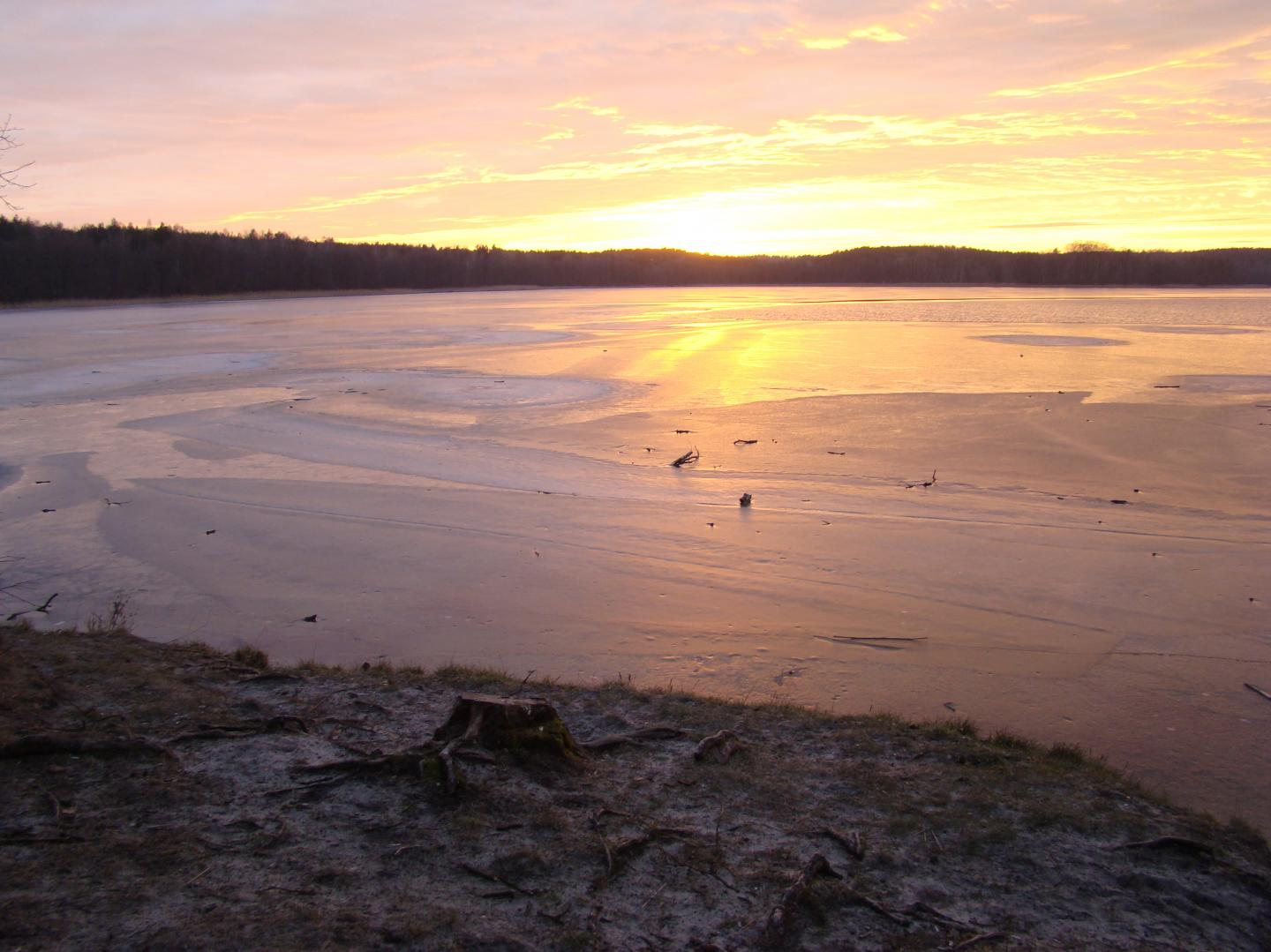
In the study published now, the researchers examined the extent to which forest management influenced the fire regime in a temperate forest landscape around Lake Czechowskie in the Bory Tucholskie (English: Tuchola Forest). Bory Tucholskie located in north-eastern Poland is one of the largest forest areas of Central Europe. The researchers combined evidence from various sources, such as pieces of charcoal and molecules formed during biomass combustion, so-called molecular fire markers. The investigated material originated from drilling cores of lake sediments. The researchers applied a new statistical approach to the classification of fires to their samples. They compared their measurements with independent climate and vegetation reconstructions and historical records.
Adaptation needs in the context of climate change
The team found two striking changes in the fire regime in the 19th and 20th centuries, both of which were driven by man. Accordingly, the amount of biomass burned unintentionally increased during the mid-19th century. At that time, the flammable, fast-growing pine monocultures necessary for industrialisation were planted. “After devastating fires in 1863, fire became an important factor in forest management,” explains Elisabeth Dietze.
At the end of the 19th century, state forestry reacted with an active fire prevention strategy. Various measures, such as a denser network of paths, were used to prevent fires. These measures had been very effective over the 20th century and the number of fires had decreased. But after the collapse of the Soviet Union, more pine trees were planted again in the 1990s. The forested area had increased. “In the course of climate change with its temperature rise and more frequent dry summers a new adjustment of forestry is necessary. Fires should be suppressed more effectively in the future and the forest should be restructured – towards more diverse and less flammable tree and shrub species. This is our most important result for forestry,” says Elisabeth Dietze.?
With the new findings, models for predicting fires can be better calibrated. “We can reconstruct fire types more comprehensively than before,” says Elisabeth Dietze. “Even low-intensity fires, such as typical ground fires in contrast to crown fires, can be detected with molecular fire markers, which was not possible with charcoal alone.”
The study is a cooperation between scientists from the Netherlands and Canada and partners in ‘ICLEA – Virtual Institute for Integrated Climate and Landscape Development Analysis’. As partners the GFZ, the Ernst Moritz Arndt University Greifswald, the Brandenburg Technical University Cottbus together with the Polish Academy of Sciences bundle their research capacities and expertise to investigate the climate and landscape development of the historical cultural landscape between North East Germany and North West Poland.
###
Media Contact
Philipp Hummel
[email protected]
Related Journal Article
http://dx.