• HOME
  • NEWS
  • EXPLORE
    • CAREER
      • Companies
      • Jobs
    • EVENTS
    • iGEM
      • News
      • Team
    • PHOTOS
    • VIDEO
    • WIKI
  • BLOG
  • COMMUNITY
    • FACEBOOK
    • INSTAGRAM
    • TWITTER
Saturday, July 4, 2026
BIOENGINEER.ORG
No Result
View All Result
  • Login
  • HOME
  • NEWS
  • EXPLORE
    • CAREER
      • Companies
      • Jobs
        • Lecturer
        • PhD Studentship
        • Postdoc
        • Research Assistant
    • EVENTS
    • iGEM
      • News
      • Team
    • PHOTOS
    • VIDEO
    • WIKI
  • BLOG
  • COMMUNITY
    • FACEBOOK
    • INSTAGRAM
    • TWITTER
  • HOME
  • NEWS
  • EXPLORE
    • CAREER
      • Companies
      • Jobs
        • Lecturer
        • PhD Studentship
        • Postdoc
        • Research Assistant
    • EVENTS
    • iGEM
      • News
      • Team
    • PHOTOS
    • VIDEO
    • WIKI
  • BLOG
  • COMMUNITY
    • FACEBOOK
    • INSTAGRAM
    • TWITTER
No Result
View All Result
Bioengineer.org
No Result
View All Result
Home NEWS Science News Chemistry

Researchers save images not with a microchip, but with metabolites

Bioengineer by Bioengineer
July 3, 2019
in Chemistry
Reading Time: 3 mins read
0
IMAGE
Share on FacebookShare on TwitterShare on LinkedinShare on RedditShare on Telegram

Small molecules can encode data from an image and be read with over 98 percent accuracy
IMAGE

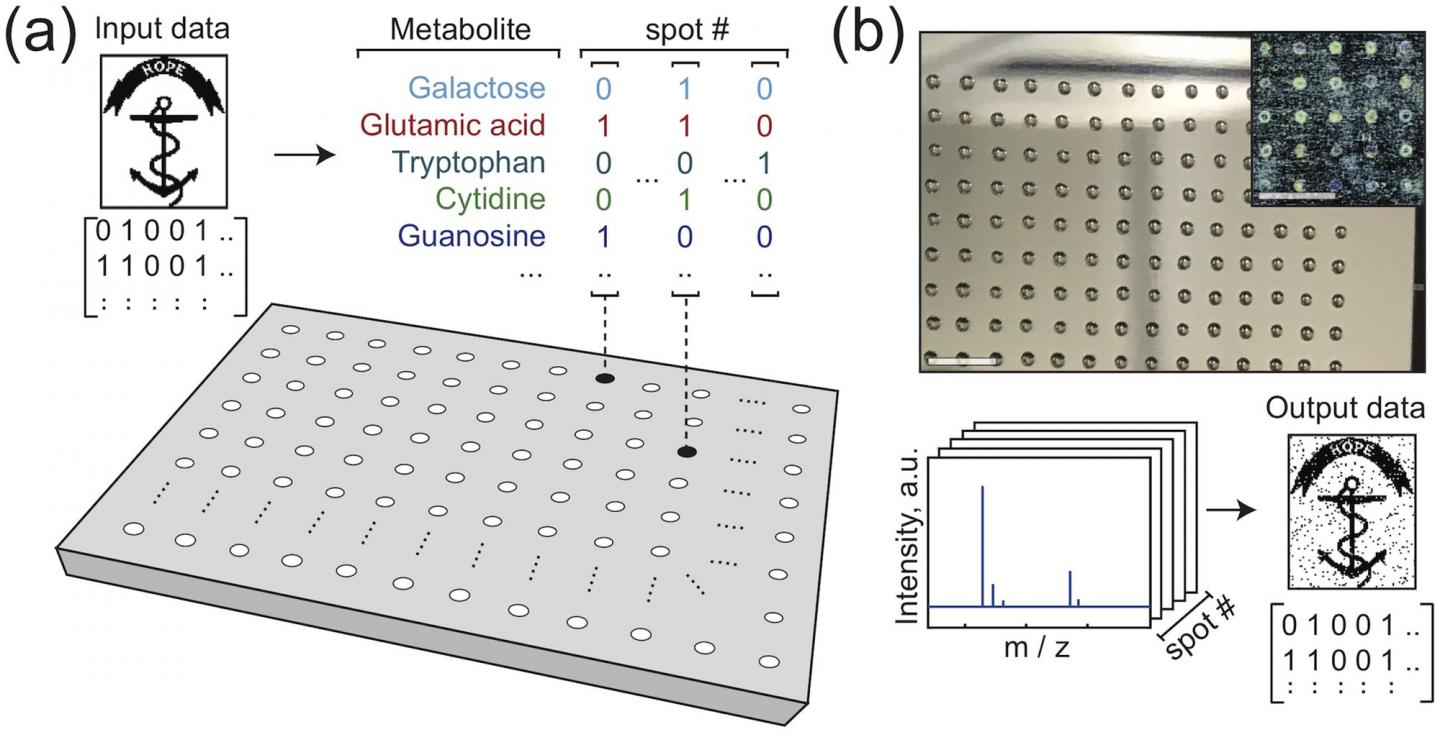
Writing and reading data encoded in mixtures of metabolites.

An anchor, an ibex and an Egyptian cat: all images that a research team from Brown University, led by Jacob Rosenstein, encoded and decoded from mixtures of small molecules called metabolites. They demonstrate the potential of this small-molecule information storage system in a new paper published July 3 in the open-access journal PLOS ONE.

Microchips have become the standard way for people to store data, such as a document on a home computer or a snapshot on a phone. Recently, scientists have experimented with ways to encode information using biomolecules, such as DNA, by synthesizing an artificial genome. In this new study, the researchers show that they can encode information using a different type of biomolecule, metabolites. They used liquid-handling robots to write digital information by dotting mixtures of metabolites into a grid on a surface. The locations and identities of the metabolites, when read by an instrument called a mass spectrometer, reported out binary data. Using this method, they could encode the information from a picture and then decode it to redraw the image with 98 to 99.5 percent accuracy.

Mixtures of metabolites, called metabolomes, offer many advantages over genomes for recording information. Metabolites are smaller, more diverse, and have the potential to store information at greater density. This proof-of-principle study shows that small-molecule information storage can successfully encode more than 100,000 bits of digital images into synthetic metabolomes. They expect that with additional development, the amount and density of information that can be encoded will grow significantly.

Rosenstein adds: “We encoded several small digital images into mixtures of metabolites, and read back the data by chemically analyzing the mixtures. A molecular hard drive or a chemical computer might still seem like science fiction, but biology shows us it is possible. We wanted to show in a mathematically precise way how to write and read digital data using some of the small molecules that our bodies use every day.”

###

Citation: Kennedy E, Arcadia CE, Geiser J, Weber PM, Rose C, Rubenstein BM, et al. (2019) Encoding information in synthetic metabolomes. PLoS ONE 14(7): e0217364. https://doi.org/10.1371/journal.pone.0217364

Funding: This research was supported by funding from the Defense Advanced Research Projects Agency (DARPA W911NF-18-2-0031) to BMR and JKR. The views, opinions and/or findings expressed are those of the authors and should not be interpreted as representing the official views or policies of the Department of Defense or the U.S. Government. The funders had no role in study design, data collection and analysis, decision to publish, or preparation of the manuscript.

Competing Interests: The authors have submitted a provisional patent application (62/791,504) related to this work.

In your coverage please use this URL to provide access to the freely available article in PLOS ONE: http://journals.plos.org/plosone/article?id=10.1371/journal.pone.0217364

Media Contact
Jacob Rosenstein
[email protected]

Related Journal Article

http://dx.doi.org/10.1371/journal.pone.0217364

Tags: BiochemistryBiomechanics/BiophysicsBiomedical/Environmental/Chemical EngineeringBiotechnologyChemistry/Physics/Materials SciencesNanotechnology/MicromachinesTechnology/Engineering/Computer Science
Share12Tweet8Share2ShareShareShare2

Related Posts

Graz University of Technology Deciphers the Structural Secrets of MOF Thin Films — Chemistry

Graz University of Technology Deciphers the Structural Secrets of MOF Thin Films

July 2, 2026
Breaking Thermodynamic Limits: Wavelength-Driven Catalysis Advances Ammonia Synthesis — Chemistry

Breaking Thermodynamic Limits: Wavelength-Driven Catalysis Advances Ammonia Synthesis

July 2, 2026

From Quantum Mechanics to AI-Powered Materials Discovery: MARVEL Marks 12 Years of Transforming Computational Science

July 2, 2026

Djire Recognized with National Award for Outstanding Contributions in Research and Teaching

July 2, 2026
Please login to join discussion

POPULAR NEWS

  • Detection of EDCs in Breast Milk and Infant Urine Up to Six Months Highlights Early Exposure Risks

    77 shares
    Share 31 Tweet 19
  • Saying Goodbye to PGY-6: Pediatric Fellowship Realities

    103 shares
    Share 41 Tweet 26
  • New Drug Candidate Developed at McMaster Shows Potential for Treating Brain Cancer

    58 shares
    Share 23 Tweet 15
  • KTU Researchers Explore Ultrasound’s Role in Enhancing Blood Flow Beyond Diagnostics

    53 shares
    Share 21 Tweet 13

About

BIOENGINEER.ORG

We bring you the latest biotechnology news from best research centers and universities around the world. Check our website.

Follow us

Recent News

Steatosis Drives Liver Metastasis Diversity in CRC

Unlocking the Mysteries of Alzheimer’s Disease

Pensoft Introduces New Peer-Reviewed Journal of Regeneration to Advance Restorative Biology Across Species

Subscribe to Blog via Email

Enter your email address to subscribe to this blog and receive notifications of new posts by email.

Join 83 other subscribers
  • Contact Us

Bioengineer.org © Copyright 2023 All Rights Reserved.

Welcome Back!

Login to your account below

Forgotten Password?

Retrieve your password

Please enter your username or email address to reset your password.

Log In
No Result
View All Result
  • Homepages
    • Home Page 1
    • Home Page 2
  • News
  • National
  • Business
  • Health
  • Lifestyle
  • Science

Bioengineer.org © Copyright 2023 All Rights Reserved.