• HOME
  • NEWS
  • EXPLORE
    • CAREER
      • Companies
      • Jobs
    • EVENTS
    • iGEM
      • News
      • Team
    • PHOTOS
    • VIDEO
    • WIKI
  • BLOG
  • COMMUNITY
    • FACEBOOK
    • INSTAGRAM
    • TWITTER
Monday, October 5, 2026
BIOENGINEER.ORG
No Result
View All Result
  • Login
  • HOME
  • NEWS
  • EXPLORE
    • CAREER
      • Companies
      • Jobs
        • Lecturer
        • PhD Studentship
        • Postdoc
        • Research Assistant
    • EVENTS
    • iGEM
      • News
      • Team
    • PHOTOS
    • VIDEO
    • WIKI
  • BLOG
  • COMMUNITY
    • FACEBOOK
    • INSTAGRAM
    • TWITTER
  • HOME
  • NEWS
  • EXPLORE
    • CAREER
      • Companies
      • Jobs
        • Lecturer
        • PhD Studentship
        • Postdoc
        • Research Assistant
    • EVENTS
    • iGEM
      • News
      • Team
    • PHOTOS
    • VIDEO
    • WIKI
  • BLOG
  • COMMUNITY
    • FACEBOOK
    • INSTAGRAM
    • TWITTER
No Result
View All Result
Bioengineer.org
No Result
View All Result
Home NEWS Science News Chemistry

Researchers review advances in 3D printing of high-entropy alloys

Bioengineer by Bioengineer
May 22, 2020
in Chemistry
Reading Time: 2 mins read
0
IMAGE
Share on FacebookShare on TwitterShare on LinkedinShare on RedditShare on Telegram

SUTD collaborates with universities in Singapore and China to shine light on HEA manufacturing processes and inspire further research in this emerging field
IMAGE

Credit: SUTD

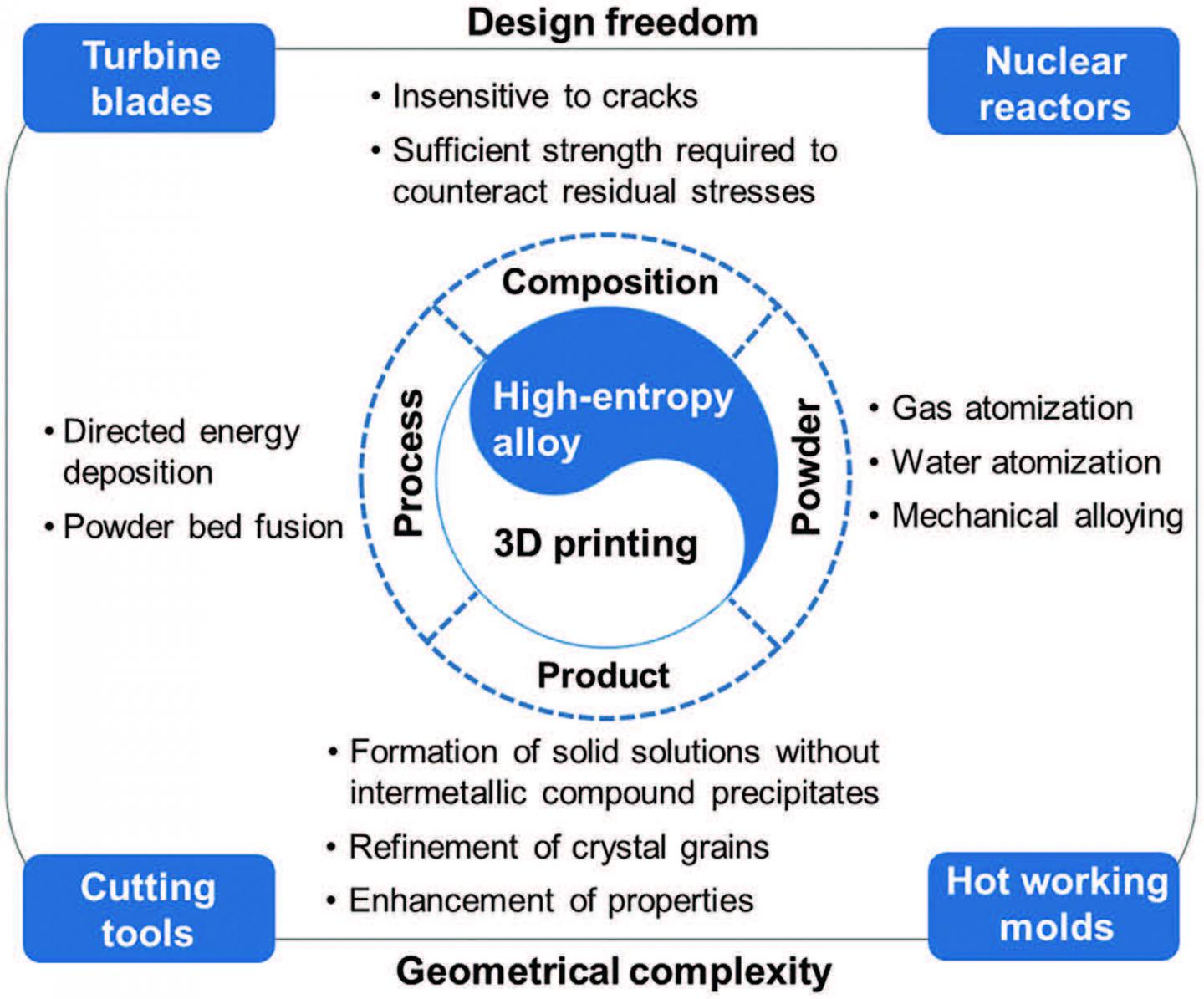
High-entropy alloys (HEAs) are at the frontier of the metal materials community. They are used as alternative materials in the production of high-temperature turbine blades, high-temperature molds and dies, hard coatings on cutting tools or even components of 4th generation nuclear reactors.

By screening proper combinations of HEAs’ constituent elements and regulating their proportions, HEAs can exhibit remarkable mechanical properties at high temperatures and display exceptional strength, ductility and fracture toughness at cryogenic temperatures.

Meanwhile, the development of HEAs for 3D printing has also been advancing rapidly, ramping up great potential for the manufacturing of such geometrically complex HEA products with desirable performances.

However, there is a lack of comprehensive understanding on the 3D printing of HEAs. To tackle this issue, researchers from Singapore University of Technology and Design (SUTD), Nanyang Technological University (NTU), Huazhong University of Science and Technology and Hunan University collaborated to publish a thorough review of the recent achievements on 3D printing of HEAs (refer to image). The study was published in Advanced Materials.

The review paper includes the production processes for HEA powders, 3D printing processes for HEA products, and the microstructure, mechanical properties, functionalities and potential applications of the printed products.

“3D printing of HEAs has been undergoing explosive growth in the academia and will gain extensive interest from industry. In our review, laser-based directed energy deposition, selective laser melting and electron beam melting are validated for their applicability to print various high-quality HEA products. It allows for a combination of material selection, design and manufacturing freedoms for lightweight, customizable and non-assembly required products,” explained lead author Professor Chua Chee Kai from SUTD.

“The ultrafast cooling rates of certain 3D printing techniques are expected to prevent the formation of undesirable intermetallic compounds in HEA products, thereby enhancing their mechanical properties. The different cooling rates of these printing processes would induce substantial variations in both the microstructures and macroscopic performances of the products,” said first author Dr Han Changjun from NTU.

“We believe that this paper serves as a valuable comprehensive review to deepen our understanding of the 3D printing of HEAs by focusing on its unique merits. Hopefully, more researchers would be encouraged to explore this highly interesting field,” added corresponding author Associate Professor Zhou Kun from NTU.

###

Media Contact
Jessica Sasayiah
[email protected]

Related Journal Article

http://dx.doi.org/10.1002/adma.201903855

Tags: Chemistry/Physics/Materials SciencesMaterialsResearch/Development
Share12Tweet8Share2ShareShareShare2

Related Posts

Computer-Designed Naphthalene Molecules Point to Cheaper, More Efficient Organic Solar Cells

Computer-Designed Naphthalene Molecules Point to Cheaper, More Efficient Organic Solar Cells

October 5, 2026
Isoniazid Reborn: Computational Design Yields a Schiff Base Lead That Outperforms a First-Line TB Drug

Isoniazid Reborn: Computational Design Yields a Schiff Base Lead That Outperforms a First-Line TB Drug

October 5, 2026

Lattice Parameter Emerges as Master Key to Magnetic States in Quasicrystal Clusters

October 5, 2026

Aluminum Doping Supercharges Lithium Transport in Low-Temperature Argyrodite Electrolyte

October 5, 2026
Please login to join discussion

POPULAR NEWS

  • Alloys That Shrink Their Own Grains: New PIX Mechanism Refines Metals With Heat Alone

    Alloys That Shrink Their Own Grains: New PIX Mechanism Refines Metals With Heat Alone

    29 shares
    Share 12 Tweet 7
  • Endurance Exercise Reshapes the Liver in Males and Females Through Distinct Molecular Routes

    29 shares
    Share 12 Tweet 7
  • Single Transcription Factor PU.1 Rapidly Converts Fibroblasts into Macrophage-Lineage Cells

    29 shares
    Share 12 Tweet 7
  • New Scale Measures How Ready Nurse Educators Really Are for the AI Era

    29 shares
    Share 12 Tweet 7

About

We bring you the latest biotechnology news from best research centers and universities around the world. Check our website.

Follow us

Recent News

Alloys That Shrink Their Own Grains: New PIX Mechanism Refines Metals With Heat Alone

Endurance Exercise Reshapes the Liver in Males and Females Through Distinct Molecular Routes

Single Transcription Factor PU.1 Rapidly Converts Fibroblasts into Macrophage-Lineage Cells

Subscribe to Blog via Email

Success! An email was just sent to confirm your subscription. Please find the email now and click 'Confirm' to start subscribing.

Join 85 other subscribers
  • Contact Us

Bioengineer.org © Copyright 2023 All Rights Reserved.

Welcome Back!

Login to your account below

Forgotten Password?

Retrieve your password

Please enter your username or email address to reset your password.

Log In
No Result
View All Result
  • Homepages
    • Home Page 1
    • Home Page 2
  • News
  • National
  • Business
  • Health
  • Lifestyle
  • Science

Bioengineer.org © Copyright 2023 All Rights Reserved.