• HOME
  • NEWS
  • EXPLORE
    • CAREER
      • Companies
      • Jobs
    • EVENTS
    • iGEM
      • News
      • Team
    • PHOTOS
    • VIDEO
    • WIKI
  • BLOG
  • COMMUNITY
    • FACEBOOK
    • INSTAGRAM
    • TWITTER
Saturday, July 11, 2026
BIOENGINEER.ORG
No Result
View All Result
  • Login
  • HOME
  • NEWS
  • EXPLORE
    • CAREER
      • Companies
      • Jobs
        • Lecturer
        • PhD Studentship
        • Postdoc
        • Research Assistant
    • EVENTS
    • iGEM
      • News
      • Team
    • PHOTOS
    • VIDEO
    • WIKI
  • BLOG
  • COMMUNITY
    • FACEBOOK
    • INSTAGRAM
    • TWITTER
  • HOME
  • NEWS
  • EXPLORE
    • CAREER
      • Companies
      • Jobs
        • Lecturer
        • PhD Studentship
        • Postdoc
        • Research Assistant
    • EVENTS
    • iGEM
      • News
      • Team
    • PHOTOS
    • VIDEO
    • WIKI
  • BLOG
  • COMMUNITY
    • FACEBOOK
    • INSTAGRAM
    • TWITTER
No Result
View All Result
Bioengineer.org
No Result
View All Result
Home NEWS Science News Biology

Researchers reveal mechanisms for regulating temperature sensitivity of soil organic matter decompos

Bioengineer by Bioengineer
July 12, 2019
in Biology
Reading Time: 2 mins read
0
IMAGE
Share on FacebookShare on TwitterShare on LinkedinShare on RedditShare on Telegram

IMAGE

Credit: Yang Yuanhe

The temperature sensitivity of soil organic matter (SOM) decomposition, commonly referred to as Q10, is a key parameter in the terrestrial carbon cycle. It quantifies the increase in the rate of decomposition corresponding to a 10oC rise in temperature and can determine the sign and magnitude of terrestrial carbon-climate feedback.

The regulatory mechanisms involved in the temperature sensitivity of SOM decomposition has been a topic of great interest among the global change research community over the last 20 years. However, comprehensive analyses involving the roles of substrate, environment and microbial properties in regulating Q10 have been limited.

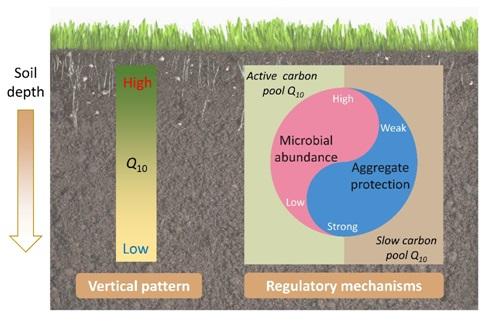
Recently, a research team led by Prof. YANG Yuanhe from the Institute of Botany of the Chinese Academy of Sciences elucidated the mechanisms underlying vertical variations in Q10. Based on the natural gradient of soil profile in Tibetan alpine grasslands, the team collected soil samples at two soil depths and then conducted long-term incubation, SOM decomposition modeling and manipulative experiments.

The team found that lower microbial abundance and stronger aggregate protection were coexisting mechanisms underlying lower Q10 in subsoil. Substrate quality and mineral protection were less responsible for Q10 variations.

Further analysis revealed that regulatory mechanisms differed between various carbon components. Microbial communities were the main determinant of depth-associated variations in Q10 in the active carbon pool, whereas aggregate protection exerted more important control in the slow carbon pool.

These results revealed the crucial role of soil carbon stabilization mechanisms in regulating the temperature response of SOM decomposition, and provided important insights for accurately understanding the feedback between the terrestrial carbon cycle and climate warming.

###

The paper, entitled “Temperature sensitivity of SOM decomposition governed by aggregate protection and microbial communities”, was recently published online in Science Advances.

This study was supported by the Strategic Priority Research Program of the Chinese Academy of Sciences, the National Key R&D Program of China, the National Natural Science Foundation of China, the Key Research Program of Frontier Sciences of the Chinese Academy of Sciences, and the Chinese Academy of Sciences-Peking University Pioneer Cooperation Team.

Media Contact
Jin Shuo
[email protected]

Original Source

http://english.cas.cn/newsroom/research_news/201907/t20190711_212889.shtml

Related Journal Article

http://dx.doi.org/10.1126/sciadv.aau1218

Tags: BiologyCell BiologyMicrobiology
Share12Tweet8Share2ShareShareShare2

Related Posts

Han directs new $15M NIH center for organ-on-chip technology

Han directs new $15M NIH center for organ-on-chip technology

July 11, 2026
Bacteriophages Enable Next-Gen Smart Pathogen Detection Sensors

Bacteriophages Enable Next-Gen Smart Pathogen Detection Sensors

July 10, 2026

Temperature Fluctuations Have Greater Impact Than Previously Believed

July 10, 2026

New Study Uncovers Biology Behind Glioma Cancer Progression

July 10, 2026
Please login to join discussion

POPULAR NEWS

  • Detection of EDCs in Breast Milk and Infant Urine Up to Six Months Highlights Early Exposure Risks

    77 shares
    Share 31 Tweet 19
  • New Drug Candidate Developed at McMaster Shows Potential for Treating Brain Cancer

    58 shares
    Share 23 Tweet 15
  • KTU Researchers Explore Ultrasound’s Role in Enhancing Blood Flow Beyond Diagnostics

    53 shares
    Share 21 Tweet 13
  • 高齢者の骨粗鬆症治療の持続性比較

    51 shares
    Share 20 Tweet 13

About

We bring you the latest biotechnology news from best research centers and universities around the world. Check our website.

Follow us

Recent News

Multi-Omics Reveal DNA Methylation Changes in Obesity Rat Model

Plasma pTau217 and pTau231 Forecast Dementia Progression in Parkinson’s Disease

Urban Navigation Services Increase Traffic Congestion in Cities

Subscribe to Blog via Email

Enter your email address to subscribe to this blog and receive notifications of new posts by email.

Join 85 other subscribers
  • Contact Us

Bioengineer.org © Copyright 2023 All Rights Reserved.

Welcome Back!

Login to your account below

Forgotten Password?

Retrieve your password

Please enter your username or email address to reset your password.

Log In
No Result
View All Result
  • Homepages
    • Home Page 1
    • Home Page 2
  • News
  • National
  • Business
  • Health
  • Lifestyle
  • Science

Bioengineer.org © Copyright 2023 All Rights Reserved.