A study published today in Cell Reports reveals important insights into the molecular mechanisms that underpin the body’s natural defences against the development of skin cancer. The findings offer new clues into the behaviour of skin cancer at the cellular level, paving the way for potential new therapeutic targets to treat the disease.
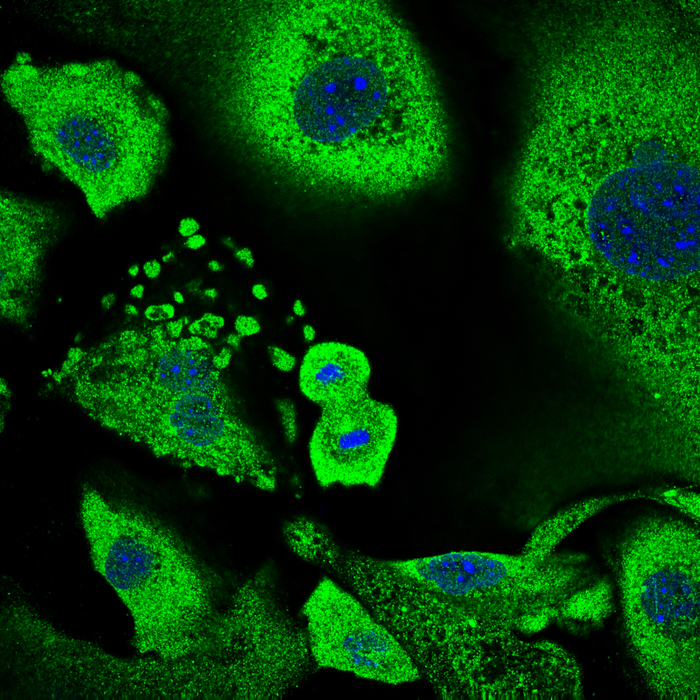
Credit: Annagiulia Ciocia/CRG
A study published today in Cell Reports reveals important insights into the molecular mechanisms that underpin the body’s natural defences against the development of skin cancer. The findings offer new clues into the behaviour of skin cancer at the cellular level, paving the way for potential new therapeutic targets to treat the disease.
“We found that the protein CSDE1 coordinates a complex chain of events that enable senescence in skin cells, significantly slowing down their function without causing death,” says Rosario Avolio, first author of the study and postdoctoral researcher at the CRG at the time of submission. “The resulting cells act as a firewall against cancer, suppressing the formation of tumours.”
Researchers led by Fátima Gebauer at the Centre for Genomic Regulation (CRG) carried out the study by collecting keratinocytes from mice, the most abundant type of skin cell in the epidermis. Keratinocytes can give rise to various types of skin cancer including basal and squamous cell carcinomas, two of the most frequently occurring forms of all human cancers.
The group experimentally introduced genes that drive the formation of cancer, which induced the cells into a state of senescence. They found that when levels of CSDE1 were depleted, cells could not undergo senescence and became immortalised, a necessary step in the development of cancer.
Further experiments revealed that when CSDE1-depleted cells were implanted under the skin of mice, they started forming malignant tumours. The authors found this striking because every treated mouse developed squamous cell carcinomas within 15 to 20 days, highlighting the importance of CSDE1 in tumour suppression.
The researchers discovered that CSDE1 promotes tumour suppression through two different mechanisms. CSDE1 induces the cell to secrete a cocktail of cytokines and enzymes that force the cell to enter a state of permanent growth arrest. CSDE1 also stops the synthesis of YBX1, a protein previously known to promote tumour growth and aggressiveness.
According to the authors, the findings of the study are surprising because CSDE1 has been previously linked to driving the formation of cancers, not suppressing them. Previous studies from the same group led by Dr. Gebauer found that CSDE1 promotes the formation of metastases in melanoma, a less common but the most aggressive type of skin cancer. Other studies have shown CSDE1 is linked to tumour proliferation in many types of cancer.
“CSDE1 is very much the ‘Dr. Jekyll and Mr. Hyde’ of proteins. It has an unpredictable dual nature depending on what type of cell and tissue it’s found in,” explains Dr. Gebauer, acting co-coordinator of the Gene Regulation, Stem Cells and Cancer research programme at the CRG and senior author of the study. “We do not know why this protein causes cancer in some cases and suppresses them in others. Exploring the root cause of this will have important implications for the discovery of new, more personalized cancer treatments.”
CSDE1 is an RNA-binding protein, a type of protein that monitors RNA, often as soon as they’re made with the potential to significantly change their function. One possible theory that explains why CSDE1 behaves differently is that normal skin cells or tumours each have slightly different variants of the protein which affect the wider molecular machinery in different ways.
The study is one of the few to examine the role of RNA-binding proteins in establishing cell senescence, which is an important new frontier in cancer research. “It was long thought that RNA-binding proteins are universal molecules that cells use for general housekeeping, and that they cannot be targeted therapeutically. It is becoming increasingly clear that this is not true, and that this emerging field is critical for understanding human disease,” concludes Dr. Gebauer.
Journal
Cell Reports
DOI
10.1016/j.celrep.2021.110211
Method of Research
Experimental study
Subject of Research
Animals
Article Title
Coordinated post-transcriptional control of oncogene-induced senescence by UNR/CSDE1
Article Publication Date
11-Jan-2022
COI Statement
The authors declare no competing interests