Credit: Alexander Tokarev, Ella Maru Studio
ANN ARBOR, Michigan — Researchers led by the University of Michigan Rogel Cancer Center have identified a new subtype of prostate cancer that occurs in about 7 percent of patients with advanced disease.
The subtype is characterized by loss of the gene CDK12. It was found to be more common in metastatic prostate cancer compared to early stage tumors that had not spread.
Tumors in which CDK12 was inactivated were responsive to immune checkpoint inhibitors, a type of immunotherapy treatment that has overall had limited success in prostate cancer.
"Because prostate cancer is so common, 7 percent is a significant number. The fact that immune checkpoint inhibitors may be effective against this sub-type of prostate cancer makes it even more significant. This is an exciting prospect for patients who have CDK12 alterations and may benefit from immunotherapy," says senior study author Arul Chinnaiyan, M.D., Ph.D., director of the Michigan Center for Translational Pathology.
Researchers at the Rogel Cancer Center will lead a multisite clinical trial to assess checkpoint inhibitors as a treatment for metastatic prostate cancer with CDK12 loss.
In this study, published in Cell, researchers looked at DNA and RNA sequencing data from 360 tumor samples from patients with metastatic castration-resistant prostate cancer. This is an aggressive, advanced form of the disease in which the cancer has spread throughout the body and no longer responds to traditional hormone-based treatments. Tumor samples were from U-M's Mi-ONCOSEQ program and from samples collected through the Stand Up to Cancer-Prostate Cancer Foundation Dream Team.
Researchers found loss of CDK12 in only about 1 percent of early prostate cancer samples. That jumped to 7 percent for metastatic cancer, which indicates a more-aggressive form of the disease.
"It suggests that those early stage patients who have CDK12 loss are the ones who will develop metastatic disease. This could be a harbinger in early cancer," Chinnaiyan says.
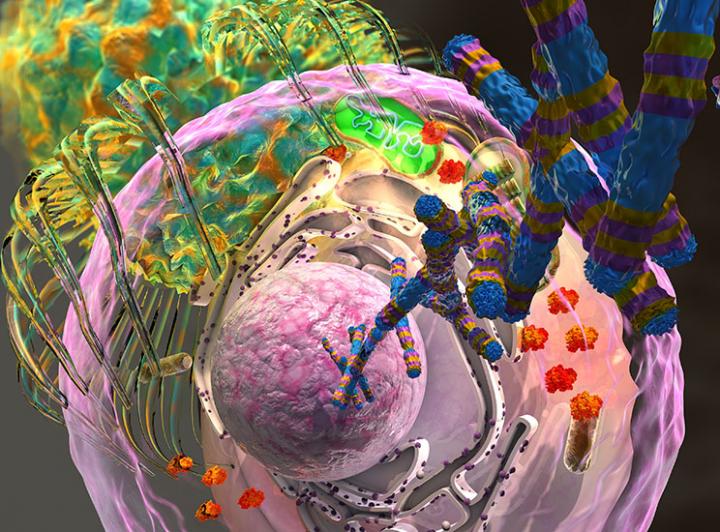
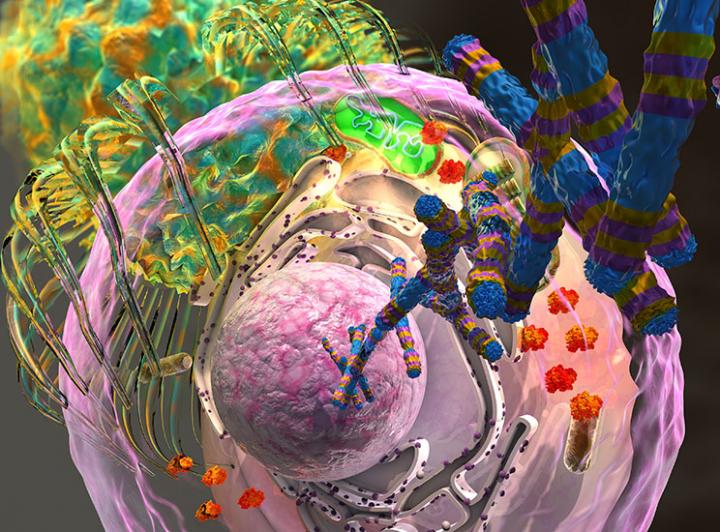
By following the mechanism of how CDK12 loss impacts the cell, researchers found a process in which cells create neoantigens that are foreign to the immune system. This boosts immune-fighting T-cells, which may explain why these patients benefit from immune checkpoint blockade.
This suggests that a precision medicine approach to prostate cancer could help better direct immunotherapy treatment. It could also explain why some prostate cancer patients have had exceptional responses to immunotherapy while the treatment has had lackluster results overall in prostate cancer.
The team had first recognized a possible role for CDK12 in a 2015 paper that evaluated the genomic landscape of advanced prostate cancers. CDK12 has also been linked to ovarian cancer.
Little is known about CDK12 on a molecular basis but scientists do know that CDK12 regulates several critical cellular processes and is essential for development. Eliminating it is likely lethal to most cell types. So why can tumors lose CDK12 and survive? Researchers suspect cancer must inherit something that allows it to grow in the face of CDK12 loss. More study is needed to understand this.
"This very promising study suggests that CDK12 loss may be a biomarker for identifying prostate cancer patients who may respond to checkpoint immunotherapy," says Howard Soule, Ph.D., executive vice president and chief science officer of the Prostate Cancer Foundation. "The Prostate Cancer Foundation is proud to have funded this team, which continues to make foundational strides in identifying actionable genomic mutations in prostate cancer and using this information to identify new classes of precision treatments that can be used to improve the lives of men with prostate cancer."
###
Additional authors: Yi-Mi Wu, Marcin Cieslik, Robert J. Lonigro, Pankaj Vats, Melissa A. Reimers, Xuhong Cao, Yu Ning, Lisha Wang, Lakshmi P. Kunju, Navonil de Sarkar, Elisabeth I. Heath, Jonathan Chou, Felix Y. Feng, Peter S. Nelson, Johann S. de Bono, Weiping Zou, Bruce Montgomery, Ajjai Alva, International SU2C/PCF Prostate Cancer Dream Team, Dan R. Robinson
Funding: Prostate Cancer Foundation; Stand Up 2 Cancer-Prostate Cancer Foundation Dream Team grant SU2C-AACR-DT0712; Department of Defense grants W81XWH-15-1-0562 and PC160429; National Cancer Institute grants U01 CA214170, P50 CA186786, P50 CA097186; Howard Hughes Medical Institute, American Cancer Society
Disclosure: None
Reference: Cell, doi: 10.1016/j.cell.2018.04.034, published June 14, 2018
Resources:
University of Michigan Rogel Cancer Center, http://www.rogelcancercenter.org
Michigan Health Lab, http://www.MichiganHealthLab.org
Michigan Medicine Cancer AnswerLine, 800-865-1125
Media Contact
Nicole Fawcett
[email protected]
734-764-2220
@umichmedicine
http://www.med.umich.edu
Related Journal Article
http://dx.doi.org/10.1016/j.cell.2018.04.034