• HOME
  • NEWS
  • EXPLORE
    • CAREER
      • Companies
      • Jobs
    • EVENTS
    • iGEM
      • News
      • Team
    • PHOTOS
    • VIDEO
    • WIKI
  • BLOG
  • COMMUNITY
    • FACEBOOK
    • INSTAGRAM
    • TWITTER
Monday, May 18, 2026
BIOENGINEER.ORG
No Result
View All Result
  • Login
  • HOME
  • NEWS
  • EXPLORE
    • CAREER
      • Companies
      • Jobs
        • Lecturer
        • PhD Studentship
        • Postdoc
        • Research Assistant
    • EVENTS
    • iGEM
      • News
      • Team
    • PHOTOS
    • VIDEO
    • WIKI
  • BLOG
  • COMMUNITY
    • FACEBOOK
    • INSTAGRAM
    • TWITTER
  • HOME
  • NEWS
  • EXPLORE
    • CAREER
      • Companies
      • Jobs
        • Lecturer
        • PhD Studentship
        • Postdoc
        • Research Assistant
    • EVENTS
    • iGEM
      • News
      • Team
    • PHOTOS
    • VIDEO
    • WIKI
  • BLOG
  • COMMUNITY
    • FACEBOOK
    • INSTAGRAM
    • TWITTER
No Result
View All Result
Bioengineer.org
No Result
View All Result
Home NEWS Science News Biology

Researchers look to nature to unearth the secrets of cyclic imine cleavage

Bioengineer by Bioengineer
March 7, 2019
in Biology
Reading Time: 2 mins read
0
IMAGE
Share on FacebookShare on TwitterShare on LinkedinShare on RedditShare on Telegram

Researchers from the University of Tsukuba use soil bacteria as a starting point to show that copper amine oxidase can degrade cyclic imines
IMAGE

Credit: University of Tsukuba

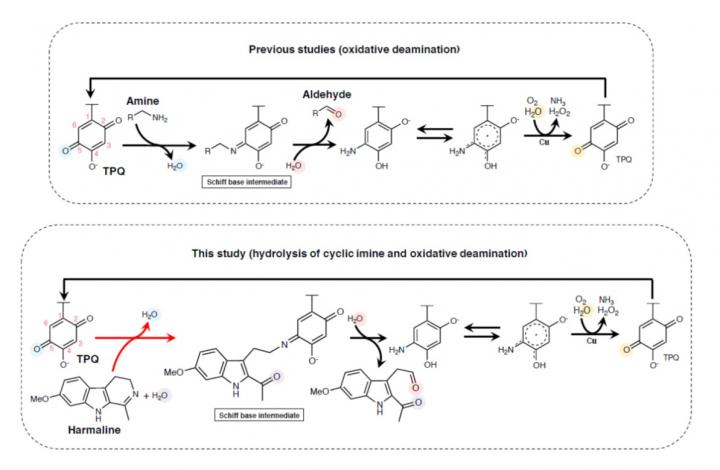
Tsukuba, Japan – Cyclic imines form a general class of chemical compounds that includes the metabolites of drugs used to treat a wide variety of conditions. β-carboline alkaloids in particular have been extensively studied as medicines, showing excellent bioactivities, and have been used in treatments for hypertension. However, despite significant understanding of the biosynthesis that forms cyclic imines, the degradation of these compounds is not well understood. Now, researchers from the University of Tsukuba have isolated cyclic imine-metabolizing microorganisms from soil, identified a cyclic imine-metabolizing enzyme, and proposed its catalytic mechanism. Their findings are published in Nature Communications.

One of the simplest β-carboline alkaloids is harmaline, which is a bioactive component of the medicinal plant Peganum harmala. The roots, seeds, leaves and bark of P. harmala have been used in traditional medicine in various cultures around the world. With this in mind, the researchers hypothesized that harmaline produced by the plants must be degraded by microorganisms in the surrounding soil.

“We were able to isolate the harmaline-metabolizing bacteria Arthrobacter sp. C-4A from the soil around the roots of P. harmala,” study leading author Toshiki Nagakubo explains. “Subsequently, the particular enzyme involved in the catalysis was isolated from the bacteria, and we identified it as copper amine oxidase. This is the first time a link has been made between copper amine oxidase and cyclic imine ring opening.”

As a result of their findings, the researchers proposed a two-step mechanism for the enzymatic breaking of the carbon-nitrogen double bond that is particular to imine compounds. In addition to identifying copper amine oxidase as the catalyst, the team was able to show that the same enzyme isolated from different bacteria had a similar effect on degradation. Given the broad range of organisms, including humans, that produce β-carboline alkaloids, this expansion of the general understanding of cyclic imine degradation has the potential to impact many areas of research.

“Our findings add an interesting dimension to the current knowledge surrounding copper amine oxidases,” study corresponding author Michihiko Kobayashi explains. “We hope that our mechanism and the transferability of our observations will allow for further catalytic physiological processes to be identified and lead to significant developments in pharmacology.”

###

Media Contact
Masataka Watanabe
[email protected]

Related Journal Article

http://dx.doi.org/10.1038/s41467-018-08280-w

Tags: BiochemistryBiologyBiotechnology
Share12Tweet8Share2ShareShareShare2

Related Posts

Uncovering C. elegans Immunity via Genetic Screens — Biology

Uncovering C. elegans Immunity via Genetic Screens

May 16, 2026
Single mother must adapt swiftly — the survival of her colony depends on it — Biology

Single mother must adapt swiftly — the survival of her colony depends on it

May 15, 2026

Why Are Nearly Everyone Right-Handed? It Might Be Linked to How We Learned to Walk

May 15, 2026

Excessive Neuronal Activity Initiates Severe Autoimmune Brain Disorder

May 15, 2026
Please login to join discussion

POPULAR NEWS

  • Research Indicates Potential Connection Between Prenatal Medication Exposure and Elevated Autism Risk

    844 shares
    Share 338 Tweet 211
  • New Study Reveals Plants Can Detect the Sound of Rain

    731 shares
    Share 292 Tweet 182
  • Salmonella Haem Blocks Macrophages, Boosts Infection

    62 shares
    Share 25 Tweet 16
  • Breastmilk Balances E. coli and Beneficial Bacteria in Infant Gut Microbiomes

    58 shares
    Share 23 Tweet 15

About

We bring you the latest biotechnology news from best research centers and universities around the world. Check our website.

Follow us

Recent News

DKC1 Drives Colorectal Cancer via Sphingolipid Disruption

Health and Carbon Footprint of Barcelona’s Water Choices

Compression Spurs Tumor Spread via Malate-Microtubule Pathway

Subscribe to Blog via Email

Enter your email address to subscribe to this blog and receive notifications of new posts by email.

Join 82 other subscribers
  • Contact Us

Bioengineer.org © Copyright 2023 All Rights Reserved.

Welcome Back!

Login to your account below

Forgotten Password?

Retrieve your password

Please enter your username or email address to reset your password.

Log In
No Result
View All Result
  • Homepages
    • Home Page 1
    • Home Page 2
  • News
  • National
  • Business
  • Health
  • Lifestyle
  • Science

Bioengineer.org © Copyright 2023 All Rights Reserved.