• HOME
  • NEWS
  • EXPLORE
    • CAREER
      • Companies
      • Jobs
    • EVENTS
    • iGEM
      • News
      • Team
    • PHOTOS
    • VIDEO
    • WIKI
  • BLOG
  • COMMUNITY
    • FACEBOOK
    • INSTAGRAM
    • TWITTER
Monday, August 24, 2026
BIOENGINEER.ORG
No Result
View All Result
  • Login
  • HOME
  • NEWS
  • EXPLORE
    • CAREER
      • Companies
      • Jobs
        • Lecturer
        • PhD Studentship
        • Postdoc
        • Research Assistant
    • EVENTS
    • iGEM
      • News
      • Team
    • PHOTOS
    • VIDEO
    • WIKI
  • BLOG
  • COMMUNITY
    • FACEBOOK
    • INSTAGRAM
    • TWITTER
  • HOME
  • NEWS
  • EXPLORE
    • CAREER
      • Companies
      • Jobs
        • Lecturer
        • PhD Studentship
        • Postdoc
        • Research Assistant
    • EVENTS
    • iGEM
      • News
      • Team
    • PHOTOS
    • VIDEO
    • WIKI
  • BLOG
  • COMMUNITY
    • FACEBOOK
    • INSTAGRAM
    • TWITTER
No Result
View All Result
Bioengineer.org
No Result
View All Result
Home NEWS Science News Health

Researchers link immune system to salt-sensitive hypertension in CKD

Bioengineer by Bioengineer
March 3, 2020
in Health
Reading Time: 3 mins read
0
IMAGE
Share on FacebookShare on TwitterShare on LinkedinShare on RedditShare on Telegram

IMAGE

Credit: Department of Nephrology,TMDU


Researchers from Tokyo Medical and Dental University (TMDU) find that immune system signaling molecule TNF-α may trigger high blood pressure in patients with chronic kidney disease

Tokyo, Japan – Detecting threats, sending out response molecules, and altering gene expression–our immune system works tirelessly day and night to protect us from invading pathogens and maintain general health and wellbeing. But in a study published this month in peer-reviewed journal Kidney International, a group of researchers from Tokyo Medical and Dental University (TMDU) in Japan have found a link between the immune system and high blood pressure in patients with chronic kidney disease (CKD).

CKD affects almost 800 million people worldwide and is the underlying cause of over a million deaths each year. One of the major complications of CKD is high blood pressure, or hypertension, and studies have shown that controlling blood pressure is an important factor in preventing CKD progression. However, many CKD patients display increased salt-sensitivity, a condition where blood pressure is unduly influenced by dietary salt intake, making it much harder to control.

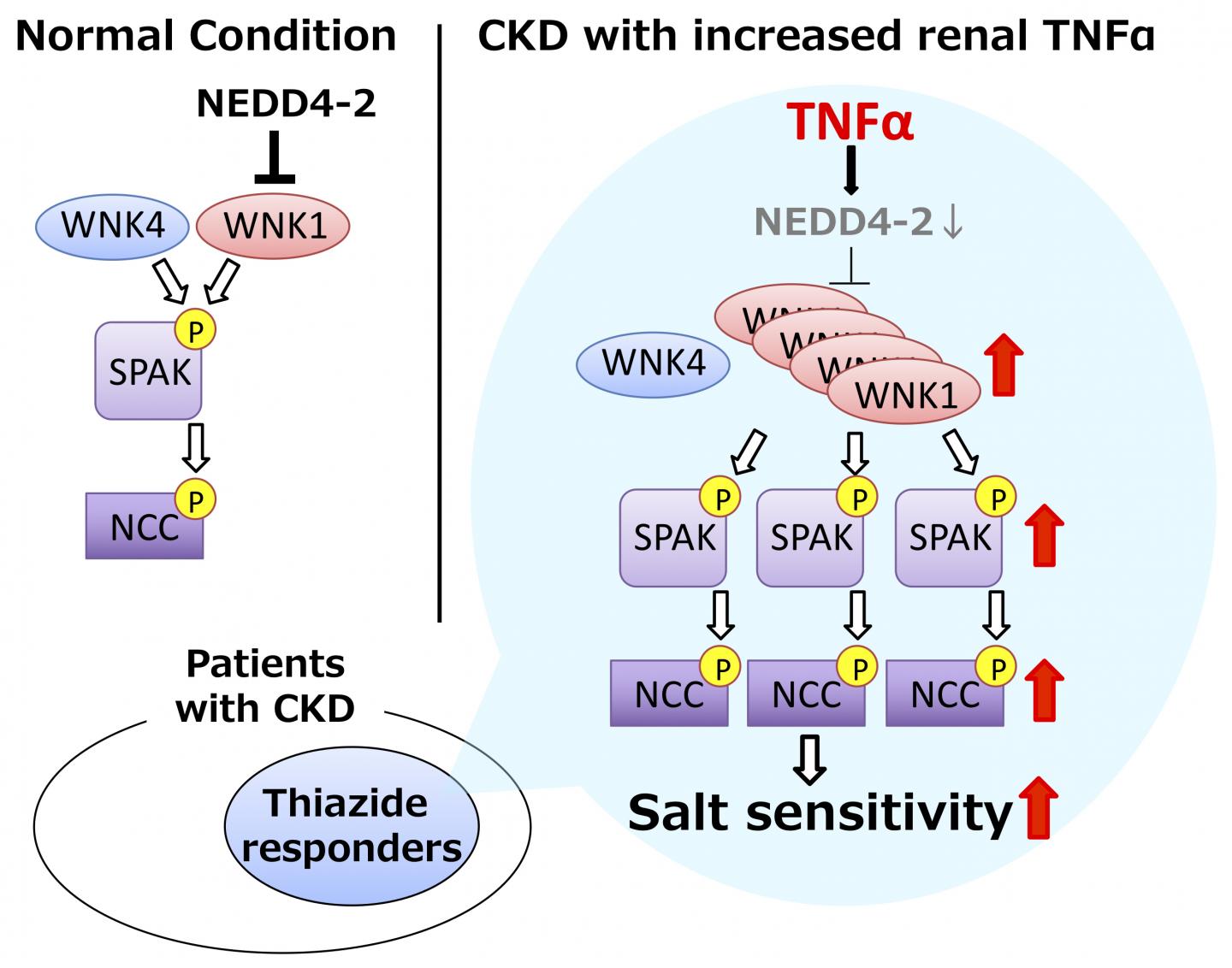
Inappropriate over-activation of a pathway called the WNK-SPAK-NCC phosphorylation cascade increases salt reabsorption in the kidney, leading to salt-sensitive hypertension. However, whether this pathway causes hypertension in CKD patients and what regulates the phosphorylation cascade had not been investigated.

Using a mouse model of disease, the researchers confirmed that mice with CKD had increased levels of the WNK1 protein in their kidneys, causing increased activation of the downstream proteins SPAK and NCC. When fed a high salt diet, the WNK-SPAK-NCC pathway remained activated in CKD mice, leading to salt-sensitive hypertension.

The researchers then looked to several recent studies suggesting that the immune system may play a role in salt sensitivity. Sure enough, levels of pro-inflammatory cytokine TNF-α were elevated in the kidneys of CKD mice, and provision of TNF-α resulted in increased levels of WNK1.

“Interestingly, TNF-α did not increase the transcription of WNK1, suggesting that it somehow prevented the degradation of mature WNK1 protein instead,” says corresponding author of the study Dr Eisei Sohara. “Based on this hypothesis, we confirmed that TNF-α enhances WNK1 protein levels by preventing the transcription of NEDD4-2 E3-ligase, a protein that normally degrades mature WNK1.” By inhibiting TNF-α, the researchers were able to reverse the salt sensitivity of CKD mice fed a high salt diet, confirming the link between the immune system and salt sensitivity.

Thiazide diuretics, NCC inhibitors, are widely used antihypertensive drugs, but their efficacy varies among patients with CKD. To achieve precision medicine, it is important to predict the efficacy of medication beforehand. Patients with enhanced activity of NCC are considered to respond well to thiazide diuretics. Therefore, finding of this study may contribute to better choice of antihypertensives in the future.

###

The article, “Renal TNFα activates the WNK phosphorylation cascade and contributes to salt-sensitive hypertension in chronic kidney disease,” was published in Kidney International at DOI: 10.1016/j.kint.2019.11.021.

Media Contact
Eisei SOHARA
[email protected]

Original Source

http://www.tmd.ac.jp/english/press-release/20200212_1/index.html

Related Journal Article

http://dx.doi.org/10.1016/j.kint.2019.11.021

Tags: CardiologyDiabetesImmunology/Allergies/AsthmaInternal MedicineMedicine/HealthMolecular Biology
Share12Tweet8Share2ShareShareShare2

Related Posts

Study reveals surge in type 2 diabetes among people under 20

August 24, 2026

Blocking glucosylceramide production kills cancer cells via lysosomal dysfunction, not ceramide buildup

August 23, 2026

ZCCHC4 boosts replication-dependent histone mRNA translation by interacting with eIF3

August 23, 2026

Tirzepatide Versus GLP-1 Agonists for Stroke Risk in Atrial Fibrillation and Diabetes

August 22, 2026
Please login to join discussion

POPULAR NEWS

  • Cochrane Map Reveals Major Evidence Gaps in Dengue Prevention Research

    Cochrane Map Reveals Major Evidence Gaps in Dengue Prevention Research

    29 shares
    Share 12 Tweet 7
  • Study reveals surge in type 2 diabetes among people under 20

    29 shares
    Share 12 Tweet 7
  • KAIST discovers pathway to faster-charging, longer-lasting electric vehicle batteries

    29 shares
    Share 12 Tweet 7
  • Blocking glucosylceramide production kills cancer cells via lysosomal dysfunction, not ceramide buildup

    29 shares
    Share 12 Tweet 7

About

We bring you the latest biotechnology news from best research centers and universities around the world. Check our website.

Follow us

Recent News

Cochrane Map Reveals Major Evidence Gaps in Dengue Prevention Research

Study reveals surge in type 2 diabetes among people under 20

KAIST discovers pathway to faster-charging, longer-lasting electric vehicle batteries

Subscribe to Blog via Email

Enter your email address to subscribe to this blog and receive notifications of new posts by email.

Join 85 other subscribers
  • Contact Us

Bioengineer.org © Copyright 2023 All Rights Reserved.

Welcome Back!

Login to your account below

Forgotten Password?

Retrieve your password

Please enter your username or email address to reset your password.

Log In
No Result
View All Result
  • Homepages
    • Home Page 1
    • Home Page 2
  • News
  • National
  • Business
  • Health
  • Lifestyle
  • Science

Bioengineer.org © Copyright 2023 All Rights Reserved.