• HOME
  • NEWS
  • EXPLORE
    • CAREER
      • Companies
      • Jobs
    • EVENTS
    • iGEM
      • News
      • Team
    • PHOTOS
    • VIDEO
    • WIKI
  • BLOG
  • COMMUNITY
    • FACEBOOK
    • INSTAGRAM
    • TWITTER
Wednesday, June 3, 2026
BIOENGINEER.ORG
No Result
View All Result
  • Login
  • HOME
  • NEWS
  • EXPLORE
    • CAREER
      • Companies
      • Jobs
        • Lecturer
        • PhD Studentship
        • Postdoc
        • Research Assistant
    • EVENTS
    • iGEM
      • News
      • Team
    • PHOTOS
    • VIDEO
    • WIKI
  • BLOG
  • COMMUNITY
    • FACEBOOK
    • INSTAGRAM
    • TWITTER
  • HOME
  • NEWS
  • EXPLORE
    • CAREER
      • Companies
      • Jobs
        • Lecturer
        • PhD Studentship
        • Postdoc
        • Research Assistant
    • EVENTS
    • iGEM
      • News
      • Team
    • PHOTOS
    • VIDEO
    • WIKI
  • BLOG
  • COMMUNITY
    • FACEBOOK
    • INSTAGRAM
    • TWITTER
No Result
View All Result
Bioengineer.org
No Result
View All Result
Home NEWS Science News Health

Researchers identify protein sensor that plays a role in lung fibrosis

Bioengineer by Bioengineer
March 26, 2024
in Health
Reading Time: 2 mins read
0
Researchers Identify Protein Sensor that Plays a Role in Lung Fibrosis
Share on FacebookShare on TwitterShare on LinkedinShare on RedditShare on Telegram

Researchers at Weill Cornell Medicine have discovered a protein called SEL1L that plays a critical role in clearing collagen from tissue, and which may be a therapeutic target to help prevent fibrosis, scar tissue that interferes with organ function. The paper, published on Feb. 20 in Nature Communications, provides clues that could lead to drug development for diseases like lung fibrosis which have no therapeutic options currently.
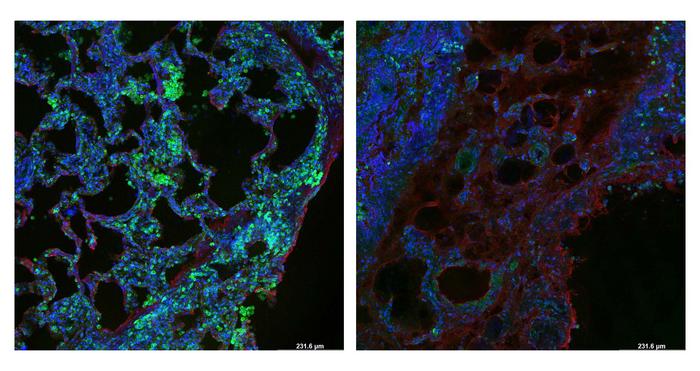
Researchers Identify Protein Sensor that Plays a Role in Lung Fibrosis

Credit: Michael J. Podolsky

Researchers at Weill Cornell Medicine have discovered a protein called SEL1L that plays a critical role in clearing collagen from tissue, and which may be a therapeutic target to help prevent fibrosis, scar tissue that interferes with organ function. The paper, published on Feb. 20 in Nature Communications, provides clues that could lead to drug development for diseases like lung fibrosis which have no therapeutic options currently.

Corresponding author, Dr. Michael J. Podolsky, assistant professor of medicine at Weill Cornell Medicine, has led a team that searched the human genome for genes involved in the process that triggers specialized cells to engulf and digest excess collagen from tissue. Cells called fibroblasts and macrophages pick up collagen fragments for degradation in lysosomes, the trash compactors of cells.

Normal lungs continuously synthesize collagen and degrade excess collagen, keeping the two processes precisely balanced to maintain healthy tissue architecture. Even when lungs are injured and the body responds by increasing the rate of collagen production, simultaneously collagen degradation is increased to prevent the formation of permanent scar tissue. However, when the two processes are uncoupled, the result is disease. In pulmonary fibrosis, for instance, collagen degradation does not keep pace with collagen production, resulting in an excess accumulation.

The researchers discovered a mechanism that cells use to detect collagen production internally and regulate clearance of excess collagen in tissues.  The protein SEL1L acts as a sensor that responds to collagen production by triggering another protein called MRC2 which is involved in the uptake and disposal of collagen.

This study suggests that a defective collagen clearing pathway based on MRC2 is a key part of the imbalance in fibrotic disease. The data show when SEL1L is overproduced in cells, it leads to increased MRC2 production and thereby prevents the accumulation of collagen. This pathway could eventually be therapeutically targeted to drive increased clearance of collagen to improve fibrosis when it is impaired. Next, Dr. Podolsky, who is also an attending physician at NewYork Presbyterian/Weill Cornell Medical Center, plans to investigate how SEL1L is impaired in fibrotic human lungs. The lab is also exploring the molecular consequences of when MRC2 is inadequately triggered in pulmonary fibrosis.

This research was supported in part by the National Institutes of Health grant K08 HL145015 and a Grant-in-aid from The Stony Wold-Herbert Fund.


Journal

Nature Communications

Share12Tweet8Share2ShareShareShare2

Related Posts

Epigenetic Changes Drive Pancreatic Adaptation to Aging, Diabetes

June 3, 2026

New Study Uncovers Key Values Influencing Black and Hispanic Parents’ COVID-19 Vaccination Choices for Their Children

June 3, 2026

Reprogramming the Immune System: A New Approach to Treat Type 1 Diabetes

June 3, 2026

MIT Scientists Create Innovative Vaccine Adjuvant to Accelerate Polio Eradication

June 3, 2026

POPULAR NEWS

  • ESMO 2025: mRNA COVID Vaccines Enhance Efficacy of Cancer Immunotherapy

    321 shares
    Share 128 Tweet 80
  • Multi-Hospital Study Reveals Long Covid Burden Is Twice as High as Current Estimates

    87 shares
    Share 34 Tweet 22
  • Saying Goodbye to PGY-6: Pediatric Fellowship Realities

    70 shares
    Share 28 Tweet 18
  • Common Food Preservatives Associated with Elevated Blood Pressure and Increased Heart Disease Risk

    57 shares
    Share 23 Tweet 14

About

We bring you the latest biotechnology news from best research centers and universities around the world. Check our website.

Follow us

Recent News

Cold-Induced Peptides Boost Pollen and Yield

Epigenetic Changes Drive Pancreatic Adaptation to Aging, Diabetes

New Study Uncovers Key Values Influencing Black and Hispanic Parents’ COVID-19 Vaccination Choices for Their Children

Subscribe to Blog via Email

Enter your email address to subscribe to this blog and receive notifications of new posts by email.

Join 83 other subscribers
  • Contact Us

Bioengineer.org © Copyright 2023 All Rights Reserved.

Welcome Back!

Login to your account below

Forgotten Password?

Retrieve your password

Please enter your username or email address to reset your password.

Log In
No Result
View All Result
  • Homepages
    • Home Page 1
    • Home Page 2
  • News
  • National
  • Business
  • Health
  • Lifestyle
  • Science

Bioengineer.org © Copyright 2023 All Rights Reserved.