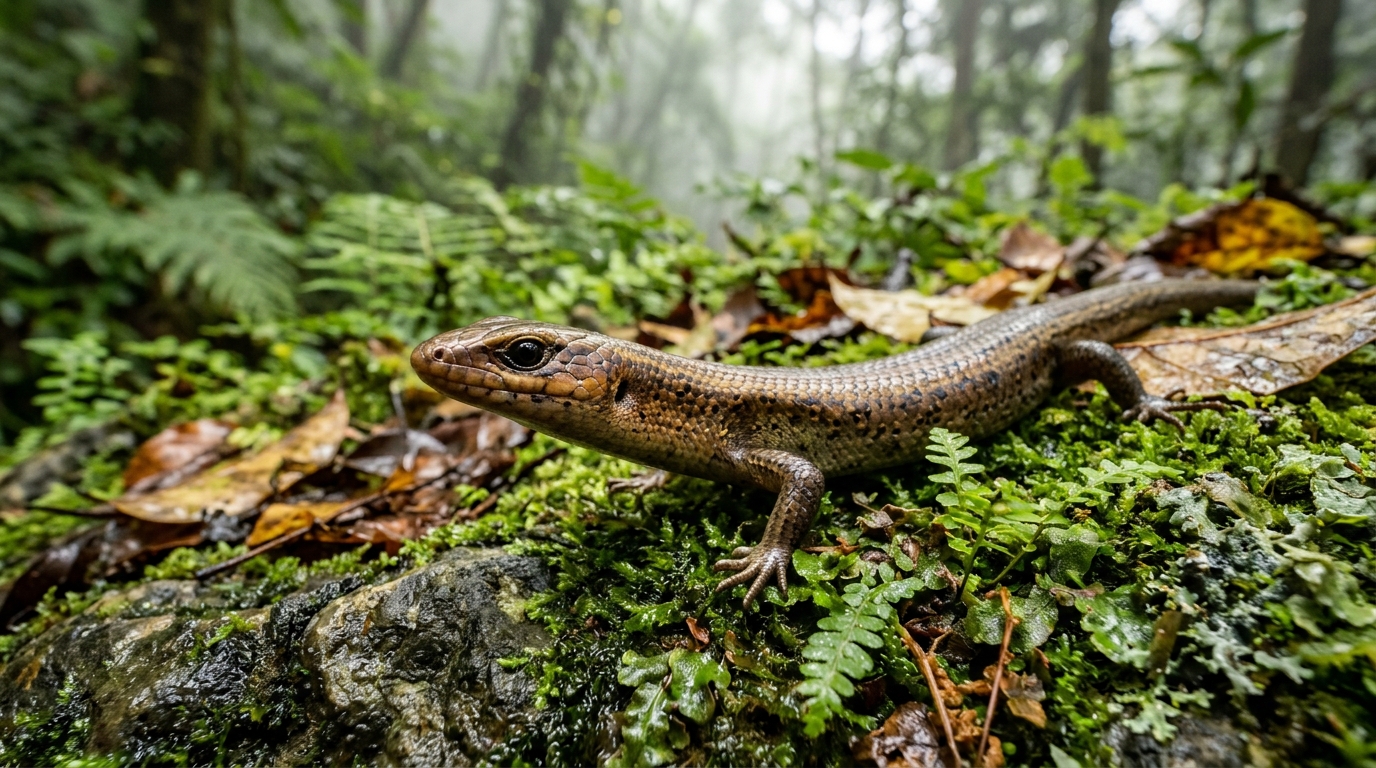
Biological surveys conducted across the mountainous subtropical broadleaf forests of northern Guizhou Province, China, have revealed a previously unrecognized reptile species belonging to the ground skink genus Scincella. Herpetologists identified the taxon, formally designated as Scincella qianbeiensis, by integrating comprehensive comparative morphological examinations with multilocus molecular phylogenetic analyses. The genus Scincella encompasses small-bodied, ground-dwelling lizards distributed widely from North America through East and Southeast Asia. Despite this expansive geographic range, evolutionary diversity across the group has historically remained underestimated as a consequence of highly conservative external morphologies and widespread cryptic speciation. The discovery of Scincella qianbeiensis adds to a growing series of recent taxonomic discoveries across southwestern China, demonstrating that the rugged topographic barriers and complex river systems of the Yunnan-Guizhou Plateau continue to shelter uncataloged terrestrial vertebrate lineages whose evolutionary lineages can be resolved through modern integrative methodologies.
The study was initiated following recent herpetological field investigations in northern Guizhou Province, during which researchers encountered several ground skinks displaying an unusual configuration of morphological traits that failed to match any known congener. Four adult male specimens were secured for systematic evaluation, consisting of three individuals collected from Kuankuoshui National Nature Reserve in Suiyang County and a fourth individual obtained from Dashahe National Nature Reserve in Daozhen County. Both sampling localities are located within montane subtropical broadleaf forest environments situated between 1,300 and 1,500 meters above sea level. Field observations noted that the active diurnal skinks inhabited microhabitats dominated by abundant damp leaf litter, fallen decomposing logs, and moist rock crevices on the forest floor. Following capture and field photography, the specimens were prepared in accordance with standard institutional protocols, with muscle tissue preserved in high-concentration ethanol prior to specimen fixation and long-term deposition in the herpetological collection of the Museum of Moutai Institute under ethical research clearance.
To rigorously verify the taxonomic status of the collected specimens, researchers conducted molecular phylogenetic analyses centered on two standard mitochondrial gene fragments: the 16S ribosomal RNA and cytochrome oxidase subunit I genes. Genomic DNA was extracted from muscle tissue using standard extraction kits, followed by polymerase chain reaction amplification using established primer pairs P7 and P8 for the 16S fragment and Chmf4 and Chmr4 for the COI fragment. Following automated sequencing, the resulting fragments measured 510 base pairs for 16S and 629 base pairs for COI. The newly generated sequence datasets were aligned with homologous sequences from related Scincella species retrieved from public genetic repositories. Phylogenetic trees reconstructed through maximum likelihood algorithms in PhyML and Bayesian inference methods in MrBayes converged upon highly congruent topologies under the GTR plus gamma plus invariant sites substitution model selected by PartitionFinder, providing robust analytical foundations to evaluate the placement of the population.
Phylogenetic reconstructions showed that all four newly collected specimens formed an exclusive, well-supported monophyletic lineage with maximum statistical confidence, displaying 1.00 Bayesian posterior probability and 100 percent maximum likelihood bootstrap support. Within the reconstructed mitochondrial topology, Scincella qianbeiensis was resolved as the sister group to an evolutionary clade comprising Scincella dabieshanensis and an unnamed lineage collected from Yichang, designated as species 2. Together, these branches formed a strongly supported lineage that is sister to Scincella vandenburghi, an insular and peninsular species inhabiting Tsushima Island in Japan and regions across the Korean Peninsula. Calculation of uncorrected pairwise genetic distances in MEGA demonstrated substantial divergence separating the new Guizhou skink from its closest relatives. The uncorrected p-distances between Scincella qianbeiensis and its sister species Scincella dabieshanensis reached 2.0 percent across the 16S rRNA gene and 6.2 percent across the COI barcode, values that markedly exceed standard interspecific divergence thresholds established across the genus.
Adults of Scincella qianbeiensis exhibit a medium body size, with measured snout-vent lengths ranging between 42.81 and 46.02 millimeters among adult males, paired with relatively elongated tails yielding tail-to-snout-vent ratios between 1.13 and 1.81. The diagnostic combination defining the species includes twenty-eight longitudinal midbody scale rows, between 52 and 60 paravertebral scale rows counted from the parietal plates to the hindlimb insertion, and 62 to 69 ventral scale rows between the gular region and precloacal scales. In addition, the species possesses seven infralabials, six to seven supraciliary scales, three to four pairs of enlarged nuchal scales, and a temporal scalation formula of one primary and two secondary temporals on both sides of the head. The tympanum is deeply sunken and entirely lacks lobules, while the lower eyelid features an undivided, transparent disc.
The physical patterning and coloration of Scincella qianbeiensis further distinguish it from congeners in both living and preserved states. In life, the dorsal surface of the head is bronze-brown and marked by irregular dark brown flecking that extends along the trunk toward the tail base. A prominent pair of dark dorsolateral stripes extends continuously from the posterior corner of each eye along the lateral surfaces of the trunk; the upper margin of each stripe is conspicuously wavy, while the lower margin remains comparatively straight. The midbody dorsal space between these dark stripes spans four full scale rows bordered by half-scales on either margin, formulated as one-half plus four plus one-half rows, while each dorsolateral stripe itself blankets four longitudinal scale rows. The ventral surfaces of the head and torso are uniform, immaculate yellowish-green, transitioning along the anterior third of the tail into bright yellow before shifting to whitish-cream with dispersed dark spotting across the posterior caudal segments.
Detailed comparative evaluations differentiated Scincella qianbeiensis from all other phylogenetically related and geographically adjacent Chinese ground skinks. Compared to its sister species Scincella dabieshanensis, Scincella qianbeiensis attains a larger adult male body size ranging from 42.81 to 46.02 millimeters versus 24.47 to 40.60 millimeters, a longer relative axilla-groin distance, fewer dorsal scale rows between the dorsolateral stripes, and a higher count of enlarged subdigital lamellae beneath the fourth finger. From Scincella vandenburghi, it is distinguished by having generally fewer paravertebral scale rows, more subdigital lamellae beneath finger IV, and a different dorsal stripe spacing. Compared to Scincella modesta, it possesses a single primary temporal scale rather than two, fewer scale rows between the stripes, and more fourth-finger lamellae.
When contrasted with species found within the surrounding southwestern Chinese mountains, Scincella qianbeiensis exhibits sharp character differences that preclude misidentification. From Scincella qianica, described from Guiyang and Weining, it is distinguished by higher numbers of subdigital lamellae beneath finger IV and toe IV, more ventral scale rows, fewer paravertebral scale rows, and significantly larger limb-to-body ratios. From Scincella tenuistriata, it differs by having twenty-eight midbody scale rows rather than twenty-four, 62 to 69 ventral scale rows rather than 40 to 43, seven infralabials instead of five to six, and noticeably greater head depth and snout length ratios. Comparisons against other East and Southeast Asian congeners, including Scincella apraefrontalis, Scincella auranticaudata, Scincella badenensis, and Scincella vuquangensis, confirmed further divergence in midbody scale counts, digit lamellae numbers, and body proportions.
Beyond describing the new taxon, the investigation resolved persistent historical uncertainties regarding the composition of skink populations inhabiting northern Guizhou nature reserves. Earlier biodiversity inventories had initially documented the widespread taxon Scincella potanini from Kuankuoshui National Nature Reserve, though that historical assignment relied solely on general external resemblances and lacked molecular verification. Subsequent revisions suggested that the Kuankuoshui skinks might instead represent Scincella tenuistriata. Through new sequencing and phylogenetic screening of local Kuankuoshui samples, the present authors confirmed that certain resident specimens indeed clustered tightly with type material of Scincella tenuistriata with very low genetic distances of 0.8 percent at 16S and 2.3 percent at COI. Crucially, the collection of Scincella qianbeiensis within the exact same reserve boundaries demonstrates that Scincella qianbeiensis and Scincella tenuistriata occur in regional sympatry, occupying shared broadleaf montane habitats while maintaining absolute genetic and morphological distinction.
The authors emphasize that although Scincella qianbeiensis is currently documented only from Kuankuoshui and Dashahe National Nature Reserves, vast expanses of rugged montane forest across northern and western Guizhou remain unsurveyed. In addition, the phylogenetic analysis revealed that an unnamed lineage from Yichang, designated as species 2, diverged from Scincella qianbeiensis by 7.0 percent in the COI gene while showing a shallow 0.8 percent divergence at 16S; because morphological specimens for that population remain unavailable, its status as either a localized variant or an independent cryptic species awaits further material. The researchers conclude that systematic, province-wide baseline surveys across the isolated montane refugia of the Yunnan-Guizhou Plateau, integrating high-resolution DNA barcoding with disciplined morphological examination, are essential to establish an accurate inventory of southwestern China’s hidden reptilian diversity and inform regional conservation planning.
Subject of Research: Taxonomic description of a new ground skink species, Scincella qianbeiensis, from northern Guizhou, China
Article Title: Morphological and molecular evidence for a new species of the genus Scincella Mittleman, 1950 ( Squamata , Scincidae ) from northern Guizhou, China
Article References: Xiao, X., Gou, W., Liu, J., Li, S., Li, G., Wang, W., Ke, X., & Chen, S. (2026). Morphological and molecular evidence for a new species of the genus Scincella Mittleman, 1950 (Squamata, Scincidae) from northern Guizhou, China. Zoosystematics and Evolution, 102(6), 1345-1360. https://doi.org/10.3897/zse.102.215390
Image Credits: AI Generated
Keywords: Scincella qianbeiensis, herpetology, Guizhou Province, integrative taxonomy, mitochondrial phylogenetics, Squamata, Scincidae, Kuankuoshui Nature Reserve, Morphological, molecular, evidence, species
News Source: Drew Townsend. (November 6, 2026). Researchers Identify New Ground Skink Species in Mountain Forests of Guizhou, China. Scienmag.