• HOME
  • NEWS
  • EXPLORE
    • CAREER
      • Companies
      • Jobs
    • EVENTS
    • iGEM
      • News
      • Team
    • PHOTOS
    • VIDEO
    • WIKI
  • BLOG
  • COMMUNITY
    • FACEBOOK
    • INSTAGRAM
    • TWITTER
Saturday, June 13, 2026
BIOENGINEER.ORG
No Result
View All Result
  • Login
  • HOME
  • NEWS
  • EXPLORE
    • CAREER
      • Companies
      • Jobs
        • Lecturer
        • PhD Studentship
        • Postdoc
        • Research Assistant
    • EVENTS
    • iGEM
      • News
      • Team
    • PHOTOS
    • VIDEO
    • WIKI
  • BLOG
  • COMMUNITY
    • FACEBOOK
    • INSTAGRAM
    • TWITTER
  • HOME
  • NEWS
  • EXPLORE
    • CAREER
      • Companies
      • Jobs
        • Lecturer
        • PhD Studentship
        • Postdoc
        • Research Assistant
    • EVENTS
    • iGEM
      • News
      • Team
    • PHOTOS
    • VIDEO
    • WIKI
  • BLOG
  • COMMUNITY
    • FACEBOOK
    • INSTAGRAM
    • TWITTER
No Result
View All Result
Bioengineer.org
No Result
View All Result
Home NEWS Science News Chemistry

Researchers have determined the three-dimensional atomic structure of a protein important for organ functions

Bioengineer by Bioengineer
October 14, 2022
in Chemistry
Reading Time: 2 mins read
0
Sodium–potassium–chloride transporter NKCC1
Share on FacebookShare on TwitterShare on LinkedinShare on RedditShare on Telegram

NKCC1 is a human chloride transporter that has the ability to transport sodium, potassium, and chloride from the exterior into cells. In the kidney, for example, NKCC1 type proteins ensure that these ions are reabsorbed from the urine, and generally NKCC1 is important for osmotic cell volume regulation. In brain, NKCC1 and related proteins are important for chloride gradients that are vital for the electrical signaling in neuronal networks.
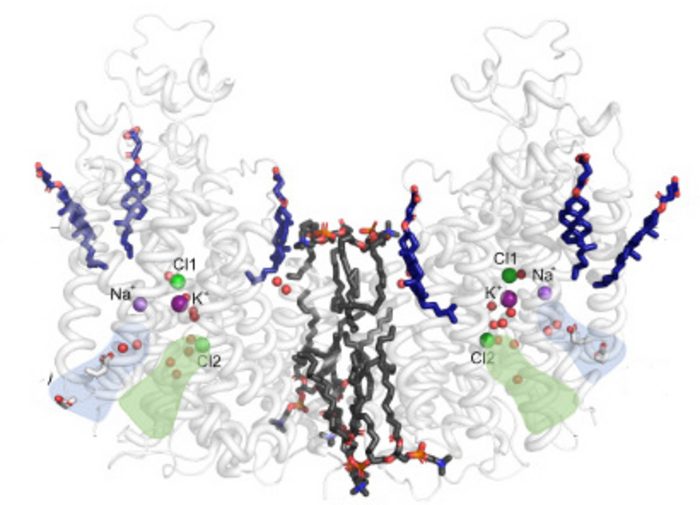
Sodium–potassium–chloride transporter NKCC1

Credit: Caroline Neumann and Poul Nissen, Aarhus University

NKCC1 is a human chloride transporter that has the ability to transport sodium, potassium, and chloride from the exterior into cells. In the kidney, for example, NKCC1 type proteins ensure that these ions are reabsorbed from the urine, and generally NKCC1 is important for osmotic cell volume regulation. In brain, NKCC1 and related proteins are important for chloride gradients that are vital for the electrical signaling in neuronal networks.

Using cryo-electron microscopy (cryo-EM), a team from Poul Nissen’s laboratory with colleagues from the Fenton and Hartmann laboratories at Aarhus University (AU) and the Lindorff-Larsen laboratory at University of Copenhagen (KU) have determined the three-dimensional atomic structure of NKCC1 (a so-called Na+– K+– 2 Cl– cotransporter) and investigated its function.

Insights into the three-dimensional atomic structure and dynamics of NKCC1 including the bound ions, lipids and water molecules as well as ion transport studies in cells provide important new information on NKCC1 function, which is driven by the sodium gradient established by the sodium-potassium pump.

The studies that the team present in an article in EMBO Journal reveal a surprising mechanism for release of the ions into the cell that begins with one of the two bound chloride ions, and only then the sodium ion and finally the other chloride and the potassium ion. The researchers will now continue to try to identify novel compounds that interfere with NKCC1 function and that may help in for example kidney and brain disorders.

The project was highly challenging from the very beginning and was started almost 10 years ago as a collaboration between the Nissen and Fenton laboratories. First-author and PhD student Caroline Neumann (now graduated) and colleagues from the Nissen laboratory undertook important collaborations with Prof. Rune Hartman’s laboratory (AU) to establish an advanced expression system for efficient protein production, and with Prof. Robert Fenton’s laboratory (Dept. of Biomedicine, AU) for functional studies of the transporter in mammalian cells. Finally, a collaboration was initiated with Prof. Kresten Lindorff-Larsen’s group from the University of Copenhagen for the computational simulations of the NKCC1 dynamics and ion release.


Journal

The EMBO Journal

DOI

10.15252/embj.2021110169

Method of Research

Experimental study

Subject of Research

Cells

Article Title

Cryo-EM structure of the human NKCC1 transporter reveals mechanisms of ion coupling and specificity

Article Publication Date

14-Oct-2022
Share12Tweet8Share2ShareShareShare2

Related Posts

Conducting Charge Along Linear Carbon Chains — Chemistry

Conducting Charge Along Linear Carbon Chains

June 13, 2026
Thiolated Biochar Enhances Soil’s Ability to Retain Toxic Mercury Amid Climate-Induced Wet-Dry Cycles — Chemistry

Thiolated Biochar Enhances Soil’s Ability to Retain Toxic Mercury Amid Climate-Induced Wet-Dry Cycles

June 12, 2026

AI Advances the Design of Enhanced Biochar Catalysts to Combat Antibiotic Pollution

June 12, 2026

Anti-Inflammatory Molecule Demonstrates Promise in Parkinson’s Treatment in Mouse Study

June 12, 2026

POPULAR NEWS

  • ESMO 2025: mRNA COVID Vaccines Enhance Efficacy of Cancer Immunotherapy

    324 shares
    Share 130 Tweet 81
  • Saying Goodbye to PGY-6: Pediatric Fellowship Realities

    98 shares
    Share 39 Tweet 25
  • Multi-Hospital Study Reveals Long Covid Burden Is Twice as High as Current Estimates

    90 shares
    Share 36 Tweet 22
  • Common Food Preservatives Associated with Elevated Blood Pressure and Increased Heart Disease Risk

    58 shares
    Share 23 Tweet 15

About

We bring you the latest biotechnology news from best research centers and universities around the world. Check our website.

Follow us

Recent News

How Environment Shapes Newborn Health Outcomes

Unseen Vision Loss: Danish Seniors’ Hidden Struggles

Precision Ablation Targets Metastatic Cancer via Rewired Signaling

Subscribe to Blog via Email

Enter your email address to subscribe to this blog and receive notifications of new posts by email.

Join 82 other subscribers
  • Contact Us

Bioengineer.org © Copyright 2023 All Rights Reserved.

Welcome Back!

Login to your account below

Forgotten Password?

Retrieve your password

Please enter your username or email address to reset your password.

Log In
No Result
View All Result
  • Homepages
    • Home Page 1
    • Home Page 2
  • News
  • National
  • Business
  • Health
  • Lifestyle
  • Science

Bioengineer.org © Copyright 2023 All Rights Reserved.