Some molecules respond to external light pulses by changing their structure and holding certain states that can be switched from one to another. These are commonly referred to as photoswitches and usually have two possible states. Recently, however, scientists from the Institute of Organic Chemistry and Biochemistry of the Czech Academy of Sciences (IOCB Prague) have developed a molecule that takes the possibilities of photoswitches a step further. The new molecule can be switched not between two, but between three distinct states. This gives it the ability to hold much more complex information in its molecular structure than has been possible so far. A paper on the topic, co-authored by PhD student Jakub Copko and Dr Tomáš Slanina, has now been published in the journal Chemical Communications.
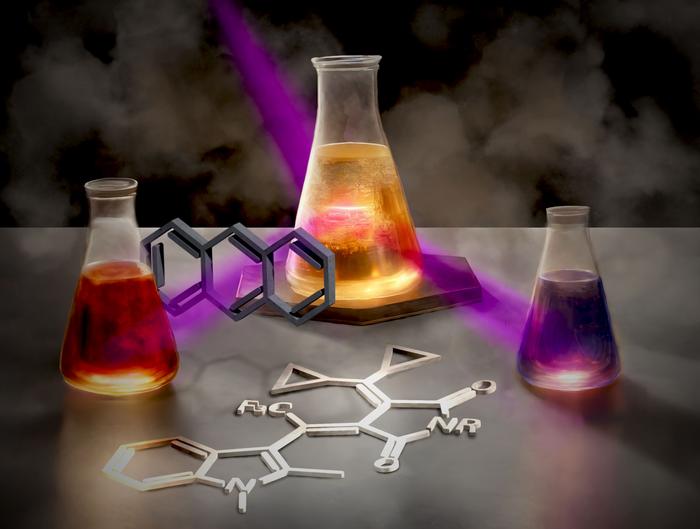
Credit: Design: Lucie Wohlrábová / IOCB Prague
Some molecules respond to external light pulses by changing their structure and holding certain states that can be switched from one to another. These are commonly referred to as photoswitches and usually have two possible states. Recently, however, scientists from the Institute of Organic Chemistry and Biochemistry of the Czech Academy of Sciences (IOCB Prague) have developed a molecule that takes the possibilities of photoswitches a step further. The new molecule can be switched not between two, but between three distinct states. This gives it the ability to hold much more complex information in its molecular structure than has been possible so far. A paper on the topic, co-authored by PhD student Jakub Copko and Dr Tomáš Slanina, has now been published in the journal Chemical Communications.
Although scientists had known that similar molecules could enter a third state, they opted not to study it. The reasoning was that they could not maintain control over the transitions between the individual molecular forms and that the presence of a third form only complicated the behaviour of molecules. Now, researchers from the group led by Dr Tomáš Slanina have overcome this obstacle. ‘We are able to precisely and selectively switch molecules between three states as we please,’ says one of the authors of the paper, Jakub Copko.
Structural changes in photoswitches are usually manifested as alterations of their macroscopic properties. When exposed to light of certain parameters, a molecule can, for example, change its colour, which can even be visible to the naked eye. For instance, blue can turn into yellow and vice versa, and the two colours can be treated as zeroes and ones, respectively. Individual molecules thus function in the same way as memory bits and are also easy to read. ‘There is, however, one difference, namely that thanks to their minuscule size they can store an order of magnitude more information than silicon-based chips,’ says Dr Tomáš Slanina, pointing out that: ‘This all works only with photoswitches that are stable enough so as not to switch between individual states spontaneously in the absence of light. It was this very requirement which has so far been so difficult to meet, so experts had never even attempted to achieve a transition into a third state within one molecule. This is only possible thanks to our current discovery.’
Upon the transition from the second state to the third, it is not the colour, but the geometry of the molecule that changes significantly. This is especially convenient whenever it is suitable to ‘shape’ a molecule so that it either fits into a target active centre or, conversely, so that it is pushed out of it. All this is triggered by a light pulse of a specific wavelength. The range of possible practical applications is wide. However, because it is such a recent discovery, experts are only beginning to discover its potential.
Scientists from the Tomáš Slanina Group have been researching photoswitches for a long time. Specifically, they have been focusing on substances known as fulgids, which are being studied by only a handful of laboratories around the world even though they generally have better properties compared to other photoswitches. The reason is straightforward: Their preparation has so far been greatly complicated.
However, Jakub Copko has managed to remove this obstacle, too. He explains: ‘When I started my doctoral studies, it took me up to a month to prepare a single fulgid. Now, thanks to our chemical shortcut, it’s ready in an afternoon.’ He uses what is called a one-pot reaction, which means that all chemical transformations take place in a single flask, eliminating the need to isolate and purify all intermediate products. This not only markedly expedites the preparation but also results in a cleaner reaction with a greater yield and decreases the environmental impact. Tomáš Slanina adds: ‘We are striving to ensure that fulgides are not merely a group of substances that is relegated to the textbooks, but one that receives wider exposure. It can advance the field of photoswitches globally.’ Thanks to the work of his group, the preparation of this type of photoswitches is now so simple that it can be done at any synthetic chemistry lab even without any previous experience with photoswitch chemistry.
Watch the video: https://youtu.be/YHqBjK_xZG4
Original article: Copko J., Slanina T. Multiplicity-driven photochromism controls three-state fulgimide photoswitches. Chem. Commun. 2024. https://doi.org/10.1039/d3cc05975h
IOCB Prague / Institute of Organic Chemistry and Biochemistry of the Czech Academy of Sciences is a leading internationally recognized scientific institution whose primary mission is the pursuit of basic research in chemical biology and medicinal chemistry, organic and materials chemistry, chemistry of natural substances, biochemistry and molecular biology, physical chemistry, theoretical chemistry, and analytical chemistry. An integral part of the IOCB Prague’s mission is the implementation of the results of basic research in practice. Emphasis on interdisciplinary research gives rise to a wide range of applications in medicine, pharmacy, and other fields.
Journal
Chemical Communications
DOI
10.1039/d3cc05975h
Method of Research
Experimental study
Subject of Research
Not applicable
Article Title
Multiplicity-driven photochromism controls three-state fulgimide photoswitches
Article Publication Date
13-Feb-2024