• HOME
  • NEWS
  • EXPLORE
    • CAREER
      • Companies
      • Jobs
    • EVENTS
    • iGEM
      • News
      • Team
    • PHOTOS
    • VIDEO
    • WIKI
  • BLOG
  • COMMUNITY
    • FACEBOOK
    • INSTAGRAM
    • TWITTER
Wednesday, June 24, 2026
BIOENGINEER.ORG
No Result
View All Result
  • Login
  • HOME
  • NEWS
  • EXPLORE
    • CAREER
      • Companies
      • Jobs
        • Lecturer
        • PhD Studentship
        • Postdoc
        • Research Assistant
    • EVENTS
    • iGEM
      • News
      • Team
    • PHOTOS
    • VIDEO
    • WIKI
  • BLOG
  • COMMUNITY
    • FACEBOOK
    • INSTAGRAM
    • TWITTER
  • HOME
  • NEWS
  • EXPLORE
    • CAREER
      • Companies
      • Jobs
        • Lecturer
        • PhD Studentship
        • Postdoc
        • Research Assistant
    • EVENTS
    • iGEM
      • News
      • Team
    • PHOTOS
    • VIDEO
    • WIKI
  • BLOG
  • COMMUNITY
    • FACEBOOK
    • INSTAGRAM
    • TWITTER
No Result
View All Result
Bioengineer.org
No Result
View All Result
Home NEWS Science News Biology

Researchers for the first time identify neurons in the human visual cortex that respond to faces

Bioengineer by Bioengineer
January 21, 2019
in Biology
Reading Time: 3 mins read
0
IMAGE
Share on FacebookShare on TwitterShare on LinkedinShare on RedditShare on Telegram

IMAGE

Credit: Dr. Vadim Axelrod

Imagine a world where everyone has the same face. That would be a very different world than the one we know. In our world, in which faces are different, faces convey essential information. For example, most of us can recognize a celebrity’s face even if it only appears for a fraction of second or the face of an old college friend even after decades of not seeing him. Many of us can sense the mood of a significant other just based on facial expression. Often, we can establish whether a person is trustworthy by just looking at his or her face. Despite intensive research, how the brain achieves all of these behaviors is still a great mystery.

A new study published in Neurology, the medical journal of the American Academy of Neurology (issue of January 22, 2019), identifies for the first time the neurons in the human visual cortex that selectively respond to faces. The study was carried out by Dr. Vadim Axelrod, head of the Consciousness and Cognition Laboratory at the Gonda (Goldschmied) Multidisciplinary Brain Research Center at Bar-Ilan University, in collaboration with a team from Institut du Cerveau et de la Moelle Épinière and Pitié-Salpêtrière Hospital (team leader: Prof. Lionel Naccache).

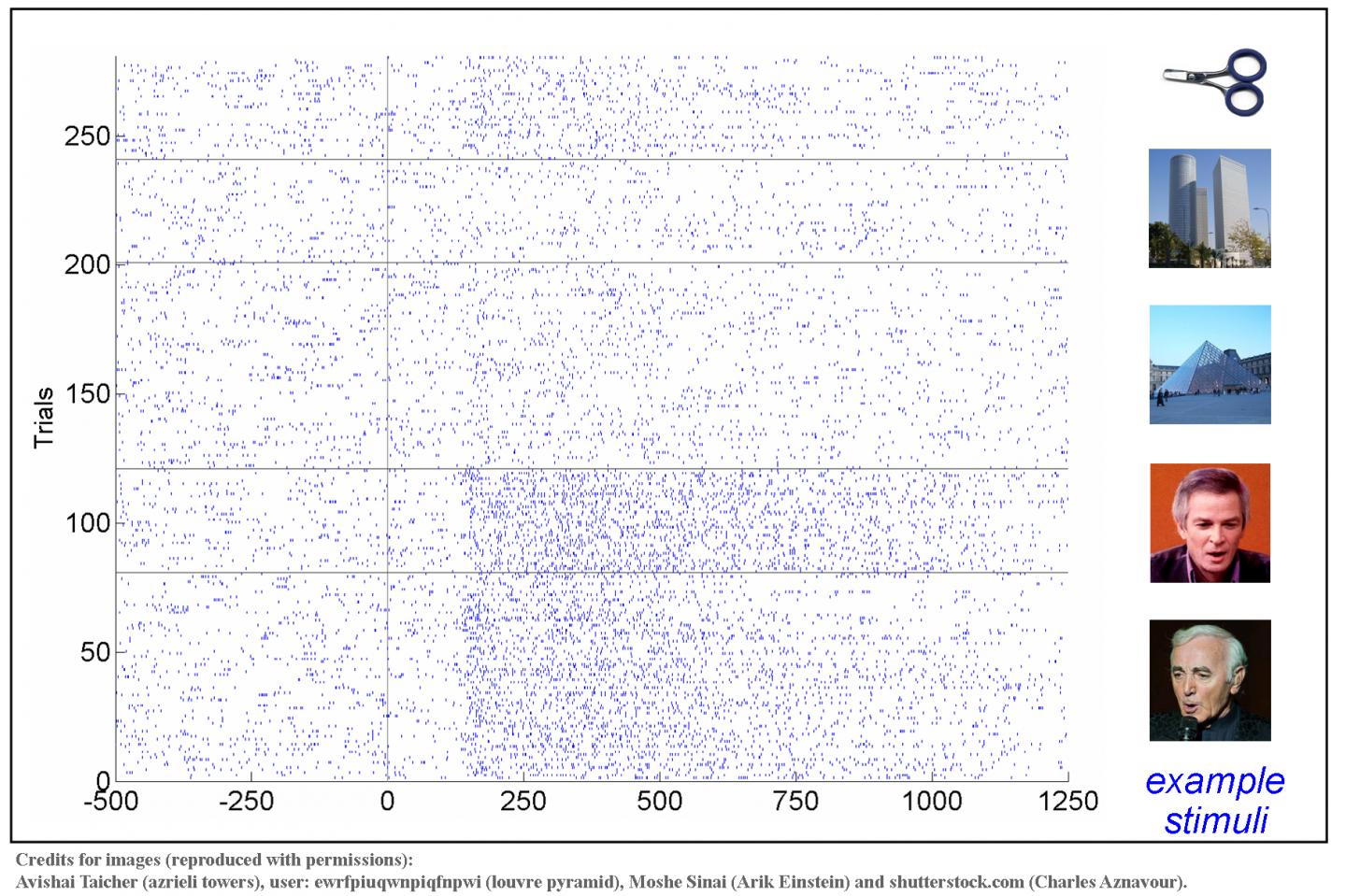
The researchers showed that the neurons in the visual cortex (in the vicinity of the Fusiform Face Area) responded much more strongly to faces than to city landscapes or objects (see examples: https://youtu.be/QYJCB60FhHE). A high response was found both for faces of famous people (e.g., Charles Aznavour, Nicolas Sarkozy, Catherine Deneuve, Louis De Funes) and for faces unfamiliar to the participant in the experiment. In an additional experiment, the neurons exhibited face-selectivity to human and animal faces that appeared within a movie (a clip from Charlie Chaplin’s The Circus).

“In the early 1970s Prof. Charles Gross and colleagues discovered the neurons in the visual cortex of macaque monkeys that responded to faces. In humans, face-selective activity has been extensively investigated, mainly using non-invasive tools such as functional magnetic resonance imaging (fMRI) and electrophysiology (EEG),” explains the paper’s lead author, Dr. Axelrod. “Strikingly, face-neurons in posterior temporal visual cortex have never been identified before in humans. In our study, we had a very rare opportunity to record neural activity in a single patient while micro-electrodes were implanted in the vicinity of the Fusiform Face Area ? the largest and likely the most important face-selective region of the human brain.”

Probably the best-known neurons that respond to faces have been the so-called “Jennifer Aniston cells” ? the neurons in the medial temporal lobe that respond to different images of a specific person (e.g., Jennifer Aniston in the original study published in Nature by Quiroga and colleagues in 2005). “But the neurons in the visual cortex that we reported here are very different from the neurons in the medial temporal lobe,” emphasizes Dr. Axelrod. “First, the neurons in the visual cortex respond vigorously to any type of face, regardless of the person’s identity. Second, they respond much earlier. Specifically, while in our case, a strong response could be observed within 150 milliseconds of showing the image, the “Jennifer Aniston cells” usually take 300 milliseconds or more to respond.”

The present results provide unique insights into human brain functioning at the cellular level during face processing. These findings also help bridge the understanding of face mechanisms across species (i.e., monkeys and humans). “It is really exciting,” Dr. Axelrod says, “that after almost half a century since the discovery of face-neurons in macaque monkeys, it is now possible to demonstrate similar neurons in humans.”

###

Media Contact
Elana Oberlander
[email protected]

Related Journal Article

http://dx.doi.org/10.1212/WNL.0000000000006806

Tags: Memory/Cognitive ProcessesneurobiologyPerception/AwarenessPhysiologySocial/Behavioral Science
Share12Tweet8Share2ShareShareShare2

Related Posts

Copal Tree Genetics Reveal Tropical Forest Connectivity — Biology

Copal Tree Genetics Reveal Tropical Forest Connectivity

June 24, 2026
How Intestinal Mucus Influences Klebsiella pneumoniae Colonization and Antibiotic Effectiveness — Biology

How Intestinal Mucus Influences Klebsiella pneumoniae Colonization and Antibiotic Effectiveness

June 24, 2026

From Darkness to Light: How Blind Mexican Cavefish Reveal Brain Evolution

June 24, 2026

Reevaluating the Impact of ‘Yo-Yo Dieting’: Is It Less Harmful Than Commonly Thought?

June 24, 2026
Please login to join discussion

POPULAR NEWS

  • Saying Goodbye to PGY-6: Pediatric Fellowship Realities

    103 shares
    Share 41 Tweet 26
  • Multi-Hospital Study Reveals Long Covid Burden Is Twice as High as Current Estimates

    92 shares
    Share 36 Tweet 23
  • Detection of EDCs in Breast Milk and Infant Urine Up to Six Months Highlights Early Exposure Risks

    77 shares
    Share 31 Tweet 19
  • New Drug Candidate Developed at McMaster Shows Potential for Treating Brain Cancer

    58 shares
    Share 23 Tweet 15

About

We bring you the latest biotechnology news from best research centers and universities around the world. Check our website.

Follow us

Recent News

Robotic Hand That “Feels” Motion: International Study Uncovers How the Brain Detects Movement

Unveiling the Impact of TP53 Mutations in Oral Cancer: Molecular Insights and Prognostic Significance

Electric Field and Oxygen Spillover Collaborate to Control Electrode Migration in SOECs

Subscribe to Blog via Email

Enter your email address to subscribe to this blog and receive notifications of new posts by email.

Join 82 other subscribers
  • Contact Us

Bioengineer.org © Copyright 2023 All Rights Reserved.

Welcome Back!

Login to your account below

Forgotten Password?

Retrieve your password

Please enter your username or email address to reset your password.

Log In
No Result
View All Result
  • Homepages
    • Home Page 1
    • Home Page 2
  • News
  • National
  • Business
  • Health
  • Lifestyle
  • Science

Bioengineer.org © Copyright 2023 All Rights Reserved.