Study is first to define how a little-known type of cell death impacts tumor cells and immune cells
Credit: University of Michigan Rogel Cancer Center
ANN ARBOR, Michigan — New findings suggest an unexpected path to killing cancer cells could make the hottest cancer treatment, immunotherapy, more effective.
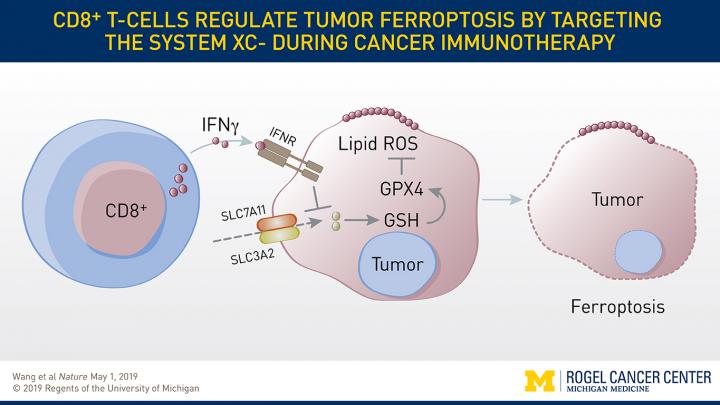
Researchers at the University of Michigan Rogel Cancer Center looked at a little-understood type of cell death called ferroptosis. They found ferroptosis occurs in tumor cells and plays a role in cancer immunity, suggesting the potential of targeting this pathway to improve immunotherapy treatments. The study is published in Nature.
“Ferroptosis had been defined before but it was not known to be linked to cancer cell death or immune cells. This will open a huge window for scientists to explore,” says senior study author Weiping Zou, M.D., Ph.D., the Charles B. de Nancrede Professor of Surgery, Immunology, Biology and Pathology at the University of Michigan.
The researchers, in collaboration with Cayman Chemical, found that when immunotherapy revs up the immune T-cells, it then enhances oxidized lipids in the tumor cells that leads to ferroptosis. Increased ferroptosis made immunotherapy treatment more effective at killing the cancer, based on studies in mice and human cancer cells.
Ferroptosis is a form of cell death, distinct from the better-known and well-studied apoptosis. It’s dependent on iron, but little more is understood about it. It’s known to be involved in brain and kidney injuries. This is the first time it’s been linked to immune-mediated cancer cell death.
In cancer cells, researchers found, the T-cells change the metabolism of the amino acids cystine and cysteine, key fuel sources for tumor cells. Working with chemical engineers from the University of Texas at Austin, they engineered an enzyme to deplete tumor cells of cystine and cysteine. This led to dramatic tumor cell death, which the researchers could reverse or block by inhibiting ferroptosis.
When mice were given the checkpoint inhibitor immunotherapy drug in combination with the ferroptosis sensitizer, the impact on tumor growth was dramatically stronger than with either agent alone. The researchers conclude the combination of a ferroptosis sensitizer and checkpoint inhibitor creates a strong immune response that fights the tumor by causing ferroptosis. In cancer patients treated with immunotherapy, signs of ferroptosis correlated to the benefits from therapy.
“If ferroptosis is a critical pathway, we may be able to sensitize it to further stimulate immunotherapy or overcome resistance to immunotherapy,” Zou says. “We need to understand this better and work out different mechanisms.”
This is the initial step, and Zou cites many questions that need to be explored and understood before any treatment moves forward.
“Immunotherapy is effective in only about 30 percent of cancer patients. Our findings provide new insights to understand and explore how to make the immune system work for more patients,” Zou says.
###
Additional authors: Weimin Wang, Michael Green, Jae Eun Choi, Miguel Gijon, Paul D. Kennedy, Jeffrey K. Johnson, Peng Liao, Xueting Lang, Ilona Kryczek, Amanda Sell, Houjun Xia, Jiajia Zhou, Gaopeng Li, Jing Li, Wei Li, Shuang Wei, Linda Vatan, Hongjuan Zhang, Wojciech Szeliga, Wei Gu, Rebecca Liu, Theodore Lawrence, Candice Lamb, Yuri Tano, Marcin Cieslik, Everett Stone, George Georgiou, Timothy A. Chan, Arul Chinnaiyan
Funding: National Cancer Institute grants CA217648, CA123088, CA099985, CA193136, CA152470, CA46592, CA189623, CA205426, CA232097, CA008748; Pershing Square Sohn Cancer Research grant; PaineWebber Chair; STARR Cancer Consortium
Disclosure: The authors declare competing financial interests, including Georgiou and Stone as inventors on the intellectual property related to the cystine and cysteine blocker. The University of Michigan has applied for patent protection and is seeking commercialization partners for this technology. Zou has served as a consultant or adviser for Lycera, NGM, Synlogic and Henlix
Reference: Nature, doi: 10.1038/s41586-019-1170-y, published online May 1, 2019
Resources:
University of Michigan Rogel Cancer Center, http://www.
Michigan Health Lab, http://www.
Michigan Medicine Cancer AnswerLine, 800-865-1125
Media Contact
Nicole Fawcett
[email protected]
Related Journal Article
http://dx.