• HOME
  • NEWS
  • EXPLORE
    • CAREER
      • Companies
      • Jobs
    • EVENTS
    • iGEM
      • News
      • Team
    • PHOTOS
    • VIDEO
    • WIKI
  • BLOG
  • COMMUNITY
    • FACEBOOK
    • INSTAGRAM
    • TWITTER
Tuesday, June 30, 2026
BIOENGINEER.ORG
No Result
View All Result
  • Login
  • HOME
  • NEWS
  • EXPLORE
    • CAREER
      • Companies
      • Jobs
        • Lecturer
        • PhD Studentship
        • Postdoc
        • Research Assistant
    • EVENTS
    • iGEM
      • News
      • Team
    • PHOTOS
    • VIDEO
    • WIKI
  • BLOG
  • COMMUNITY
    • FACEBOOK
    • INSTAGRAM
    • TWITTER
  • HOME
  • NEWS
  • EXPLORE
    • CAREER
      • Companies
      • Jobs
        • Lecturer
        • PhD Studentship
        • Postdoc
        • Research Assistant
    • EVENTS
    • iGEM
      • News
      • Team
    • PHOTOS
    • VIDEO
    • WIKI
  • BLOG
  • COMMUNITY
    • FACEBOOK
    • INSTAGRAM
    • TWITTER
No Result
View All Result
Bioengineer.org
No Result
View All Result
Home NEWS Science News Chemistry

Researchers extend quantum amplification to floquet systems

Bioengineer by Bioengineer
June 27, 2022
in Chemistry
Reading Time: 2 mins read
0
Researchers Extend Quantum Amplification to Floquet Systems
Share on FacebookShare on TwitterShare on LinkedinShare on RedditShare on Telegram

Detection of weak signals is a crucial step in the verification of physics hypothesis and making breakthroughs in cutting-edge and fundamental physics research. However, the signals are too weak to measure, and thus need enhancement. One attractive way to amplify the signals is quantum amplification. The state-of-the-art quantum amplification techniques still have some limitations because they rely on the inherent discrete state transitions of atoms and molecules and therefore lacks tunability, usually enhancing only one signal within a narrow range of frequencies.
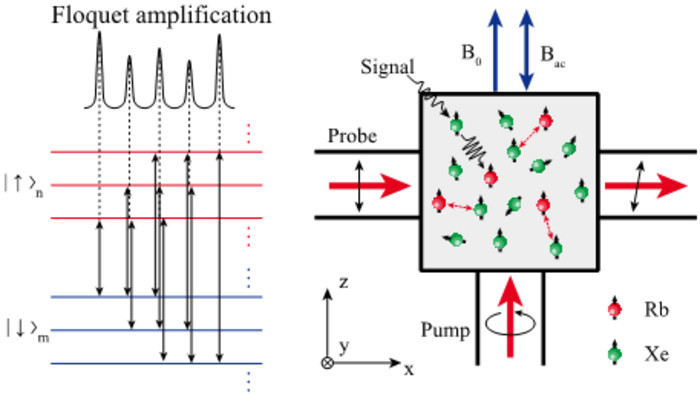
Researchers Extend Quantum Amplification to Floquet Systems

Credit: Image by the group of Prof. PENG Xinhua

Detection of weak signals is a crucial step in the verification of physics hypothesis and making breakthroughs in cutting-edge and fundamental physics research. However, the signals are too weak to measure, and thus need enhancement. One attractive way to amplify the signals is quantum amplification. The state-of-the-art quantum amplification techniques still have some limitations because they rely on the inherent discrete state transitions of atoms and molecules and therefore lacks tunability, usually enhancing only one signal within a narrow range of frequencies.

To solve this problem, the research team led by Prof. PENG Xinhua from University of Science and Technology of China (USTC) of the Chinese Academy of Sciences, collaborating with Prof. Dmitry Budker from the Helmholtz Institution in Mainz, extended quantum amplification to periodically driven spins. The result was published on Physical Review Letters.

Periodically driven systems, or Floquet systems, are described by time-dependent, periodic Hamiltonians. A Floquet system possesses energy levels with equal energy gaps, and the system’s state can jump between different energy levels via resonance transitions. The combination of quantum amplification and the Floquet system is promising in overcoming the limitations of conventional quantum amplification methods.

The researchers periodically drove 129Xe noble gas with an oscillating field. The Hamiltonians of 129Xe spins then became time-periodic, and the system obtained extra synthetic dimensions, which allows resonance transitions in a broader frequency range. With this 129Xe Floquet spin system, researchers demonstrated the amplification of multiple weak electromagnetic waves simultaneously, both in theory and experiment.

This work extends quantum amplification to Floquet systems and observes a new type of amplification phenomenon——“Floquet spin amplification”. It largely overcomes the limitations of conventional amplifiers, increases the operation bandwidth in femtotesla-level measurements, and allows amplifying more than one signal at different frequencies in the meantime. This “Floquet amplifier” enables a wide range of applications in precision measurements and in the study of fundamental physics.


Journal

Physical Review Letters

DOI

10.1103/PhysRevLett.128.233201

Article Title

Floquet Spin Amplification

Article Publication Date

9-Jun-2022

Share12Tweet8Share2ShareShareShare2

Related Posts

AI and Physics Collaborate to Design Advanced Hydrogen Storage Materials

June 25, 2026

International Team Including Dresden Scientists Develops Novel Designer Proteins for Advanced Study of Living Tissue

June 25, 2026

New Study Uncovers Key Factors Driving Water Chemistry in Nanoscale Environments

June 25, 2026

Plasma Technology Extends Catalyst Lifespan in Hydrogen Production

June 24, 2026

POPULAR NEWS

  • Saying Goodbye to PGY-6: Pediatric Fellowship Realities

    103 shares
    Share 41 Tweet 26
  • Multi-Hospital Study Reveals Long Covid Burden Is Twice as High as Current Estimates

    92 shares
    Share 36 Tweet 23
  • Detection of EDCs in Breast Milk and Infant Urine Up to Six Months Highlights Early Exposure Risks

    77 shares
    Share 31 Tweet 19
  • New Drug Candidate Developed at McMaster Shows Potential for Treating Brain Cancer

    58 shares
    Share 23 Tweet 15

About

We bring you the latest biotechnology news from best research centers and universities around the world. Check our website.

Follow us

Recent News

Tracking Lanthanide-Labeled Microplastics in Plants

POSTECH Researchers Slash Cost of Reconstituted Cell-Free Systems by 95%

AI and Physics Collaborate to Design Advanced Hydrogen Storage Materials

Subscribe to Blog via Email

Success! An email was just sent to confirm your subscription. Please find the email now and click 'Confirm' to start subscribing.

Join 82 other subscribers
  • Contact Us

Bioengineer.org © Copyright 2023 All Rights Reserved.

Welcome Back!

Login to your account below

Forgotten Password?

Retrieve your password

Please enter your username or email address to reset your password.

Log In
No Result
View All Result
  • Homepages
    • Home Page 1
    • Home Page 2
  • News
  • National
  • Business
  • Health
  • Lifestyle
  • Science

Bioengineer.org © Copyright 2023 All Rights Reserved.