• HOME
  • NEWS
  • EXPLORE
    • CAREER
      • Companies
      • Jobs
    • EVENTS
    • iGEM
      • News
      • Team
    • PHOTOS
    • VIDEO
    • WIKI
  • BLOG
  • COMMUNITY
    • FACEBOOK
    • INSTAGRAM
    • TWITTER
Tuesday, June 2, 2026
BIOENGINEER.ORG
No Result
View All Result
  • Login
  • HOME
  • NEWS
  • EXPLORE
    • CAREER
      • Companies
      • Jobs
        • Lecturer
        • PhD Studentship
        • Postdoc
        • Research Assistant
    • EVENTS
    • iGEM
      • News
      • Team
    • PHOTOS
    • VIDEO
    • WIKI
  • BLOG
  • COMMUNITY
    • FACEBOOK
    • INSTAGRAM
    • TWITTER
  • HOME
  • NEWS
  • EXPLORE
    • CAREER
      • Companies
      • Jobs
        • Lecturer
        • PhD Studentship
        • Postdoc
        • Research Assistant
    • EVENTS
    • iGEM
      • News
      • Team
    • PHOTOS
    • VIDEO
    • WIKI
  • BLOG
  • COMMUNITY
    • FACEBOOK
    • INSTAGRAM
    • TWITTER
No Result
View All Result
Bioengineer.org
No Result
View All Result
Home NEWS Science News Health

Researchers elucidate mechanism between exercise and improved motor learning

Bioengineer by Bioengineer
July 5, 2019
in Health
Reading Time: 2 mins read
0
IMAGE
Share on FacebookShare on TwitterShare on LinkedinShare on RedditShare on Telegram

IMAGE

Credit: Kai Chen, Jinan University

Muscle memory — it’s not just a saying. Repetitive exercise induces improved learning for motor skills, and researchers have now identified the molecular pathway underpinning the process.

The team published their paper on July 3 in the Science Advances, a journal of the American Association for the Advancement of Science.

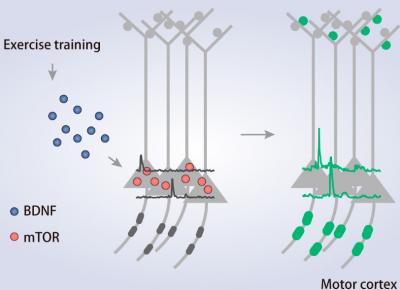
Led by Li Zhang, an associate professor in Jinan University at Guangzhou, China, the researchers zoned in on the mechanistic target of rapamycin (mTOR) pathway in mice. Previous research by other scientists had identified the molecular system as a potential key to understanding how exercise helps improve learning but hadn’t pinpointed the exact function.

“The mTOR pathway is already known to be involved in learning and memory process. There are also reports indicating mTOR activation inside the brain after exercise training,” Zhang said, who is also a member of the Guangzhou Regenerative Medicine and Health Guangdong Laboratory. “However, our study, for the first time, provides direct in vivo evidence that exercise-activated mTOR is necessary for enhanced spinogenesis and neural plasticity.”

Neurons have a hand-like protrusion on one end of their long body. The hand stretches, the fingers spread, waiting for incoming signals from other cells. The fingers are called dendrites, which can grow wispy spines–spinogenesis. The spines are memory incarnate; they store memory of a specific incoming signal that requires a quick reaction. It’s similar to how a body develops antibodies to quickly defeat pathogens that it has already encountered.

Zhang and the researchers exercised mice on treadmills for an hour a day for three weeks and compared their brains to mice who sat on a still treadmill for the same amount of time. The mice who exercised had significantly more evidence of spinogenesis and stronger neural connections in the motor cortex. mTOR appears to be a critical factor in growing the spines and in keeping the brain able to make new connections and continue to grow, according to Zhang.

“Our results identify one critical intracellular pathway for the exercise mediation of cognitive functions and address the long-standing question for the role of mTOR underlying structural and functional adaptations of neural networks in response to the exercise,” Zhang said. “We believe that the comprehensive understanding of mTOR pathway in exercised brain can provide us with objective targets and biomarkers for evaluating exercise efficiency.”

The team’s ultimate goal is to apply this information to benefit the clinical intervention of cognitive deficits in humans using exercise training.

This work was supported by the National Key Research and Development Program of China, the National Natural Science Foundation of China, and the Guangdong Natural Science Foundation. Kai Chen, who recently obtained his PhD degree, performed the experimental works with other graduate students from Jinan University under the supervision from Dr. Li Zhang and Prof. Kwok-Fai So. Other collaborators include researchers from the University of Hong Kong and Peking University.

###

###

Media Contact
Li Zhang
[email protected]

Related Journal Article

http://dx.doi.org/10.1126/sciadv.aaw1888

Tags: Medicine/Healthneurobiology
Share12Tweet8Share2ShareShareShare2

Related Posts

Nursing Home Staffing Decreased in States Shielding Facilities from COVID-19 Malpractice Lawsuits

June 2, 2026

Probiotics and Preterm NEC: Post-FDA Warning Updates

June 2, 2026

Genetic Testing Enables Rapid Diagnosis of Rare Pancreatic Disorder in 98% of Infants

June 2, 2026

Chinese Adaptation of Snyder Hope Scale Validated

June 2, 2026
Please login to join discussion

POPULAR NEWS

  • ESMO 2025: mRNA COVID Vaccines Enhance Efficacy of Cancer Immunotherapy

    320 shares
    Share 128 Tweet 80
  • Multi-Hospital Study Reveals Long Covid Burden Is Twice as High as Current Estimates

    85 shares
    Share 34 Tweet 21
  • Saying Goodbye to PGY-6: Pediatric Fellowship Realities

    62 shares
    Share 25 Tweet 16
  • Common Food Preservatives Associated with Elevated Blood Pressure and Increased Heart Disease Risk

    57 shares
    Share 23 Tweet 14

About

We bring you the latest biotechnology news from best research centers and universities around the world. Check our website.

Follow us

Recent News

Ultrathin Free-Standing Two-Dimensional Peptide Crystals

Nursing Home Staffing Decreased in States Shielding Facilities from COVID-19 Malpractice Lawsuits

Probiotics and Preterm NEC: Post-FDA Warning Updates

Subscribe to Blog via Email

Enter your email address to subscribe to this blog and receive notifications of new posts by email.

Join 82 other subscribers
  • Contact Us

Bioengineer.org © Copyright 2023 All Rights Reserved.

Welcome Back!

Login to your account below

Forgotten Password?

Retrieve your password

Please enter your username or email address to reset your password.

Log In
No Result
View All Result
  • Homepages
    • Home Page 1
    • Home Page 2
  • News
  • National
  • Business
  • Health
  • Lifestyle
  • Science

Bioengineer.org © Copyright 2023 All Rights Reserved.